D1 · Publication Volume 17
Structural Scenarios
alternative geometries, conditioning and model comparison
Learning objectives
By the end of this lesson, the learner should be able to distinguish parameter uncertainty from conceptual structural uncertainty; formulate alternative scenarios that are geologically coherent; keep shared evidence separate from scenario-specific assumptions; condition, compare and reject scenarios using explicit tests; and communicate scenario consequences without averaging incompatible geological histories into one misleading geometry.
Sparse subsurface observations often support more than one structural interpretation. A single preferred model can hide that ambiguity. Scenario modelling makes alternatives visible and turns new data collection into a discriminating test rather than a search for confirmation.
What constitutes a structural scenario
A scenario is a coherent set of relationships, event order, object identities and geometric rules. It is more than moving one surface. Examples include a fault that terminates versus continues, a folded repetition versus two separate units, an intrusion that cuts a fault versus being displaced by it, or a contact interpreted as erosional versus tectonic.
Separate conceptual choices from continuous parameters. Fault dip varying from 62^\circ to 68^\circ within one relationship graph is parameter uncertainty. Fault A cutting Fault B versus terminating against it is a conceptual change. Both matter, but they should not be mixed into one unlabeled ensemble.
Scenario formulation and evidence ledger
Start with an evidence ledger. List observations that every scenario must explain, observations whose interpretation differs, and assumptions unique to each scenario. Use the same accepted source package where possible. If a scenario excludes an observation, record the quality or geological reason rather than silently removing it.
Each scenario needs a relation graph, construction rules, parameter ranges and expected observations. Give it a stable identifier. A scenario name should be descriptive, such as “through-going eastern fault,” not “best” or “wrong.” Preference comes after testing.
Conditioning and rejection
Condition scenarios on evidence within stated tolerances. Tests can include contact residuals, orientation agreement, stratigraphic order, surface expression, offset markers, topology, gravity or other physical response, and downstream observations. Avoid counting multiple derivatives of one observation as independent support.
Reject a scenario when it violates a high-confidence constraint or required geological relation beyond its uncertainty. Do not reject merely because its geometry looks unfamiliar. Conversely, do not preserve every imaginable alternative; a scenario should have a geological rationale and explain the accepted evidence.
Comparison metrics and consequences
Compare scenarios using a matrix rather than one composite score. Include data fit, held-out prediction, topology, volume, connectivity, extrapolation, complexity, sensitivity and decision consequence. A simpler scenario may be preferred when evidence is equivalent, but simplicity should not erase a required structure.
Map where scenarios agree and diverge. Agreement volume is not certainty; all scenarios may share the same unsupported assumption. Divergence zones are useful for planning observations because they show where outcomes discriminate conceptual models.
Ensembles without false averaging
Within a scenario, an ensemble may sample uncertain contacts, orientations or parameters. Across scenarios, keep conceptual identities visible. Averaging surfaces from different topologies can create a geometry that belongs to no plausible scenario—for example, a blurred connection between bodies that are either fully connected or fully separated.
Summaries can include occupancy probability, contact-position quantiles, topology frequency and scenario-weighted decision outcomes. State how weights were chosen. Equal weights mean lack of preference, not equal truth. Data-driven weights remain conditional on likelihood and prior assumptions.
Synthetic worked example
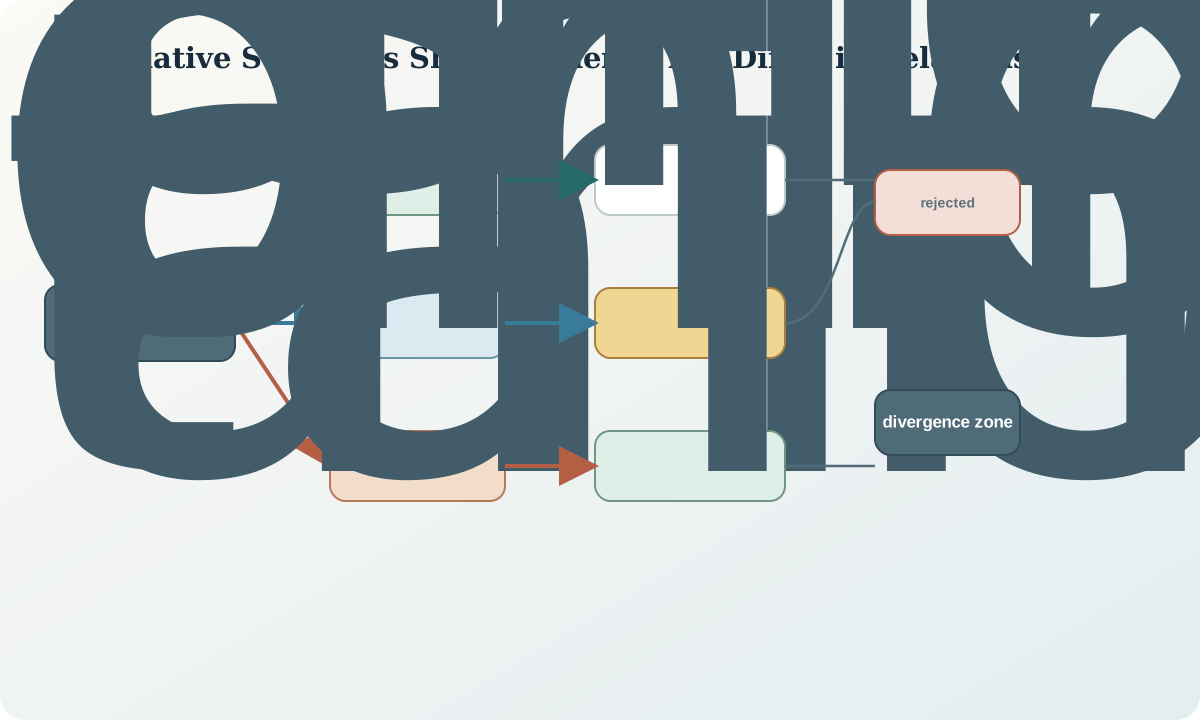
The fictional model admits three explanations for repeated target intersections: Scenario S1 uses one folded horizon; S2 uses a fault repetition; S3 uses two separate mineralised horizons. All fit the construction data. Held-out orientation data conflict with S3, and the mapped fault trace makes S2 more plausible in the east but not in the west.
Instead of forcing a winner, the review retains S1 and S2. Their target volumes overlap in the south and diverge beneath the northern corridor. A synthetic planned hole is rotated so that its lower half crosses the maximum-divergence zone. The expected contact order under each scenario is recorded before drilling, providing a falsifiable test.
Practice and review checklist
Create two or three scenarios for one ambiguous structure. For each, record relationship graph, assumptions, parameter ranges, predicted observations and failure conditions. Then check:
- Are the scenarios conceptually distinct and geologically coherent?
- Do they consume the same evidence package?
- Are excluded observations visible with reasons?
- Which tests are independent of construction?
- Where do geometry, topology and decision outcomes diverge?
- Would an averaged geometry be geologically meaningless?
- Which feasible new observation has the greatest discriminatory value?
Decision implications and integration
Scenario status belongs in model metadata: proposed, conditioned, rejected, retained, adopted-for-purpose or superseded. Keep rejected scenarios when they document why an interpretation changed. Downstream users should receive the retained set and consequences, not only a preferred mesh.
When one scenario is adopted for a bounded decision, record residual alternatives and the trigger that would reopen them. Adoption is a conditional decision, not proof that the subsurface has one known geometry.
Sources
- Constraining stochastic 3D models with topology information, uses topology to condition ensembles of plausible geological models.
- LoopStructural 1.0, demonstrates structurally distinct fault realisations and time-aware relationships.
- loopUI uncertainty indicators, develops indicators for comparing synthetic geological model scenarios and ensembles.
- Automated stratigraphic interpretation with uncertainty quantification, retains multiple plausible stratigraphic orderings and compares their consistency.