D1 · Publication Volume 17
Model Validation and Sense Checks
section review, data honouring, volumes and contact analysis
Learning objectives
By the end of this lesson, the learner should be able to distinguish verification, validation and fitness review; design checks for data honouring, topology, geometry, volume and geological relationships; use sections and held-out evidence effectively; detect circular validation; and produce a validation package that records both passed tests and unresolved findings.
Validation asks whether the model is an adequate representation for its declared purpose. Verification asks whether construction and computation were performed as specified. Neither proves the geology true. A model can run without error and still be geologically invalid; it can honour every construction point and still extrapolate incorrectly between them.
Validation plan and independence
Write the validation plan before final model selection. Link each acceptance criterion to a test, dataset, tolerance and reviewer action. Separate construction evidence from withheld or independent evidence where density permits. If all observations are required to construct the model, use alternative checks such as leave-one-out prediction, unused sections, cross-method response or scenario sensitivity.
Independence is graded. A contact point and the section interpreted from that point are not independent. A geophysical inversion and a geological surface used as its starting model may not provide independent confirmation. Maintain an evidence-dependency graph so support is not double-counted.
Data-honouring and residual analysis
Calculate distances from accepted contact points to the corresponding surface, angular differences between orientations and predicted gradients, and categorical agreement along drillhole intervals. Compare residuals with measurement and support uncertainty rather than demanding zero. Stratify results by source, quality, domain, depth and distance to other constraints.
Inspect residual direction and spatial clustering. A low mean can hide opposing systematic errors. A cluster of same-sign residuals may indicate missing structure, trajectory error or biased trend. Document whether constraints were hard, soft or excluded from the fit.
Section, volume and contact checks
Inspect orthogonal, oblique and curved sections, including planes not used for construction. Compare model contacts with observations at true 3D positions, not only projections. Check thickness, curvature, pinch-outs, fault cut-offs and relationships to topography. Use scale-appropriate exaggeration and also review at true scale.
Track volumes by domain, block and depth between versions or scenarios. A volume change is not automatically an error, but it should be explainable from geometry or extent. Contact analysis can compare distributions and trends on either side of a proposed boundary, while recognising support and sampling bias.
Topology and geological sense checks
Run geometric validity and adjacency tests from the previous lesson. Then test geological order, event sequence, allowed contacts and expected map expression. Check that older surfaces are truncated by younger unconformities where intended, that displaced markers correspond across faults and that intrusive or erosional geometries behave consistently.
Sense checks should be explicit enough to challenge preference. Ask what geometry would be impossible, which thickness change lacks a process explanation, and where continuity is maintained only by interpolation. A senior review label without recorded findings is not a validation result.
Downstream and decision-based validation
Test outputs through the operations the model is meant to support. Examples include point containment, section extraction, volume calculation, distance to boundary, grid transfer, connectivity or planned intersection prediction. A geometrically valid model can fail when converted to a coarse grid or when boundary ownership is ambiguous.
Compare sensitivity of the decision to plausible model variants. If the decision changes under small, defensible changes, the model should communicate that instability. If the decision is stable across retained scenarios, additional geometric refinement may have low value.
Synthetic worked example
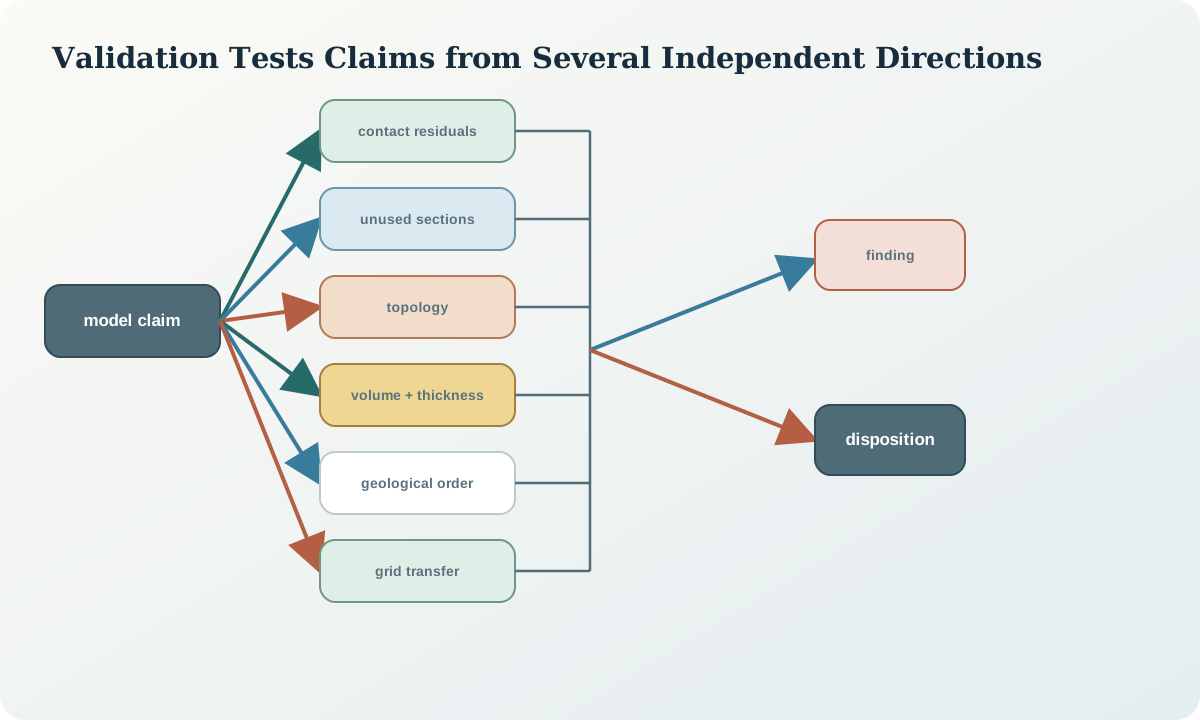
The fictional preferred model passes contact residual tolerances and has valid closed solids. An oblique unused section nevertheless exposes a 90\,\mathrm{m}-long lens thinner than the output grid. Voxel transfer removes the lens and connects two surrounding domains. A volume-only check barely changes, so the connectivity error would have been missed.
The validation package adds a minimum-feature test and a topology comparison between source solids and the grid. The downstream grid is refined locally, preserving the lens. A separate residual cluster near the northern model edge remains unresolved and is recorded as a limitation rather than smoothed away.
Practice and review checklist
Build a validation matrix with rows for model claims and columns for test, evidence, tolerance, result, finding severity and disposition. Include at least:
- coordinate and input-version checks;
- contact and orientation residuals;
- held-out or unused-view prediction;
- surface and solid validity;
- adjacency and stratigraphic-order tests;
- volume and thickness comparisons;
- scenario sensitivity;
- downstream representation checks; and
- unresolved limitations.
Confirm that a failed test cannot disappear merely by changing display settings.
Decision implications and integration
Validation findings need persistent identifiers, affected objects, severity, evidence, owner role, disposition and model version. “Accepted with limitation” should state the permitted use and excluded region or operation. Revalidate when inputs, relationships, geometry, resolution or downstream transformations change.
Release the validation package with the model. A screenshot of a few sections is evidence only for those views; it is not a substitute for machine-checkable geometry and complete findings.
Sources
- Three-dimensional geologic framework model of the Rio San Jose basin, documents iterative construction, evaluation and uncertainty related to data density.
- Techniques for improved geologic modeling, addresses modelling controls, uncertainty and mapper review.
- Simple Feature Access, provides geometry concepts supporting validity tests.
- Summary of verification, validation and uncertainty procedures, distinguishes model credibility activities in computational work.