D1 · Publication Volume 17
Versioning and Change Review
new drilling, interpretation change and model lineage
Learning objectives
By the end of this lesson, the learner should be able to define an immutable model release; link inputs, constraints, relationships, parameters, geometry, validation and derived outputs through provenance; classify changes by material effect; compare versions spatially and topologically; and conduct a change review that preserves previous models and decision history.
A geological model changes when new evidence arrives, errors are corrected, interpretations change or downstream requirements evolve. Overwriting the old files destroys the ability to distinguish learning from unrecorded drift. Versioning turns change into evidence.
Model release as a compound object
A release is more than one geometry file. It includes purpose, extent, reference systems, source register, accepted constraint package, domain dictionary, relationship graph, scenario set, construction parameters, surfaces, solids, uncertainty layers, validation results, change log and derived products. Give the release a stable identifier and record checksums or equivalent integrity information for its components.
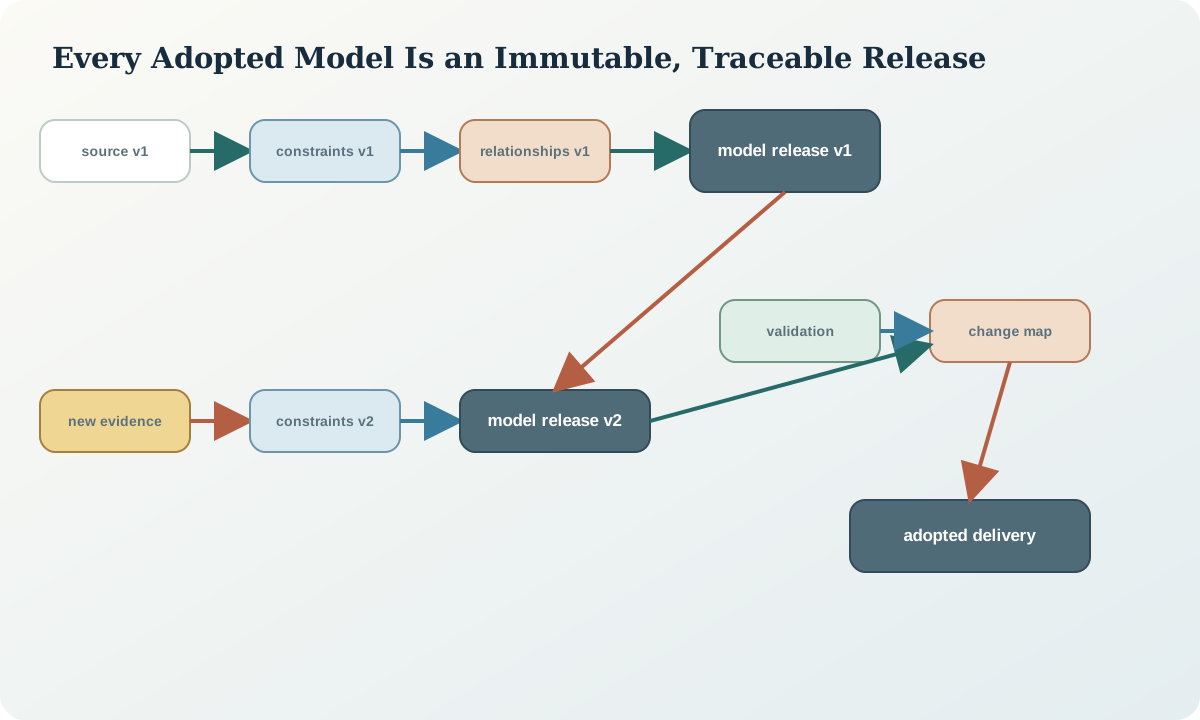
Separate editable working state from an adopted release. A working model can change frequently; an adopted release is immutable. Corrections or additions create a new release linked to its predecessor. Derived exports should identify the exact release and transformation that produced them.
Provenance and dependency graph
Represent source data, modelling activities and outputs as a dependency graph. A derived contact point depends on a log and trajectory version. A surface depends on constraints, relationship graph, parameters and method. A solid depends on surfaces and boundary rules. A block coding depends on solids, grid geometry and boundary ownership.
This graph supports impact analysis. If a collar or trajectory changes, the system can identify affected contacts, surfaces, domains and validations. If a display colour changes, geometry-dependent tests need not rerun. Provenance should describe the actual transformation, not merely list files in a folder.
Change classes and materiality
Classify changes by effect. Metadata clarification may not alter interpretation. Data correction can move constraints. New observations extend evidence. Parameter changes alter geometry within a scenario. Conceptual changes alter identity, relationships or topology. Representation changes alter tessellation or grid transfer. Purpose changes alter fitness criteria.
Materiality depends on consequence, not file size. A single corrected fault intersection can change connectivity more than thousands of added vertices. Define review triggers for topology, volume, domain membership, confidence, acceptance tests and downstream decisions.
Spatial and semantic differencing
Compare versions at several levels. File checksums show whether an object changed but not how. Geometric differences include signed surface distance, changed volume, boundary displacement and affected extent. Topological differences include adjacency, component and connectivity changes. Semantic differences include domain definitions, relationship graph, object status and uncertainty class.
Use a common comparison frame and resolution. Distinguish real interpretation change from export tessellation or coordinate-rounding effects. Provide maps or sections of change together with numeric summaries and object identifiers.
Review, adoption and rollback
A change review asks why the change occurred, which evidence supports it, which objects and decisions are affected, which tests were rerun and whether alternatives remain. Reviewers should be able to inspect both versions. Adoption records the accepted release, bounded purpose, limitations and superseded predecessor.
Rollback means selecting a preserved prior release, not reversing files manually. It may be appropriate when new data are found invalid or a transformation is wrong. A rollback itself is a new decision event and should record why the prior state became authoritative again.
Synthetic worked example
Three new synthetic holes are added north of the fictional fault. Two support the adopted horizon; the third appears to contradict it. Review finds that the third hole used an older trajectory. Correcting the trajectory moves its contact 24\,\mathrm{m} and removes the apparent contradiction, but the new evidence still changes the fault dip and reduces the target solid by 7%.
The new release preserves the previous model, links each new contact to its trajectory version, updates the fault surface and target solid, reruns topology and scenario tests, and publishes a change map. Connectivity remains unchanged, while the planned intersection moves outside its tolerance. The decision record therefore requires replanning even though the percentage volume change is modest.
Practice and review checklist
Compare two model states and produce a change package containing:
- predecessor and successor identifiers;
- changed source and constraint records;
- relationship, parameter and domain-definition changes;
- surface-distance and volume differences;
- topology and connectivity differences;
- validation tests rerun and their results;
- affected derived products and decisions; and
- adoption, limitation and rollback information.
Confirm that every unchanged claim can be distinguished from a component that was simply not reviewed.
Decision, release and completion
Complete the book by assembling the synthetic study volume as a versioned interpretation package. Include a bounded purpose, evidence register, domain concepts, explicit or implicit construction, fault graph, valid solids, retained scenarios, validation matrix, uncertainty layers and a documented revision. State clearly what remains unknown and which use is unsupported.
The final release should be reproducible from source records and declared transformations without dependence on a company-specific workflow. A website, file format or modelling application may carry the package, but none becomes the author or owner of the geological reasoning. The evidence and decision record must stand independently.
Sources
- PROV-O, defines entities, activities, derivation, revision and provenance relations.
- Data release revisions, provides practices for preserving versions, metadata and change history.
- Guidance on documenting revisions to scientific digital data, classifies revisions and their documentation consequences.
- An inventory of three-dimensional geologic models, demonstrates persistent model identifiers, source linkage and descriptive release attributes.