E7 · Publication Volume 29
Confidence and Calibration
claim-level confidence, source confidence and uncertainty language
*claim-level confidence, source confidence and uncertainty language*
Learning objectives and boundary
This lesson is general and institution-neutral. It uses no real company, individual, property, project or identifiable place. Generic roles describe responsibilities only, and every SYN-AI identifier denotes explicitly synthetic teaching evidence.
- Frame the decision governed by claim-level confidence, source confidence and uncertainty language.
- Separate generated proposals from admissible evidence, deterministic results and accountable judgement.
- Define measurable failure, abstention, escalation and release conditions.
- Produce a claim-level calibration report with coverage, abstention and language policy from synthetic evidence and defend its controls.
Decision and professional boundary
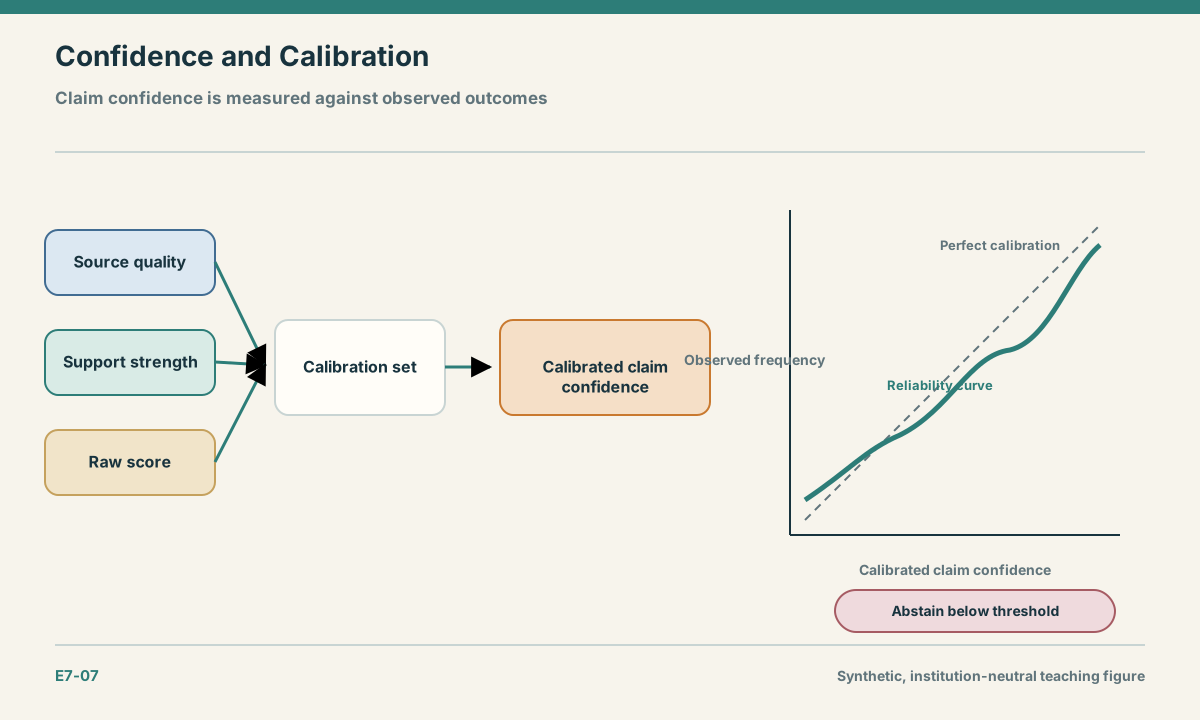
Confidence is attached to a defined claim and evaluation population, not to a paragraph or a model persona. Separate source quality, extraction reliability, retrieval completeness, support strength, model score and final claim confidence. These quantities answer different questions and must not be averaged without a declared model. Natural-language certainty is mapped to tested probability bands or categorical criteria; adjectives alone are not calibration.
Calibration compares stated confidence with observed correctness on independent, representative cases. A system that is correct 80 percent of the time overall can still be dangerously overconfident on rare structures or poor-quality scans. Report reliability by task, evidence state and consequence class, together with coverage and abstention.
Core concepts
| Concept | Operational meaning | |---|---| | Claim confidence | A tested estimate for one proposition under a stated evidence and task condition. | | Source confidence | An assessment of source identity, method, quality, currency and directness. | | Calibration | Agreement between predicted confidence bands and observed outcome frequencies. | | Sharpness | Concentration of predictions away from an uninformative middle, considered after calibration. | | Coverage | The fraction of eligible cases for which the system issues a claim rather than abstaining. |
Evidence model
A confidence record stores claim ID, evidence snapshot, raw score, calibration mapping version, calibrated value or category, evaluation population, threshold, abstention status and eventual outcome. Source assessments remain separate linked nodes. When the real outcome is not yet known, the record remains unresolved rather than being labelled correct by agreement with another generated answer.
Controlled workflow
- Define atomic claims, outcome labels and evaluation population.
- Separate evidence-quality features from model output scores.
- Reserve independent calibration and evaluation partitions.
- Fit or map confidence without inspecting final evaluation outcomes.
- Plot reliability and score by task, subgroup and evidence state.
- Set abstention and language bands from consequence-aware criteria.
Every step emits a versioned artefact or an explicit failure. A later stage consumes only verified outputs from the preceding stage; conversational context is never an undocumented data channel.
Measures and acceptance criteria
Use reliability diagrams, mean squared probability score, calibration error, coverage and risk at coverage. Report bin counts and uncertainty because small bins can look deceptively reliable. A confidence system passes only within its declared population; transferring it to another commodity, language, document type or evidence regime requires new evaluation.
$BS=\frac{1}{N}\sum_{i=1}^{N}(p_i-y_i)^2$
| Gate | Required evidence | Release consequence | |---|---|---| | Identity | Resolvable claim, source, configuration and result IDs | Block when any identity is ambiguous | | Grounding | Every factual claim reaches sufficient source spans | Remove or withhold unsupported claims | | Independence | Lineage and partition checks show no circular or target information | Invalidate affected support and scores | | Review | Required roles disposition the exact candidate version | Keep the candidate non-published | | Reproducibility | Manifest, tools and checks reconstruct the evidence package | Return the package for correction |
Claim–source and system contract
The confidence contract defines claim granularity, outcome label, reference population, score origin, calibration dataset, mapping version, language bands, abstention thresholds and expiration triggers. It forbids converting token probability or verbal emphasis directly into geological confidence. Every displayed confidence links to its calibration evidence.
Security, privacy and access boundary
Calibration partitions and outcome labels are protected from development workflows. Subgroup reports must avoid exposing restricted attributes or very small groups. Confidence displays cannot reveal the existence of hidden evidence; when access filtering changes the evidence set, the system recalculates or withholds confidence instead of reusing a privileged score.
Human review and escalation
Reviewers inspect the worst-calibrated bins, high-confidence errors, subgroup coverage and every language mapping. They approve the reference population and release thresholds, not a universal confidence scale. Any threshold change after observing evaluation outcomes is versioned as a new policy and tested on fresh evidence.
Worked synthetic example
A synthetic classifier assigns confidence to whether a description supports “continuous alteration”. On calibration cases with complete intervals, the 0.8–0.9 band is correct near 0.84. On truncated intervals it is correct near 0.52. A single global label “high confidence” is therefore unsafe. The revised contract either uses a separate mapping for validated complete intervals or abstains when continuity evidence is truncated.
Counterexample and failure analysis
A model says “I am 95 percent confident” because its answer is fluent and several retrieved passages agree. No outcome definition, calibration population or independence check exists. The number is presentation, not measurement. Repeated derivatives may even make the answer more confident while adding no new evidence.
Frequent failure modes
- Using language-model scores as geological confidence
- Calibrating and evaluating on the same cases
- Hiding coverage behind accuracy
- Pooling incompatible task populations
- Reusing confidence after evidence access changes
Practical exercise
- Define an outcome label for one claim type.
- Compute the mean squared probability score for a synthetic set.
- Draw a reliability table and identify overconfidence.
- Write language bands that include evidence and population conditions.
Assessed artefact
Submit a claim-level calibration report with coverage, abstention and language policy with its source manifest, configuration versions, acceptance evidence, rejected cases, unresolved risks and a short explanation of why one plausible alternative control was not selected. The artefact is incomplete if its diagrams or prose cannot be reconciled with machine-checkable evidence.
Verification checkpoint
Trace one released synthetic claim backwards through review, confidence, verification, evidence graph, tool result or source span to an immutable input. Then trace one rejected claim to the earliest failed contract. Re-run the package from its manifest and compare content digests. The checkpoint passes only when a second reviewer can reconstruct the accepted and blocked paths, identify every assumption and reproduce the release decision without access to the original conversation. Record unresolved risk instead of completing a missing fact with generated text.
Sources
- On Calibration of Modern Neural Networks, a primary empirical study of confidence calibration and reliability diagrams.
- Strictly Proper Scoring Rules, Prediction, and Estimation, a formal basis for evaluating probabilistic statements without rewarding strategic confidence.
- ISO/IEC 25059:2023 quality model for AI systems, a quality vocabulary for specifying and evaluating AI-system characteristics.
- AI Risk Management Framework 1.0, a lifecycle framework for governing, mapping, measuring and managing context-dependent AI risk.