E7 · Publication Volume 29
Human Review and Responsibility
review roles, approval, escalation and audit trail
*review roles, approval, escalation and audit trail*
Learning objectives and boundary
This lesson is general and institution-neutral. It uses no real company, individual, property, project or identifiable place. Generic roles describe responsibilities only, and every SYN-AI identifier denotes explicitly synthetic teaching evidence.
- Frame the decision governed by review roles, approval, escalation and audit trail.
- Separate generated proposals from admissible evidence, deterministic results and accountable judgement.
- Define measurable failure, abstention, escalation and release conditions.
- Produce a role-separated review, approval and escalation protocol with audit trail from synthetic evidence and defend its controls.
Decision and professional boundary
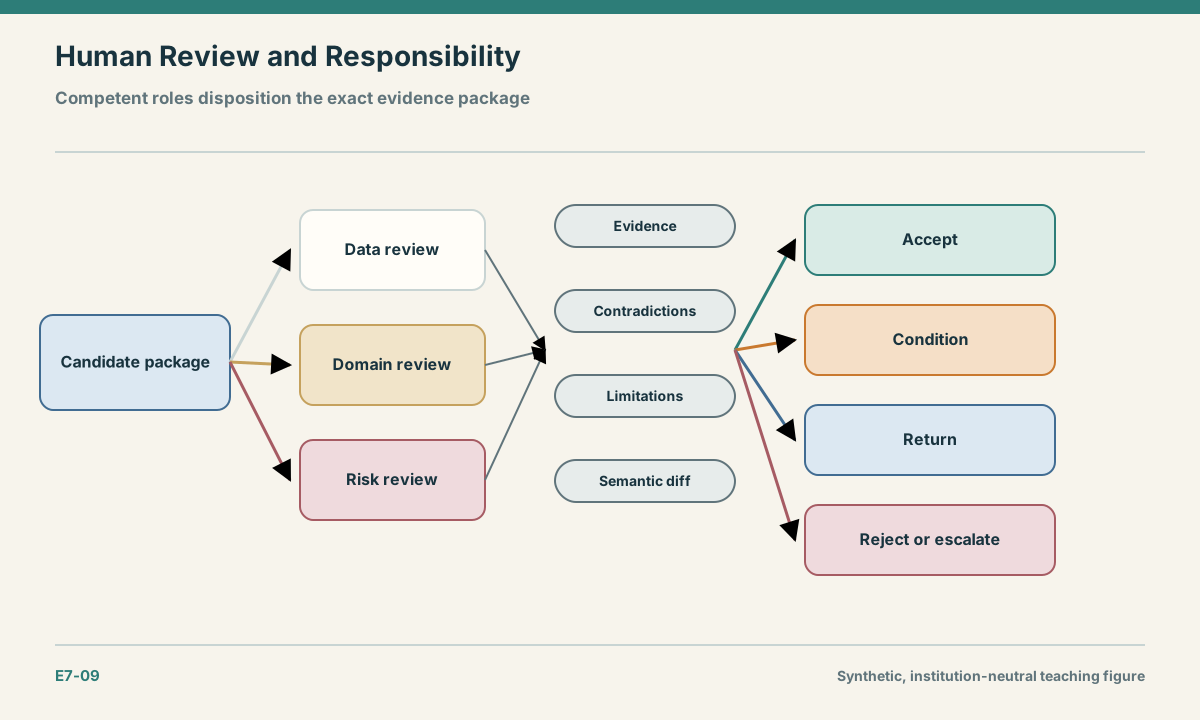
Human review is a designed control with competence, scope, evidence and authority; it is not a person clicking “approve” after reading fluent prose. Define preparation, domain review, data review, risk review and approval roles according to consequence. Reviewers receive atomic claims, evidence spans, tool results, alternatives, confidence basis, limitations and change history. They can accept, conditionally accept, return, reject or escalate.
Responsibility remains with accountable people and governing processes. The system records recommendations and evidence but cannot hold professional competence, statutory accountability or informed consent. Workload matters: a control that presents hundreds of unverifiable claims creates automation bias and review fatigue rather than meaningful oversight.
Core concepts
| Concept | Operational meaning | |---|---| | Reviewer competence | The domain, data, system or risk capability required for the stated review scope. | | Disposition | A versioned accept, condition, return, reject or escalate decision with rationale. | | Separation of duties | Consequential preparation, verification and approval are not controlled by one role. | | Reviewability | The effort required to inspect claims, evidence, alternatives and changes. | | Escalation | A defined transfer when competence, evidence, authority or risk tolerance is exceeded. |
Evidence model
A review package includes request, task contract, candidate version, change set, atomic claims, source locators, evidence graph, failed checks, competing hypotheses, confidence records, limitations and proposed release state. The audit trail records who reviewed which version under which role, what evidence was visible and what conditions remained. Role identifiers denote responsibilities and need not expose personal identity in teaching examples.
Controlled workflow
- Classify consequence and assign required review roles.
- Assemble a bounded review package with changes highlighted.
- Check task boundary and evidence completeness before wording.
- Review claims, contradictions, unknowns, tool results and confidence.
- Record disposition, rationale, conditions, expiry and responsible role.
- Verify conditions before release and preserve the complete audit trail.
Every step emits a versioned artefact or an explicit failure. A later stage consumes only verified outputs from the preceding stage; conversational context is never an undocumented data channel.
Measures and acceptance criteria
Measure claim review coverage, evidence-opening success, reviewer disagreement, escalation timeliness, condition closure, high-consequence error escape and review effort per claim. Faster approval is not automatically better. A package that reduces reading time by hiding alternatives may increase risk. Acceptance requires all high-consequence claims, contradictions and release conditions to have explicit dispositions.
$C_{review}=\frac{N_{claims\ with\ required\ dispositions}}{N_{claims\ requiring\ review}}$
| Gate | Required evidence | Release consequence | |---|---|---| | Identity | Resolvable claim, source, configuration and result IDs | Block when any identity is ambiguous | | Grounding | Every factual claim reaches sufficient source spans | Remove or withhold unsupported claims | | Independence | Lineage and partition checks show no circular or target information | Invalidate affected support and scores | | Review | Required roles disposition the exact candidate version | Keep the candidate non-published | | Reproducibility | Manifest, tools and checks reconstruct the evidence package | Return the package for correction |
Claim–source and system contract
The review contract defines role competence, scope, evidence package, allowed dispositions, required rationale, separation rules, conditions, expiry and escalation path. Approval tokens bind to candidate digest and evidence snapshot. A changed claim, source, model, tool result or policy invalidates the prior approval when it affects the reviewed scope.
Security, privacy and access boundary
Use least privilege and conflict-of-interest declarations for review access. A reviewer sees only the evidence needed for the assigned scope, while the audit system retains integrity-protected events. Approval interfaces must resist click-through behaviour, show failed controls prominently and require step-up authorisation for consequential release.
Human review and escalation
Periodically evaluate reviewers and the review design using seeded defects, blinded duplicate packages and disagreement analysis. Human oversight is not assumed effective merely because a role exists. When workload or evidence design prevents reliable review, reduce scope, improve the package or block release rather than recording nominal approval.
Worked synthetic example
A synthetic report contains twelve claims. Eight are direct observations, two are interpretations, one is a target hypothesis and one is a limitation. The data reviewer resolves IDs and versions; the domain reviewer returns one interpretation because its contradiction is hidden; the risk reviewer requires the limitation beside the target statement. Approval is issued only after a new digest confirms those conditions. The trail shows the returned version and the corrected version.
Counterexample and failure analysis
A reviewer receives only the final prose and a green confidence badge. Sources require separate searches, alternatives are absent and the approve button is enabled by default. The presence of a human does not make this meaningful oversight. Review must expose the evidence and make disagreement, return and escalation operationally possible.
Frequent failure modes
- Treating any human click as oversight
- Approving prose without atomic claims and sources
- Letting one role prepare and approve high-consequence output
- Reusing approval after material changes
- Ignoring reviewer workload and disagreement
Practical exercise
- Assign review roles to a synthetic low-, medium- and high-consequence task.
- Design a review package that exposes changes and contradictions.
- Write approval invalidation rules for five material changes.
- Create a seeded-defect test for the review workflow.
Assessed artefact
Submit a role-separated review, approval and escalation protocol with audit trail with its source manifest, configuration versions, acceptance evidence, rejected cases, unresolved risks and a short explanation of why one plausible alternative control was not selected. The artefact is incomplete if its diagrams or prose cannot be reconciled with machine-checkable evidence.
Verification checkpoint
Trace one released synthetic claim backwards through review, confidence, verification, evidence graph, tool result or source span to an immutable input. Then trace one rejected claim to the earliest failed contract. Re-run the package from its manifest and compare content digests. The checkpoint passes only when a second reviewer can reconstruct the accepted and blocked paths, identify every assumption and reproduce the release decision without access to the original conversation. Record unresolved risk instead of completing a missing fact with generated text.
Sources
- ISO/IEC 42001:2023 AI management systems, requirements for accountable management, documented controls and continual improvement.
- AI Risk Management Framework 1.0, a lifecycle framework for governing, mapping, measuring and managing context-dependent AI risk.
- ISO/IEC 23894:2023 AI risk-management guidance, guidance for integrating AI-specific risk management into activities and decisions.
- PROV-O provenance ontology, a standard model for entities, activities, responsibility roles and derivation.