E7 · Publication Volume 29
Blind and Holdout Validation
frozen predictions, independent evidence and scoring
*frozen predictions, independent evidence and scoring*
Learning objectives and boundary
This lesson is general and institution-neutral. It uses no real company, individual, property, project or identifiable place. Generic roles describe responsibilities only, and every SYN-AI identifier denotes explicitly synthetic teaching evidence.
- Frame the decision governed by frozen predictions, independent evidence and scoring.
- Separate generated proposals from admissible evidence, deterministic results and accountable judgement.
- Define measurable failure, abstention, escalation and release conditions.
- Produce a sealed holdout protocol, frozen submission and independent validation report from synthetic evidence and defend its controls.
Decision and professional boundary
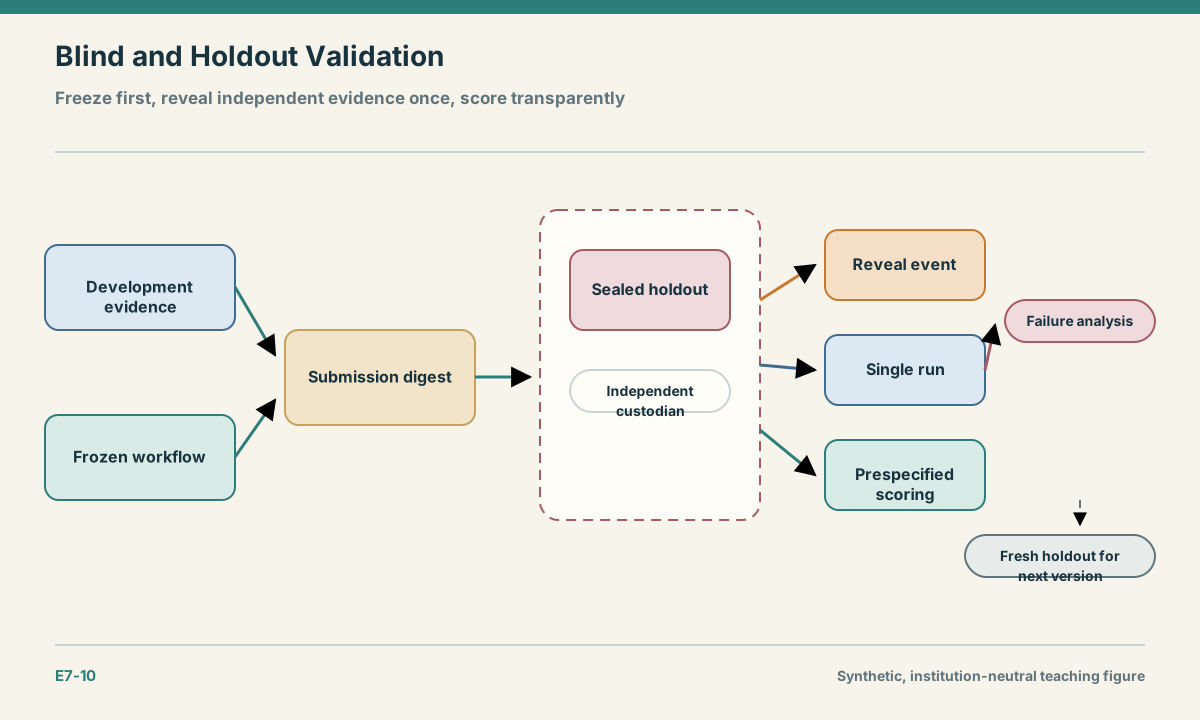
Holdout validation asks how the complete workflow performs on evidence that could not influence its design. Freeze task definition, predictions, retrieval configuration, tools, thresholds and scoring before reveal. Keep evaluation cases, labels and source derivatives outside development indexes and logs. An independent role controls reveal and records the exact submitted package.
Geoscience dependence requires more than random row splitting. Nearby samples, repeated intervals, shared source documents and later versions can leak information across partitions. Group by geological object, spatial block, time, acquisition campaign or source lineage according to the claim. The holdout must resemble the intended use while remaining independent enough to test generalisation.
Core concepts
| Concept | Operational meaning | |---|---| | Blind condition | Developers cannot access outcome labels or decisive evidence before commitment. | | Holdout unit | The independent object grouped to prevent related evidence crossing partitions. | | Frozen submission | A content-addressed package of workflow, predictions and configuration. | | Reveal event | A controlled, timestamped release of evidence or labels after commitment. | | Prospective validation | Predictions are registered before future evidence is acquired or becomes available. |
Evidence model
The validation package stores partition manifest, exclusion proof, frozen submission digest, reveal authorisation, run logs, predictions, abstentions, scores, adjudications and failure analysis. Holdout custodians preserve the relationship between hidden labels and source evidence. Development may receive error categories after scoring, but any retraining or threshold change creates a new system version.
Controlled workflow
- Define intended population, holdout unit and dependence groups.
- Remove holdout objects and derivatives from every development path.
- Freeze workflow, predictions, thresholds, metrics and failure taxonomy.
- Submit a signed manifest to the independent reveal role.
- Run once, capture outputs and score without hidden manual correction.
- Analyse failures, issue a new version and reserve fresh evidence for retest.
Every step emits a versioned artefact or an explicit failure. A later stage consumes only verified outputs from the preceding stage; conversational context is never an undocumented data channel.
Measures and acceptance criteria
Predeclare primary and secondary measures, subgroup analyses, missing-output treatment and uncertainty. Report claim correctness, citation support, retrieval recall, calibration, coverage, severe-error rate and review effort where relevant. One aggregate score cannot conceal a catastrophic subgroup. Repeated use consumes a holdout; do not tune to it and continue calling it blind.
$\Delta_{gen}=M_{holdout}-M_{development}$
| Gate | Required evidence | Release consequence | |---|---|---| | Identity | Resolvable claim, source, configuration and result IDs | Block when any identity is ambiguous | | Grounding | Every factual claim reaches sufficient source spans | Remove or withhold unsupported claims | | Independence | Lineage and partition checks show no circular or target information | Invalidate affected support and scores | | Review | Required roles disposition the exact candidate version | Keep the candidate non-published | | Reproducibility | Manifest, tools and checks reconstruct the evidence package | Return the package for correction |
Claim–source and system contract
The validation contract declares population, holdout unit, independence rationale, partition digest, prohibited access paths, freeze time, submission contents, reveal authority, metrics, adjudication rules and reuse policy. A test is invalid if any outcome-bearing derivative entered development, even when the original label file remained hidden.
Security, privacy and access boundary
Store holdout evidence in a separate access domain with dedicated service identity, audit logs and no search indexing. Prevent filenames, counts, previews, cache keys and error messages from leaking labels. Reveal only the minimum required material after a verified submission digest is committed.
Human review and escalation
An independent reviewer verifies partition construction, access logs, frozen configuration and scoring code. Domain adjudication resolves ambiguous outcomes using rules set before inspection where possible. The final report distinguishes prespecified analysis from exploratory post-hoc analysis and preserves both.
Worked synthetic example
A synthetic contact-prediction workflow is developed on spatial blocks A–D. Block E and every derivative mentioning its hidden contacts are sealed. Before reveal, the workflow submits predicted contact presence, location tolerance and abstentions for each E cell. Scoring shows good overall accuracy but poor calibration near one boundary type. The team records the failure, changes the evidence features and reserves a new block rather than rescoring E as a fresh holdout.
Counterexample and failure analysis
Rows are randomly divided into train and test sets even though adjacent intervals belong to the same synthetic hole and share a logged interpretation. The test score mostly measures memory of local patterns. Calling the rows “unseen” does not make the evidence independent. The holdout unit must follow the information path relevant to the claim.
Frequent failure modes
- Randomly splitting dependent geological records
- Leaving holdout derivatives in retrieval indexes
- Changing thresholds after reveal without a new version
- Reporting only one aggregate score
- Reusing a consumed holdout as blind evidence
Practical exercise
- Choose a defensible holdout unit for three geoscience tasks.
- Draw every path by which a hidden outcome could leak into retrieval.
- Write a frozen submission manifest and reveal event.
- Separate prespecified scores from post-hoc diagnostic analysis.
Assessed artefact
Submit a sealed holdout protocol, frozen submission and independent validation report with its source manifest, configuration versions, acceptance evidence, rejected cases, unresolved risks and a short explanation of why one plausible alternative control was not selected. The artefact is incomplete if its diagrams or prose cannot be reconciled with machine-checkable evidence.
Verification checkpoint
Trace one released synthetic claim backwards through review, confidence, verification, evidence graph, tool result or source span to an immutable input. Then trace one rejected claim to the earliest failed contract. Re-run the package from its manifest and compare content digests. The checkpoint passes only when a second reviewer can reconstruct the accepted and blocked paths, identify every assumption and reproduce the release decision without access to the original conversation. Record unresolved risk instead of completing a missing fact with generated text.
Sources
- Artificial Intelligence Technology Evaluation, a sequestered-testbed pattern designed to reduce train-test contamination.
- How to conduct a shared retrieval evaluation, a practical pattern that separates development evidence from withheld evaluation judgements.
- Leakage and the reproducibility crisis in machine-learning-based science, an evidence-based taxonomy of leakage pathways in scientific machine learning.
- Strictly Proper Scoring Rules, Prediction, and Estimation, a formal basis for evaluating probabilistic statements without rewarding strategic confidence.