E7 · Publication Volume 29
Monitoring and Continuous Evaluation
drift, benchmark sets, failure taxonomy and feedback
*drift, benchmark sets, failure taxonomy and feedback*
Learning objectives and boundary
This lesson is general and institution-neutral. It uses no real company, individual, property, project or identifiable place. Generic roles describe responsibilities only, and every SYN-AI identifier denotes explicitly synthetic teaching evidence.
- Frame the decision governed by drift, benchmark sets, failure taxonomy and feedback.
- Separate generated proposals from admissible evidence, deterministic results and accountable judgement.
- Define measurable failure, abstention, escalation and release conditions.
- Produce a continuous-evaluation plan, benchmark suite and versioned failure register from synthetic evidence and defend its controls.
Decision and professional boundary
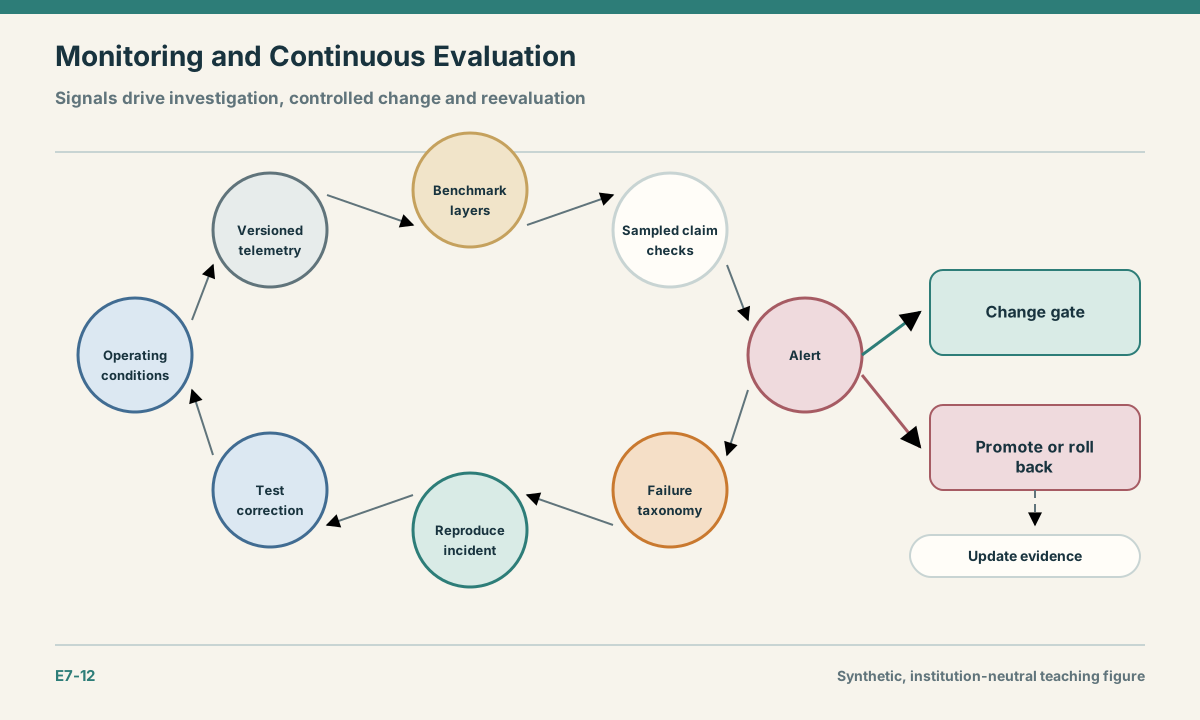
Production monitoring asks whether the deployed evidence workflow still operates within its evaluated conditions. Track changes in input sources, document structure, language, retrieval corpus, tool behaviour, model configuration, policy, reviewer workload and outcome prevalence. A stable endpoint does not imply stable semantics. Monitoring signals trigger investigation and controlled reevaluation; they do not automatically diagnose root cause.
Maintain layered benchmark sets: fixed regression cases, rotating recent cases, adversarial cases, rare high-consequence cases and prospective outcomes. Link every incident and user correction to a failure taxonomy and reproducible evidence package. Feedback becomes training or policy input only after review, de-identification where required and partition control.
Core concepts
| Concept | Operational meaning | |---|---| | Input drift | Change in source population, structure, quality, language or access state. | | Behaviour drift | Change in retrieval, generation, tool use, confidence or abstention under comparable inputs. | | Benchmark layer | A controlled case set serving regression, recency, adversarial or consequence goals. | | Failure taxonomy | A stable classification linking symptom, cause, consequence and remediation. | | Change gate | A review decision that controls promotion after evidence and policy changes. |
Evidence model
A monitoring package stores operating-condition version, source and corpus manifests, tool and model configuration, policy version, benchmark results, sampled claim verifications, review metrics, alerts, incidents, feedback disposition and release decisions. Telemetry identifies artefacts and states without recording unnecessary source content or hidden reasoning text.
Controlled workflow
- Declare evaluated operating conditions and monitored signals.
- Capture versioned input, retrieval, tool, output and review telemetry.
- Run fixed, rotating, adversarial and high-consequence benchmark layers.
- Triage alerts into data, retrieval, model, tool, policy or review failures.
- Reproduce incidents and evaluate proposed corrections on protected sets.
- Promote, roll back, restrict or retire through a documented change gate.
Every step emits a versioned artefact or an explicit failure. A later stage consumes only verified outputs from the preceding stage; conversational context is never an undocumented data channel.
Measures and acceptance criteria
Track performance with uncertainty and exposure: unsupported-claim rate, citation failure, retrieval gap rate, tool rejection, calibration drift, abstention, severe-error escape, review disagreement and time to contain incidents. Compare current and reference windows using predeclared thresholds. Alert volume and user satisfaction are context measures, not substitutes for scientific correctness.
$PSI=\sum_b (p_b-q_b)\ln\left(\frac{p_b}{q_b}\right)$
| Gate | Required evidence | Release consequence | |---|---|---| | Identity | Resolvable claim, source, configuration and result IDs | Block when any identity is ambiguous | | Grounding | Every factual claim reaches sufficient source spans | Remove or withhold unsupported claims | | Independence | Lineage and partition checks show no circular or target information | Invalidate affected support and scores | | Review | Required roles disposition the exact candidate version | Keep the candidate non-published | | Reproducibility | Manifest, tools and checks reconstruct the evidence package | Return the package for correction |
Claim–source and system contract
The monitoring contract defines operating conditions, signal schema, sampling plan, benchmark versions, thresholds, alert ownership, investigation states, feedback eligibility, rollback criteria and reevaluation triggers. A configuration, corpus, tool or policy change cannot bypass evaluation because the model binary is unchanged.
Security, privacy and access boundary
Minimise telemetry, separate operational identifiers from source content and apply retention limits. Protect benchmark cases and incident details from becoming prompt material or public examples. Feedback is untrusted input: scan, review and label it before use. Monitoring access must not create a side channel into restricted sources.
Human review and escalation
A regular review examines trends, subgroup failures, unresolved incidents, threshold suitability, benchmark freshness and reviewer capacity. Change proposals include expected benefit, risk, test evidence, rollback and observation period. Retirement is an acceptable outcome when evidence quality, access or control can no longer support safe use.
Worked synthetic example
A synthetic monthly monitor shows stable answer length but a rising citation-failure rate. Investigation finds that a new scanned-table format reduced grounding completeness; the language model and prompts did not change. The release gate restricts table-derived claims, routes affected cases to review and adds the new format to a protected regression set. Service scope returns only after extraction and citation tests pass.
Counterexample and failure analysis
A dashboard tracks request count, latency and positive feedback but has no claim verification, retrieval or review signals. It can show a healthy service while scientific evidence quality collapses. Operational availability and evidential reliability are separate dimensions and both require explicit measures.
Frequent failure modes
- Monitoring only latency and availability
- Treating any alert as a root-cause diagnosis
- Letting incidents enter training without partition control
- Ignoring corpus and policy changes when the model is unchanged
- Keeping an unsafe workflow active because retirement looks like failure
Practical exercise
- Define operating conditions and signals for one synthetic workflow.
- Build four benchmark layers and explain their distinct purposes.
- Classify five incidents by symptom, cause, consequence and remedy.
- Write a change-gate decision with promotion and rollback evidence.
Assessed artefact
Submit a continuous-evaluation plan, benchmark suite and versioned failure register with its source manifest, configuration versions, acceptance evidence, rejected cases, unresolved risks and a short explanation of why one plausible alternative control was not selected. The artefact is incomplete if its diagrams or prose cannot be reconciled with machine-checkable evidence.
Verification checkpoint
Trace one released synthetic claim backwards through review, confidence, verification, evidence graph, tool result or source span to an immutable input. Then trace one rejected claim to the earliest failed contract. Re-run the package from its manifest and compare content digests. The checkpoint passes only when a second reviewer can reconstruct the accepted and blocked paths, identify every assumption and reproduce the release decision without access to the original conversation. Record unresolved risk instead of completing a missing fact with generated text.
Sources
- AI test, evaluation, validation and verification programme, official measurement-science guidance for evaluating AI capabilities and limitations.
- AI Risk Management Framework 1.0, a lifecycle framework for governing, mapping, measuring and managing context-dependent AI risk.
- ISO/IEC 42001:2023 AI management systems, requirements for accountable management, documented controls and continual improvement.
- Data Quality Vocabulary, a vocabulary for quality measurements, dimensions, policies and annotations.