E3 · Publication Volume 25
Survey Data Semantics
station depth, methods, quality and duplicate surveys
Learning objectives
- Explain the decision and evidence boundary for station depth, methods, quality and duplicate surveys.
- Design and implement the relevant drillhole data or algorithm contract without hidden conventions.
- Separate hard release gates from diagnostics, interpretation and authorised review.
- Produce a versioned survey-station contract and duplicate-resolution register from synthetic evidence.
The lesson is complete only when the learner can defend the data model, algorithm, tests and release decision. An attractive trajectory or clean interval table without source evidence and executable invariants remains unverified.
This is a general, institution-neutral tutorial with no relationship to any company or individual. All borehole identifiers, coordinates, depths, directions, intervals, values and review events in the lesson are synthetic and must not be used for an operational decision.
Decision context
The decision is which directional observations are eligible to define a trajectory version. Eligibility cannot be inferred from the latest file timestamp or the last row at a measured depth. Each survey station needs identity, borehole identity, measured depth and unit, direction convention, acquisition method, reference direction, observation time, correction state, quality status and source lineage. Planned, measured, corrected, interpolated and rejected stations are different evidence states.
Write the intended use, consequence of error, required evidence and release authority before selecting a transformation. The same source can be suitable for exploratory display and unsuitable for a released derivative. Fitness is evaluated against a versioned contract and use, not attached permanently to a file.
Core concept
A survey station is an observation at a path coordinate, not merely a vertex. The measured depth locates the station along the borehole reference path; azimuth and inclination describe a tangent under a declared convention. Method and correction fields explain how that tangent was obtained. A trajectory version selects eligible station observations under a documented rule and then applies a named desurvey algorithm. Selection and calculation are therefore separate activities with separate manifests.
Keep received observations, accepted evidence views and derived results as distinct objects. This separation allows corrected evidence or a changed method to generate a new result without rewriting history. Every derived coordinate or interval therefore answers both a scientific question and a provenance question.
Algorithm and data model
Keep received records immutable and create an accepted-station view. Duplicate measured depths are grouped by borehole and survey series, then resolved using explicit evidence such as status, acquisition time, method suitability, correction state and review decision. A later record does not automatically supersede an earlier one. If evidence cannot establish precedence, retain the conflict and block the definitive trajectory while allowing a clearly labelled scenario trajectory if the use permits it.
Define the transformation as a pure, testable operation wherever practical. Parsing, semantic validation, evidence selection, numeric calculation and release evaluation are separate stages. Each stage emits structured output and does not depend on interface state, filename order or an undocumented default.
Constraints and invariants
| Invariant | Executable or review test | | --- | --- | | Station identity is independent of row number. | Reject or quarantine any record that violates this condition and record the exact affected identity. | | Status and correction state are explicit and versioned. | Evaluate this condition before producing a derived trajectory or interval result. | | Duplicate resolution never deletes received evidence. | Preserve received evidence and create a new version for every correction. | | A definitive trajectory has one eligible station per measured depth. | Include the rule identifier, observed value and resolution state in audit output. |
An invariant must survive import, conversion, processing, export and rerun. A failed hard invariant produces no apparently valid substitute. Diagnostic checks remain visible with their threshold, scope and evidence, and require a reviewed rule before they can trigger correction.
Quantitative reasoning
For each survey series report station count, unique-depth count, duplicate groups, rejected count, unresolved conflicts and the range of station spacing. Direction differences use angular separation of unit vectors rather than ordinary subtraction of azimuths. A duplicate pair with separation \delta=\arccos(\mathrm{clamp}(\mathbf{t}_1\cdot\mathbf{t}_2,-1,1)) may be identical, near-duplicate or conflicting under a declared rule; the threshold is diagnostic unless the contract makes it a hard condition.
Every reported metric includes units, numerator and denominator where applicable, exclusions, comparison policy and evaluation version. Aggregate values are stratified when pooling could hide a local failure. A quantitative diagnostic supports a decision but cannot overrule missing identity, invalid geometry, unresolved conflict or broken lineage.
Evidence and uncertainty
Keep observation uncertainty, interpolation uncertainty, numeric approximation and metadata uncertainty separate. A smooth trajectory can be numerically precise while still poorly constrained between widely spaced stations. An exact interval overlay can still be unfit when a source depth datum is unknown. The assessed result states which uncertainty belongs to the phenomenon, the measurement, the algorithm and the interpretation.
Build an evidence packet containing immutable received records, semantic declarations, validation findings, algorithm inputs and outputs, test results, reviewer decisions and fingerprints. Contradictory evidence remains available. When a required dependency cannot be resolved, return an explicit unknown, conflict or blocked status rather than choosing the most convenient value.
Interfaces and storage
Interfaces transmit identities, units, coordinate and depth references, conventions, value states, versions and lineage beside numeric values. A trajectory exchange includes collar and datum context, accepted station identities, algorithm identity, numerical policy and output coordinates. An interval exchange includes support type, boundary convention and source links. Structured errors identify the record, field, observed value, expected condition and rule.
Store authoritative received evidence separately from reproducible derivatives and disposable views. Indexes, caches and visualisations may improve access but cannot become the only copy of angle conventions, accepted-station decisions or interval lineage. Export round trips verify that identifiers, precision, ordering and missing states survive encoding changes.
Governance and review
Assign responsibilities to roles rather than named organisations or people: evidence custodian, rule author, implementation maintainer, independent validator and release reviewer. A role may propose a correction but cannot erase source evidence. Rule and algorithm changes are reviewed, versioned and evaluated against fixed regression fixtures before they affect a release.
Exceptions are explicit decisions with scope, rationale, evidence, approving role, affected versions and review trigger. They never rewrite a failed rule and never propagate automatically. The host website has no ownership or scientific-authority role in this workflow; it only delivers the tutorial.
Integration checkpoint
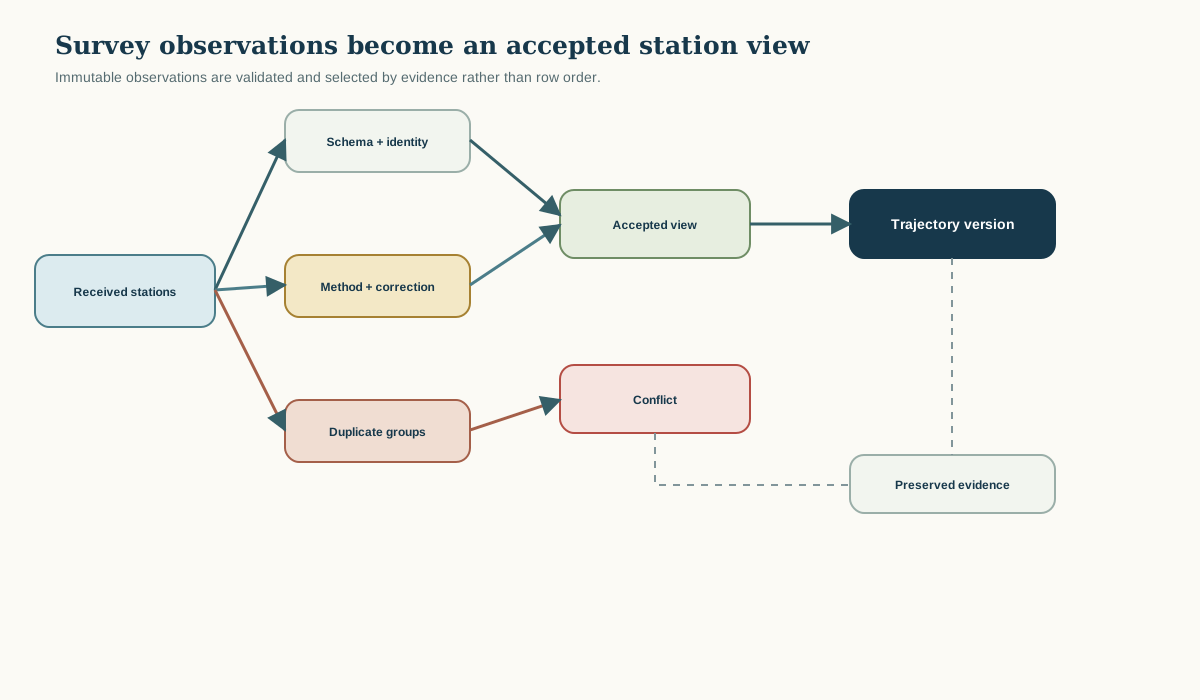
Read the figure as a reasoning map from preserved evidence through explicit conventions, deterministic calculation, validation and release. Each arrow represents a declared relationship or transformation. Integrate a versioned survey-station contract and duplicate-resolution register into the evolving synthetic drillhole package, rerun all earlier fixtures and record any changed assumption.
Synthetic worked example
At 120 m, synthetic hole SYN-H002 contains three received stations: one planned, one measured but uncorrected, and one corrected observation with a review approval. Stable row order would choose the wrong record in two of three source files. The accepted view selects the corrected observation because its state and review evidence satisfy the contract, retains the others, and records the decision rule plus all station identities.
- Preserve the received records and state the intended decision without correction.
- Resolve identities, units, conventions and evidence eligibility; mark every unresolved item.
- Run the versioned algorithm and tests while retaining intermediate diagnostics.
- Issue accept, reject or quarantine and show how an independent reviewer can reproduce it.
Practice task
Implement the chapter artefact against a synthetic fixture containing one normal case, one boundary case, one invalid case and one unresolved-evidence case. Preserve the received fixture. Produce canonical input, validation findings, derivative output, processing manifest and a short release decision.
Acceptance criteria:
- Every input identity, unit and convention required by the rule is explicit.
- The implementation is deterministic under stable ordering and the declared numerical policy.
- No correction overwrites received evidence or turns unknown into a guessed value.
- All hard failures block the affected derivative and remain machine-readable.
- A second implementation or reviewer can reproduce the result from the package alone.
Submit a versioned survey-station contract and duplicate-resolution register, the golden and adversarial fixtures, exact findings and a limitations note. A screenshot is not sufficient evidence because it does not identify the input version, algorithm or rule configuration.
Common failure modes
- Using the last duplicate row without a precedence rule.
- Mixing planned and measured stations in one unlabelled series.
- Dropping method and correction metadata after import.
- Overwriting a rejected observation with its replacement.
These failures share a pattern: an implicit convenience is substituted for evidence. Diagnose the earliest boundary where the assumption entered, restore the source statement, make the convention or rule explicit, rerun every dependent derivative and supersede rather than overwrite the affected release.
Review questions
- What makes a survey station an observation?
- How should duplicate measured depths be grouped and resolved?
- Why are planned and interpolated stations not equivalent to measured stations?
- When must a definitive trajectory be blocked?
For every answer, identify the governing invariant, the evidence needed to evaluate it, the numerical or semantic policy involved and the correct behaviour when the condition fails.
Sources and further reading
- WITSML 2.0 trajectory data object, describing trajectory stations and measured directional observations.
- WITSML 2.0 trajectory-station schema, defining measured depth, inclination, azimuth, corrections, status and related station metadata.
- WITSML trajectory best practice, identifying the directional and positional elements needed to interpret a trajectory.
- W3C PROV-O, a model for entities, activities, responsibility roles and derivation.