C6 · Publication Volume 16
Drilling Objectives and Method Selection
diamond, RC, RAB and aircore drilling suitability
Learning objectives
This lesson connects the decision to the drilling method. The learner should be able to state what the hole must observe, separate geological reach from sample quality, compare diamond core, reverse-circulation, rotary air-blast and aircore drilling by their evidence characteristics, identify method-induced bias, and write a method-selection record that can be reviewed before mobilisation.
The method is not chosen by a universal hierarchy. A continuous oriented core may be essential for structural interpretation but unnecessary for a shallow reconnaissance question. Rapid cuttings may provide useful coverage but cannot recover fabric that was never preserved. The correct comparison starts with the observation required, not with a familiar rig type.
From decision to observation requirement
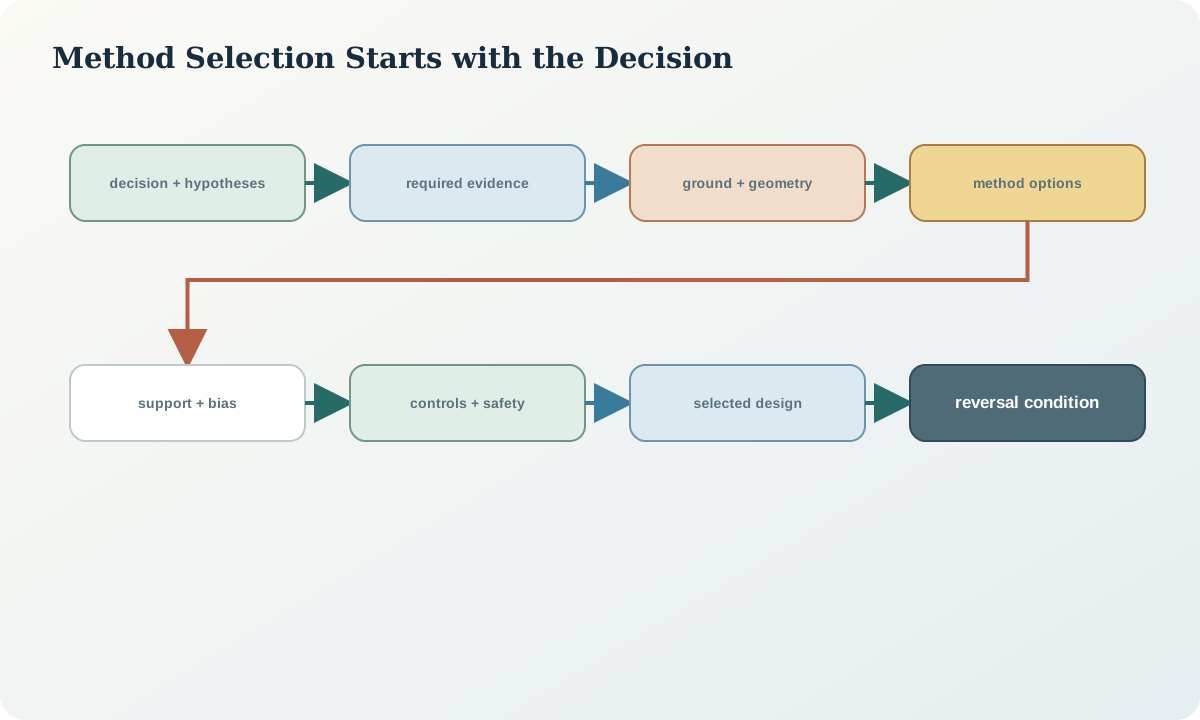
Write the decision first. Examples include testing whether a predicted contact exists at a location, estimating the orientation of a structure, characterising weathering depth, obtaining material for mineralogical work, or reducing uncertainty between two subsurface hypotheses. For each decision, specify the required evidence: continuity, depth accuracy, material mass, orientation, particle-size integrity, contamination tolerance, recovery, analytical sensitivity and spatial coverage.
Then define failure. A hole may reach planned depth yet fail scientifically because it missed the target through deviation, lost the critical interval, returned mixed cuttings, destroyed soft material, produced insufficient mass, lacked orientation or generated a sample whose support does not match the decision. Completion metres are an activity measure; they are not an evidence-quality measure.
Use a pre-drill hypothesis table. For each hypothesis, list the predicted depth range, lithology, alteration, structure, physical response and disconfirming observation. Include at least one non-geological explanation for an expected anomaly. This prevents the log from becoming a post hoc confirmation story.
Method families and evidence products
Diamond coring cuts an annular path and returns a cylindrical core. Its main evidential advantage is preserved spatial sequence and, when recovery and orientation are adequate, texture and structure. Core diameter affects material mass, structural visibility and test options. Fractured, clay-rich or soluble zones can still be lost or disturbed, and drilling fluid, core-barrel handling and mechanical breaks can change the record.
Reverse-circulation drilling commonly uses compressed air and an inner return path to deliver rock fragments to a separator and collection system. It can provide substantial sample mass and rapid penetration in suitable ground. Evidence risks include downhole mixing, residual material, wet intervals, separator loss, uneven splitting, dust loss and depth lag. The returned sample is particulate; original fabric and direct orientation are largely unavailable.
Rotary air-blast methods commonly return cuttings through the annular space between rods and hole wall. They may support shallow reconnaissance where speed and coverage matter, but wall contact and return-path mixing can increase contamination and depth uncertainty. Aircore uses a blade or similar cutting assembly and an inner return path, often in unconsolidated or weathered materials. It can recover useful chips or small pieces while still altering particle-size distribution and losing in-place fabric.
These descriptions are functional, not equipment specifications. Tool configurations vary. The actual method record must describe bit, diameter, circulation and return path, collection system, additives, casing, changes by depth and observed recovery behaviour.
Ground conditions, depth and geometry
Method suitability changes with hardness, abrasiveness, fracture state, swelling clays, unconsolidated cover, boulders, voids, water inflow, pressure and target depth. A method efficient in competent dry rock may suffer poor sample return in wet broken ground. A method that produces continuous core can still yield biased evidence if the critical soft interval is washed away.
Hole diameter, rod stiffness, drilling parameters and formation anisotropy influence deviation. Planned geometry must allow for the fact that a hole will not remain a straight mathematical line. If the target is narrow or the intersection angle matters, the method and survey plan must control trajectory uncertainty tightly enough that a miss can be distinguished from a geological absence.
Access, footprint, water and energy demand, waste streams, noise, dust, rehabilitation and seasonal constraints are part of method selection. They are not external details to be added after the scientific design. A method that cannot be executed safely and lawfully at the site is not a viable scientific option.
Sample support and method-induced bias
Sample support is the physical volume and geometry represented by a result. Core provides a near-cylindrical support before splitting; cuttings represent material broken and transported over a depth interval, with possible lag and size sorting. A nominal one-metre interval does not guarantee one-metre support if return is delayed, lost or contaminated.
List plausible biases before drilling: preferential loss of soft or fractured material; washout; coarse-particle rejection; dust loss; density segregation in a splitter; carryover between intervals; caving from above; drilling-fluid contamination; oxidation or drying after recovery; and selective breakage. Link each bias to an observable control such as recovery, return mass, moisture, pressure, flow, duplicate split, clean-out record or particle-size check.
Do not assume that larger sample mass is automatically more representative. A large mixed sample can be less useful than a smaller correctly delimited one. Conversely, a visually excellent half-core sample may be insufficient for a decision if mineralisation is coarse and heterogeneous. Support must be evaluated against the spatial scale of heterogeneity and the measurement objective.
Uncertainty, safety and quality controls
Build a method-specific control plan before drilling. Define minimum metadata, recovery measurements, sample-mass checks, duplicate types, contamination checks, survey frequency, photographs, material retention and escalation rules. State which failure stops drilling, which triggers a repeat or clean-out, which changes the method and which merely adds an uncertainty flag.
Separate scientific uncertainty from operational risk while managing both. Scientific uncertainty includes trajectory, depth attribution, recovery and contamination. Operational risk includes moving plant, rotating rods, pressure, suspended loads, stored energy, dust, noise, chemicals, terrain, weather and water. Only a site-specific, authorised safety system can set operating controls. The educational method matrix must contain a “not viable under current controls” outcome.
Record method changes by depth. If coring follows percussion drilling, or casing and diameter change, the hole is a sequence of evidence regimes. Downstream users need boundaries between those regimes rather than a single method label for the whole hole.
Synthetic worked example
A synthetic program must distinguish two explanations for a narrow steeply dipping conductive feature at an expected vertical depth near 180\,\mathrm m. Hypothesis H1 predicts a graphitic shear with diagnostic fabric; H2 predicts a wet clay-rich fracture zone without persistent fabric. The decision requires lithology, structure, recovery through weak ground and material for chemical and mineralogical tests.
Three options are scored on a declared ordinal scale from 1, weak, to 5, strong. Continuous coring scores 5 for fabric, 4 for depth attribution, 3 for recovery risk in weak ground, 3 for rate and 4 for retained material. A cuttings method scores 1 for fabric, 3 for depth attribution, 2 under wet-return risk, 5 for rate and 4 for mass. A staged design using a faster upper-hole method followed by oriented coring across the predicted target scores 5 for decisive fabric, preserves budget flexibility and introduces a method boundary that must be recorded and surveyed.
The staged design is selected, not because it is universally superior, but because fabric is the discriminating observation. The plan includes an early casing decision, survey stations bracketing the target, enhanced recovery monitoring, a stop-and-review trigger if weak-zone recovery drops, and retained unsampled material. If the target position uncertainty grows beyond the planned search window, the geometry must be reviewed before interpreting absence.
Practice and review checklist
For a proposed program, ask:
- Is the decision stated separately from the drilling activity?
- Are at least two hypotheses and their disconfirming observations recorded?
- Does the method preserve the evidence needed to distinguish them?
- Are ground, depth, water, access and rehabilitation constraints documented?
- Are trajectory and target-width uncertainties compatible?
- Is sample support defined for every method segment?
- Are expected loss, mixing, contamination and particle-size biases listed?
- Are recovery, return mass, duplicates, clean-out and survey controls planned?
- Are method and diameter changes represented as depth intervals?
- Can unsafe or environmentally unacceptable options be rejected explicitly?
Reviewers should reject a selection justified only by familiarity, lowest quoted cost, nominal rate or historical habit. They should also reject a technically elaborate option when its additional information does not alter the decision.
Decision record and integration
The approved method-selection record should contain objective, hypotheses, target geometry, required observations, options considered, ground model, expected depth, method intervals, sample support, recovery and contamination risks, survey design, retained material, safety and environmental dependencies, decision gates and residual uncertainty. Version it when assumptions change.
This record becomes the reference for later review. Core recovery is assessed against predicted weak zones; sampling is assessed against intended support; assay methods are assessed against the decision analytes; and program success is assessed against uncertainty reduction rather than metres. A method change is scientifically acceptable when its consequences are recorded and controlled. An undocumented change breaks the evidence chain.
Sources
- Applications of drilling, coring and sampling techniques, reviews method selection in relation to objectives and subsurface conditions.
- Code of practice for mineral exploration, describes drilling methods and environmental controls in a public regulatory context.
- Considerations for drilling methods and borehole logging, connects drilling choices, well construction and later subsurface measurements.
- International reporting template and checklist, lists drilling technique, recovery, sampling and representativity matters that require disclosure.