C6 · Publication Volume 16
Geological Logging
lithology, weathering, alteration, mineralisation and texture
Learning objectives
This lesson turns recovered material into structured geological observations. The learner should be able to design a logging schema, distinguish observation from interpretation, describe lithology, weathering, texture, alteration and mineralisation at appropriate resolution, place contacts with uncertainty, apply controlled terms consistently and revise interpretations without erasing original observations.
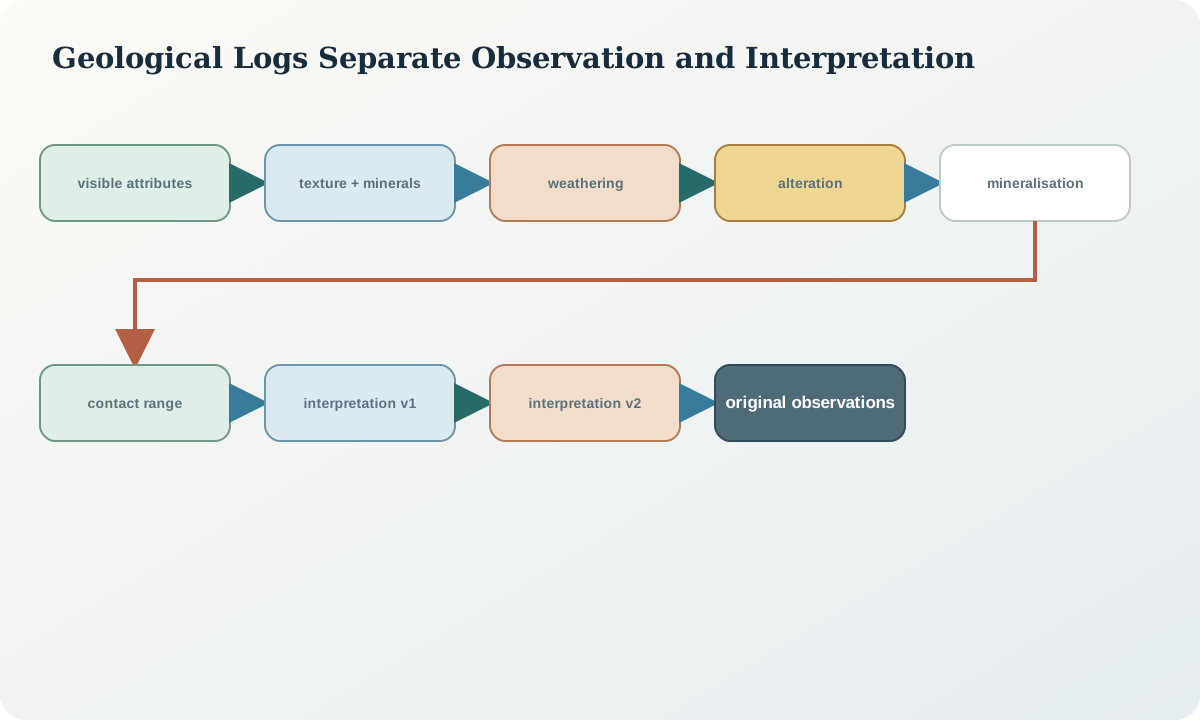
A geological log is not a compressed essay about what the hole “is.” It is a set of depth-registered claims supported by visible, measurable or testable attributes. The strongest log allows a later geologist to disagree with the interpretation while still using the observations.
Observation schema and controlled terms
Separate fields by epistemic role. Direct observations include colour under stated conditions, grain-size class, visible mineral habit, texture, fabric, veining, fracture coating, reaction, hardness test, magnetic response and contact character. Interpretations include rock name, alteration assemblage, stratigraphic unit, protolith, mineralisation style and geological domain. Administrative fields include logger role, time, schema version, equipment and review status.
Use controlled vocabularies with identifiers, definitions, allowed values, synonyms and version dates. A code should not silently change meaning between programs. Preserve free text for unexpected features, but do not force every observation into prose that cannot be queried. Allow “not observed,” “not applicable,” “not testable” and “uncertain” as distinct states.
Design the schema around the decision and material. Core, chips and cuttings support different observations. A field requiring intact fabric is invalid for mixed cuttings. Scale matters: a centimetre vein, metre-scale alteration interval and hundred-metre lithological package should not compete for one boundary table. Use feature tables or hierarchical intervals where necessary.
Lithology, weathering and texture
Describe before naming. Record grain or crystal size, sorting, shape, fabric, matrix-to-clast relation, mineral proportions with estimation method, primary structures, colour condition and overprinting. Then assign a lithological interpretation with confidence and alternatives. A name alone hides which attributes justified it.
Weathering and oxidation affect colour, strength, mineral preservation, porosity and recovery. Define weathering classes by observable criteria rather than local intuition. Record transitions separately from lithology when their boundaries differ. A weathering boundary can migrate across a rock contact and should not force coincident intervals.
Texture can carry genetic and structural information but is sensitive to core orientation, surface preparation and scale. State whether observations came from wet or dry core, a sawn face, broken surface, hand lens, image or analytical result. Do not backfill unobserved mineralogy from a later assay without marking the interpretation source and version.
Alteration, mineralisation and contacts
Alteration logging should distinguish mineral or material identity, style, intensity, distribution and overprint. “Strong alteration” is incomplete without criteria. Where mineral identity is uncertain, log the observed colour, habit, hardness, reaction or spectral response and assign a provisional interpretation with confidence. Multiple alteration events may overlap; a single categorical field can erase sequence.
Mineralisation logging records visible minerals or material, abundance-estimation method, grain form, host relation, vein or disseminated style, oxidation and confidence. Visible abundance is not an assay and an assay is not a visible-mineral observation. Avoid inferring economic significance from appearance. Record absent visibility only at the observation scale and condition actually inspected.
Contacts need depth, type, sharpness, shape, angle to core axis where measurable, evidence, confidence and boundary uncertainty. A broken or missing interval may support a contact range rather than one exact depth. Keep “observed contact,” “interpreted contact” and “sample boundary” separate. Forcing them to coincide can contaminate both geology and sampling.
Uncertainty and quality controls
Logging uncertainty arises from incomplete recovery, limited surface exposure, scale, lighting, colour perception, grain size, weathering, overprint, mixed cuttings, depth placement and vocabulary ambiguity. Record confidence per claim or feature rather than one global score. A confident colour observation may support an uncertain lithological interpretation.
Quality controls include written definitions with reference examples, calibration exercises among logging roles, periodic relogging of blinded intervals, independent review, photo comparison, consistency queries and reconciliation of interval boundaries. Measure disagreement by field and material type. Consensus reached through discussion is useful, but preserve the original records when estimating reproducibility.
Automated checks should detect gaps, overlaps, zero-length intervals, inverted depths, values outside controlled terms, impossible combinations and excessive default use. They cannot decide whether a rock name is geologically correct. A valid code is not the same as a valid observation.
Synthetic worked example
A synthetic core interval from 146.2 to 151.8\,\mathrm m is initially labelled “altered volcanic rock.” A structured relog records fine equigranular groundmass; sparse 1–3\,\mathrm{mm} pale laths; weak penetrative fabric; patchy pale-green replacement; thin carbonate-reactive veinlets; disseminated opaque grains estimated at 1%–2%; and a lower contact lost within 0.25\,\mathrm m of broken core.
The interpretation becomes “fine volcanic or shallow intrusive protolith, chlorite-like alteration provisional, carbonate veinlets, minor visible opaque mineral.” The lithology confidence is medium because diagnostic primary texture is partly overprinted. The alteration-mineral identity is low confidence pending an independent method. The lower contact is stored as the range [151.55,151.80]\,\mathrm m, not a fabricated point.
A later analytical result can revise the alteration interpretation while the texture, reaction and visible-grain observations remain immutable. This separation makes the revision scientifically legible.
Practice and review checklist
- Are observation, interpretation and administration fields distinct?
- Does every controlled code have a versioned definition?
- Are fields valid for the recovered material and inspection scale?
- Are weathering, lithology and alteration allowed to have different boundaries?
- Are intensity and abundance tied to observable criteria?
- Are visible mineral observations kept separate from assays?
- Can contacts be ranges with confidence when evidence is incomplete?
- Are original observations preserved when interpretations change?
- Do relogging and consistency checks quantify reproducibility?
- Are photos aids to review rather than substitutes for the structured record?
A log should be returned when it contains only rock names, uses undefined abbreviations, fills recovery gaps with inferred geology or presents uncertain mineral identity as fact.
Decision implications and integration
Geological logs support correlation, domain construction, sample selection and hypothesis testing only at the resolution and confidence of their evidence. A lithological interval derived from chips may be appropriate for broad correlation but not for centimetre-scale contact geometry. State the applicable scale.
Integration should retain overlapping interval sets for lithology, weathering, alteration, mineralisation and interpretation rather than flattening them prematurely. Derived composite intervals can be generated with a documented rule. Reviewers should be able to trace every domain code back to observed attributes and see how a vocabulary or interpretation revision changed the result.
Sources
- Standardized method for logging drill core, presents consistent description of lithology, texture, mineralogy, alteration and photographs.
- Engineering geology field manual, provides public field-description and core-logging guidance across geological materials.
- Geoscience information model, distinguishes geological features, observations, specimens and results in an interoperable model.
- International reporting template and checklist, identifies logging, geological interpretation and data verification matters relevant to transparent reporting.