C6 · Publication Volume 16
Drillhole Sampling Design
interval selection, support, half core and representativity
Learning objectives
This lesson designs the transition from logged material to submitted sample. The learner should be able to define sample support, choose interval boundaries, evaluate half-core and cuttings splits, preserve residual material, identify delimitation and extraction errors, design duplicates and document chain of custody without confusing a sample identifier with a depth interval.
Sampling begins before a saw, splitter or scoop is used. It begins when the decision defines what population and support a result must represent. The sample is a physical claim about part of a hole; if its boundaries, mass and extraction are unclear, later analytical precision cannot restore representativity.
Population, support and interval boundaries
Define the target population: a geological unit, mineralised zone, alteration style, weathering horizon, geotechnical domain or fixed surveillance interval. Define support as the hole segment, cross-sectional fraction and material state represented. A result from half core represents a different physical support from a full-core composite or a cuttings split.
Use interval boundaries that respect decision-relevant geological contacts where they can be located reliably. Also set minimum and maximum lengths based on heterogeneity, required mass, analytical method and operational capability. Avoid creating very short residual samples merely to meet a routine length. Any boundary rule must be declared before seeing results to reduce selective sampling.
Do not sample across core loss as though missing material had zero concentration or average composition. Split the interval or flag the support. For cuttings, account for lag, mixing and collection cycle. Nominal depth labels should not imply sharper delimitation than the return process can provide.
Core cutting and retained material
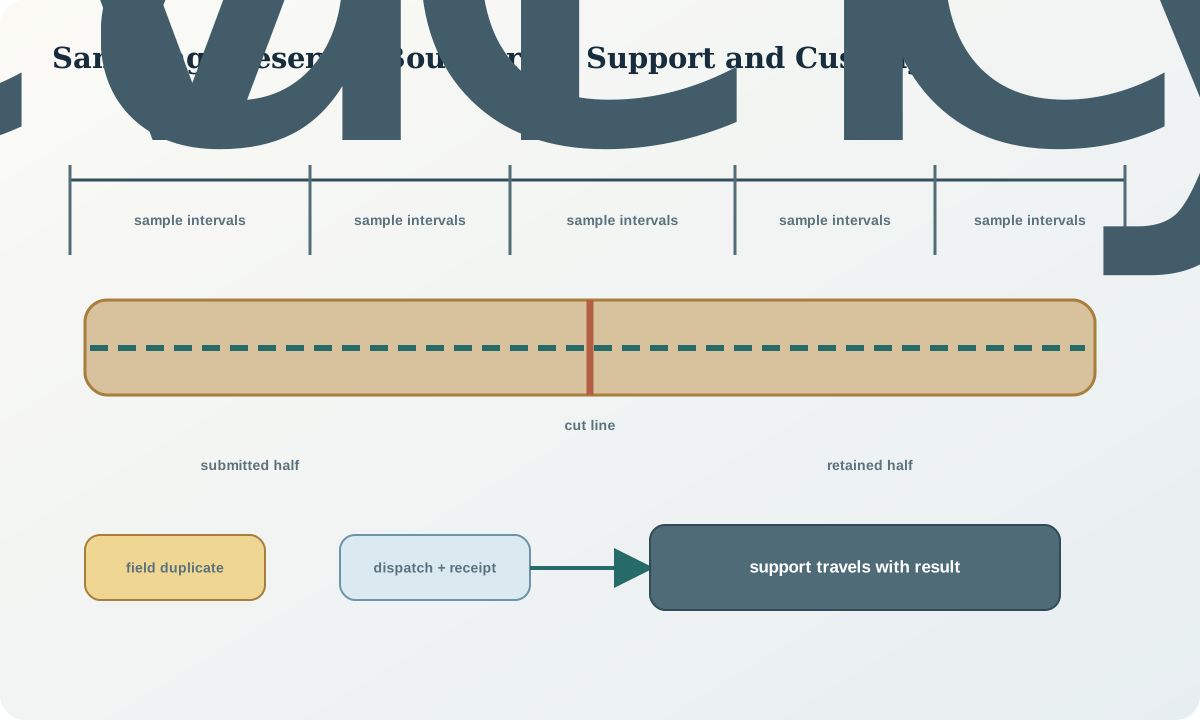
Before cutting, mark the sampling line using a consistent rule that reduces selection bias. For oriented core, the cut line and retained half should preserve the orientation reference where structural work may continue. Photograph and verify depth marks before destructive sampling.
Half-core sampling retains a physical archive, but a perfect half by geometry may not split heterogeneous veins or coarse particles representatively. A longitudinal cut should follow the declared line through each correctly reconstructed piece. Broken material needs a consistent allocation method rather than subjective selection of more mineralised fragments.
Record sample interval, original diameter, fraction taken, cutting method, retained fraction, mass, condition, loss and storage location. Destructive tests that consume the archive require a separate decision and lineage. Residual material is not “spare”; it is evidence for verification and future questions.
Cuttings splitting, mass and contamination
For particulate returns, the collection and splitting system must handle the full stream or a controlled fraction. Flow variation, wet material, blocked chutes, dust extraction, density segregation and coarse-particle bounce can bias splits. Measure total return and submitted mass at a useful frequency, and record wet or poor-split conditions.
A riffle or rotary splitter can only perform as intended when feed mass, particle size, flow and cleanliness are suitable. A scoop from the top of a bag is not equivalent to a representative split. Clean between intervals under the approved procedure and verify contamination behaviour with appropriate controls.
Duplicates should target different error stages. A second field split assesses collection and splitting plus later stages; a coarse reject split assesses later preparation and analysis; a pulp repeat assesses a narrower analytical stage. Label the duplicate relationship in metadata without making the paired identity obvious where blinding is part of the design.
Uncertainty and quality controls
Sampling uncertainty includes delimitation, extraction, preparation and analytical components. Heterogeneity can dominate. Duplicate designs should cover the material types, grades and conditions relevant to the decision rather than only convenient homogeneous intervals. Interpret differences relative to concentration and support.
Controls include interval and sample-ID validation, mass monitoring, cutting-line audit, retained-half checks, splitter inspections, field duplicates, blanks positioned after contamination-prone material, custody seals or equivalent controls, dispatch reconciliation and receipt confirmation. Define what happens when a bag is missing, damaged, wet, underweight or assigned to the wrong interval.
Preserve unsampled intervals and selection reasons. Selective submission of visually interesting material biases the dataset used for spatial interpretation. If sampling is intentionally selective, the population and limitation must be explicit.
Synthetic worked example
A synthetic mineralised interval extends from 64.35 to 68.90\,\mathrm m and contains a sharp contact at 66.10\,\mathrm m, a 0.20\,\mathrm m recovery gap and coarse vein material. A routine one-metre grid would cross the contact and assign missing support invisibly. The design instead creates intervals [64.35,65.35), [65.35,66.10), [66.10,66.80), a flagged gap-related interval [66.80,67.20), [67.20,68.20) and [68.20,68.90).
Each interval records recovered length and fraction sampled. The gap-related interval is not used as a conventional complete support. A field duplicate is inserted on one sufficiently massive, heterogeneous interval by making two controlled splits; it is not formed by resampling the remaining bag after the first split.
The result preserves the contact and makes missing support visible. It does not claim that unequal interval lengths are directly comparable without length, density and geological context.
Practice and review checklist
- Is the target population and physical support explicit?
- Are boundary rules defined independently of assay results?
- Are geological contacts respected where evidence allows?
- Are recovery gaps and cuttings lag represented honestly?
- Is the cutting or splitting rule reproducible?
- Is retained material identified and locatable?
- Are total and submitted masses monitored?
- Do duplicate types identify the error stages they test?
- Are custody, dispatch and receipt reconciled by stable IDs?
- Are unsampled intervals and selection reasons preserved?
Reject a sample table whose identifiers cannot be tied to physical intervals, or whose boundaries imply complete material where recovery was incomplete.
Decision implications and integration
Sampling design determines what later assay values can represent. Interval length, diameter, fraction, recovery and mass should accompany results into compositing, modelling and estimation. A database join that retains concentration but discards support changes the scientific meaning.
The handover package contains sample-plan version, interval and support fields, physical extraction method, masses, retained material, duplicate relationships, dispatch events, exceptions and release status. Reviewers should be able to reconstruct why every sampled and unsampled interval was treated as it was.
Sources
- Measurement uncertainty arising from sampling, provides a holistic model of sampling, preparation and analytical uncertainty with duplicate designs.
- International reporting template and checklist, addresses sampling technique, representativity, recovery, sub-sampling and verification.
- Applications of drilling, coring and sampling techniques, reviews recovery and sampling choices in subsurface investigations.
- Exploration-activity reporting guide, identifies sampling, preparation, analysis and raw-data records required for transparent reporting.