C6 · Publication Volume 16
Sample Preparation and Assay
crushing, splitting, pulverising, digestion and analysis
Learning objectives
This lesson follows a sample through physical and chemical transformation. The learner should be able to map crushing, splitting, pulverising, digestion and measurement; distinguish total from partial extraction; track mass and aliquots; interpret detection and reporting limits; identify contamination, loss and mix-up mechanisms; and decide whether an assay is fit for the geological purpose.
An analytical result describes the material that reached the instrument under a specified method. It does not automatically describe the entire original interval. The evidence chain must connect the result to the submitted sample through every split and transformation.
Preparation as a mass-and-lineage process
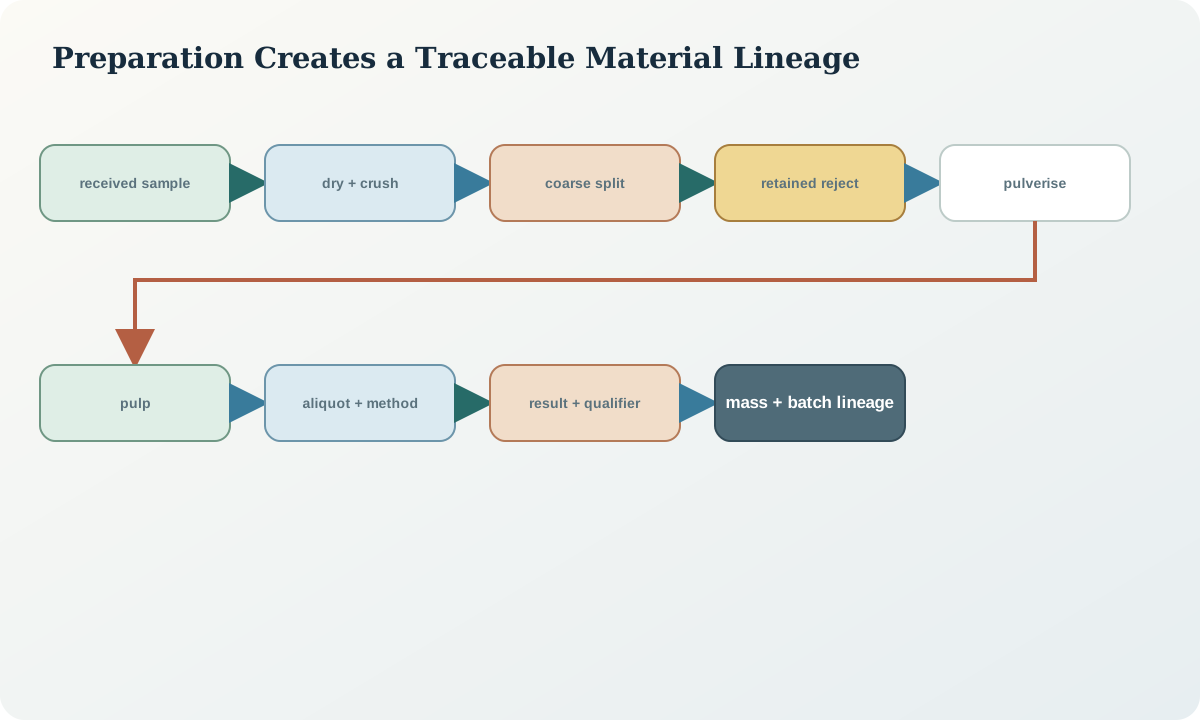
Represent preparation as a directed lineage: received sample, dried sample where applicable, crushed product, coarse split, retained reject, pulverised split, pulp, analytical aliquot and residual material. Each entity has an identifier, parent, mass, method, equipment or batch, time, status and storage or disposal state.
Crushing reduces particle size so a smaller split can be representative; splitting reduces mass; pulverising further reduces particle size for a small analytical aliquot. These operations do not remove heterogeneity automatically. Coarse valuable or dense particles, soft clay, fibres and moisture can segregate or smear. The required particle-size performance depends on material and aliquot mass.
Mass balance is a diagnostic, not an expectation of exact equality. Drying changes moisture; dust and adherent material cause loss; subsamples are retained. Record input and output masses at control points and investigate systematic deficits, gains or impossible values. A label transfer without a physical identity check can preserve mass while swapping samples.
Contamination, carryover and segregation
Contamination can arise from drilling, containers, crushers, pulverisers, bowls, mills, cleaning media, workspace dust, reagents and adjacent high-concentration samples. The likely analytes depend on equipment composition and material. Map contamination opportunities by stage and place blanks where they can diagnose the relevant path.
Carryover is sequence dependent. A blank immediately after a high-concentration sample can test one aspect of cleaning, while a randomly placed blank may estimate background occurrence. Both designs answer different questions. Record batch order; a list of results without order cannot diagnose carryover.
Segregation can occur before and after size reduction. Feeding a splitter unevenly, scooping from a pile or transporting a partially filled container can separate particle sizes and densities. Controls must inspect the physical process, not only the final assay statistics.
Digestion, extraction and instrumental measurement
A method may aim at near-total decomposition, partial extraction, phase-selective leach, fusion, combustion or direct physical measurement. “Total” must be justified for the minerals and analytes present; refractory phases may remain undissolved under some acid combinations. Partial methods can be valuable when their operationally defined fraction matches the question, but they should not be compared with total values as if method were irrelevant.
Record method code and full definition, sample mass, digestion or extraction conditions, dilution, instrument technique, calibration range, internal corrections, unit, lower and upper reporting limits and result qualifiers. A method code whose definition changes needs a version. Reanalysis by another method creates another result, not an overwrite.
Values below a reporting limit are censored observations. Store the reported limit and qualifier. Values above range require an approved dilution or alternative method and lineage. Do not replace less-than values with zero in the source record, and do not treat a rounded upper-limit result as exact.
Uncertainty and quality controls
Analytical competence involves validated methods, calibrated equipment, traceable references, trained roles, controlled environment, impartial review and documented uncertainty. Accreditation or certification can support confidence within a defined scope, but it does not prove that the selected method or submitted sample is appropriate for the geological decision.
Use reference materials to assess bias and long-term stability, blanks to assess contamination, duplicates to assess precision at selected stages, calibration checks to assess instrumental response and interlaboratory comparisons where decision risk warrants them. Match reference-material matrix and concentration to the samples; a control far from the relevant range may not diagnose the failure that matters.
Review control results by batch and over time. Predefine warning, failure, investigation, re-preparation and reanalysis rules. Avoid deleting controls or narrowing limits after seeing an inconvenient batch. Statistical control is not equivalent to geological representativity; both are required.
Synthetic worked example
A synthetic 3.8\,\mathrm{kg} submitted sample is dried to 3.5\,\mathrm{kg}, crushed, and a 1.0\,\mathrm{kg} coarse split is pulverised. A 30\,\mathrm g analytical aliquot undergoes a partial extraction. The result for element X is 420\,\mathrm{mg/kg} with a stated reporting range of 1–5{,}000\,\mathrm{mg/kg}. A matched reference material returns 6% below its assigned value, while the preparation duplicate differs by 18% relative to the pair mean.
The batch is not accepted or rejected from one number. The review asks whether reference bias breaches the predefined rule, whether duplicate dispersion is expected for this heterogeneous material, whether the partial extraction matches the decision and whether other controls show contamination or drift. If reanalysis uses a near-total method, the new value is not treated as a correction of the partial result; the methods measure different operational quantities.
Lineage preserves the retained coarse reject and pulp, allowing targeted re-preparation or reanalysis. Without that lineage, a rerun could test only the same pulp and miss a preparation problem.
Practice and review checklist
- Can every result be traced to a physical aliquot and parent sample?
- Are masses and particle-size targets recorded at critical stages?
- Are retained reject and pulp locations known?
- Are contamination and carryover risks mapped by analyte and equipment?
- Is batch order preserved?
- Does the extraction or digestion match the mineralogy and decision?
- Are methods, units, limits and qualifiers versioned?
- Are censored and over-range states preserved?
- Do controls test bias, contamination and precision at relevant stages?
- Are failures resolved at the stage implicated by evidence?
Reject a result table that provides concentrations without method, unit, qualifier, sample identity and batch. Quarantine a batch whose failed controls have no documented disposition.
Decision implications and integration
Assays become geological evidence only after sample support, preparation lineage, method suitability and quality state are joined. Different methods for the same analyte may not be commensurate. Conversion of units cannot remove extraction bias or matrix effects.
The release dataset should preserve all result versions, not only a preferred number. An adopted-result view can select the value approved for a stated purpose while retaining rejected, repeated and alternate-method records. Reviewers should be able to determine whether a conclusion changes when suspect batches or inappropriate methods are excluded.
Sources
- Measurement uncertainty arising from sampling, integrates sampling, preparation and analysis in one uncertainty model.
- Reference materials, distinguishes certified and other reference materials and their roles in measurement quality.
- Requirements for testing and calibration laboratories, defines competence, impartiality and consistent operation for laboratory activities.
- International reporting template and checklist, identifies preparation, assay, laboratory and quality-control information needed for transparent reporting.