C6 · Publication Volume 16
QA/QC across the Evidence Chain
standards, blanks, duplicates, batches and failure response
Learning objectives
This lesson designs quality assurance and quality control across drilling, surveying, recovery, logging, sampling, preparation, assay and data handling. The learner should be able to distinguish prevention from detection, choose controls for specific failure mechanisms, preserve batch and sequence context, evaluate bias and precision, define failure response before results and prevent a passed laboratory batch from concealing upstream errors.
Quality is fitness for a stated decision, supported by evidence. Quality assurance designs the system that should produce suitable records; quality control provides observations that test whether the system behaved as expected. Neither is a ceremonial collection of percentages.
Quality model and failure mechanisms
Begin with a process map. For every transformation, list input, output, identity transfer, measurement, expected variation, plausible failure, control, review role and disposition. Failures include wrong collar, survey interference, depth error, lost core, orientation reversal, logging drift, interval overlap, sample swap, non-representative split, contamination, analytical bias, unit mismatch and database overwrite.
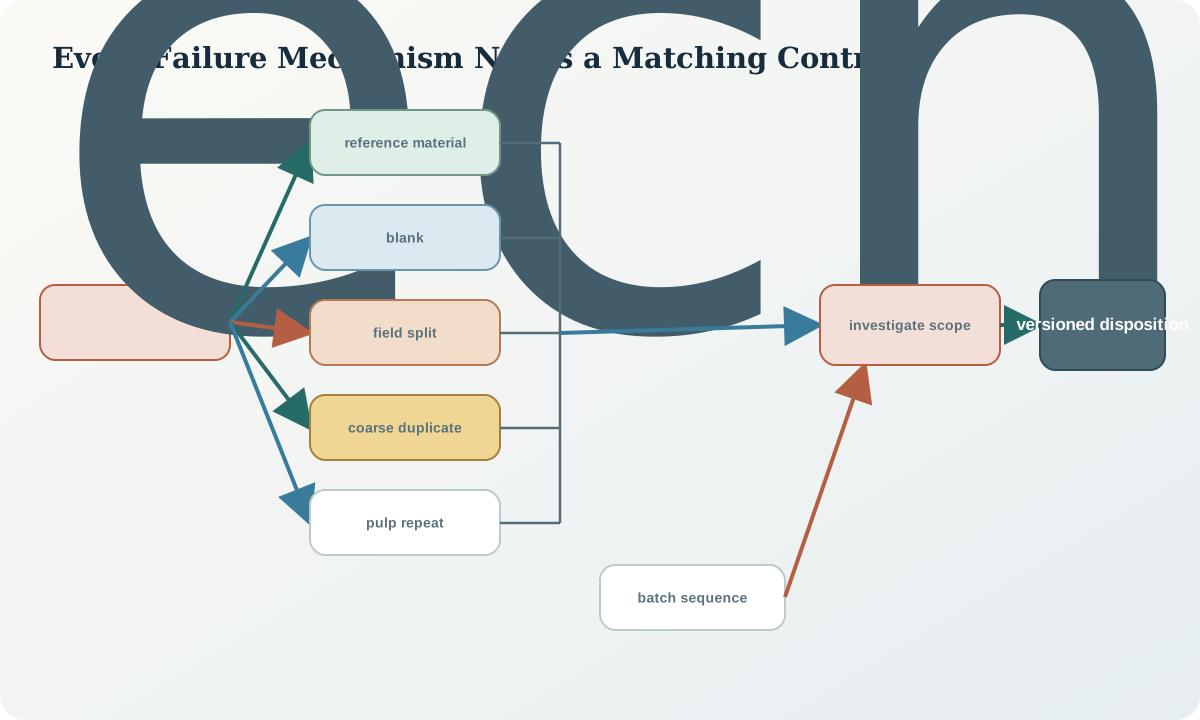
Classify errors by mechanism. Random variation affects repeatability; systematic bias shifts results; contamination adds material; loss removes material; swaps exchange identities; censoring limits information; missingness may be selective; transcription changes values; and model error arises when a method does not measure the intended quantity. Different controls detect different mechanisms.
Create a quality objective for each critical quantity. The objective should state decision, support, expected range, required uncertainty, control method and action. A universal “within 10%” rule is not meaningful across coordinates, angles, recovery, low concentrations and heterogeneous duplicate pairs.
Standards, blanks and duplicate types
Reference materials with assigned values assess analytical bias and stability when matrix, analyte and concentration are relevant. Their uncertainty and certificate must be considered. A control value outside an assigned range may indicate preparation, calibration, method or transcription problems; one passing reference does not prove every analyte and sample is correct.
Blanks test contamination at the stage where they enter. A field blank, transport blank, coarse blank, preparation blank and reagent blank have different paths. Place controls to test suspected carryover and routine background. A blank result needs the same method, unit, limit and batch context as a sample result.
Duplicates estimate combined variation from the point of duplication onward. Field splits, quarter-core pairs, coarse-reject splits, pulp duplicates and repeated instrument readings are not interchangeable. Define pairing, randomisation, blinding, frequency and material coverage. Relative difference becomes unstable near zero, so inspect absolute difference and concentration-dependent behaviour as well.
Batches, charts and acceptance rules
A batch is a controlled processing unit with sequence and shared conditions. Preserve sample order, controls, method, equipment, time, operator role, calibration and rework. Analytical batch, preparation batch, dispatch and drilling shift may have different boundaries; link them rather than forcing one batch key.
Review controls visually and statistically. Time-order plots expose drift and carryover; reference-material recovery shows bias; duplicate difference plots show concentration-dependent precision; blank plots show contamination relative to reporting limits and sample levels. Control limits should be set from quality objectives, reference uncertainty, method performance and material behaviour before reviewing the batch.
Warnings trigger investigation; failures trigger a defined hold or corrective path. Consecutive moderate deviations can matter more than one dramatic point if they reveal drift. Avoid treating control observations as independent when several come from one preparation or calibration event.
Failure response and corrective lineage
When a control fails, quarantine the affected scope. Determine the earliest plausible stage and affected samples from batch order and lineage. Review raw observations, calculations, calibrations, masses, sequence, preparation and transcription. Correct the process cause before generating replacement results.
Reanalysis of the same pulp tests later stages. Re-preparation from coarse reject tests a wider path. Resampling retained core or cuttings tests still more of the chain. Choose the response that addresses the implicated mechanism. Repeating only until a value passes creates selection bias.
Preserve original, failed and replacement results with status and derivation. Document investigation, affected range, decision, corrective action, verification and release. A corrected database view may show only adopted results to routine users, but the audit record must remain available.
Synthetic worked example
A synthetic analytical batch contains 32 routine samples, two reference materials, two blanks and three duplicate pairs. The first reference is within its assigned interval; the second is 9% low. A blank immediately after the highest sample contains element X at eight times the reporting limit. The following routine sample is also elevated. Pulp duplicates are close, while a coarse-reject pair differs substantially.
The pattern suggests more than one issue: sequence-dependent carryover near the high sample and a possible preparation or material-heterogeneity contribution in the coarse pair. The batch is held. The affected high-to-blank-to-following sequence is re-prepared from retained rejects after the cleaning process is checked; the low reference prompts review of calibration and reference identity across the batch. Repeating only the blank would not resolve contamination in the following sample.
The release decision records which samples were affected, which stage was repeated and why replacement results were adopted. The original results remain queryable with rejected status.
Practice and review checklist
- Does every critical transformation have a named failure mechanism and control?
- Are quality objectives tied to decisions and quantities?
- Do reference materials match matrix and concentration where practical?
- Does each blank traverse the stage it is meant to test?
- Are duplicate types and error stages explicit?
- Are batch order and shared conditions preserved?
- Were control limits and actions defined before results?
- Does failure response target the implicated stage?
- Are original and replacement results linked, not overwritten?
- Can the released scope be reconstructed from investigation evidence?
A dashboard of green percentages is inadequate if controls are misplaced, failures have no disposition or upstream depth and identity errors are outside the quality system.
Decision implications and integration
Quality state should travel with the data. Each collar, survey station, interval, sample, batch and result can have observation status, review status and release status. A downstream model should be able to exclude held or rejected evidence and report the effect.
Program-level review combines scientific adequacy with control performance. Passing analytical controls cannot repair selective sampling; excellent recovery cannot repair a swapped identity; duplicate precision cannot establish accuracy. The evidence chain is only as defensible as the unresolved failure that matters to the decision.
Sources
- International reporting template and checklist, addresses standards, blanks, duplicates, laboratory checks, verification and audit.
- Reference materials, explains assigned values, uncertainties and quality-assurance uses of reference materials.
- Measurement uncertainty arising from sampling, provides duplicate-based approaches for combined sampling and analytical uncertainty.
- Requirements for testing and calibration laboratories, defines general competence, impartiality and consistency requirements for laboratory work.