C6 · Publication Volume 16
Core Photography and Digital Logs
depth registration, colour, scale and image provenance
Learning objectives
This lesson treats images and digital logs as evidence products. The learner should be able to design repeatable core photography, register images to hole depth, control scale, geometry, exposure and colour, preserve original files and metadata, distinguish a photograph from a measurement and version digital logging records without losing their relationship to physical material.
A beautiful image can be scientifically weak if trays are misordered, depth blocks are unreadable, exposure varies, scale is unknown or the file has been detached from its source. Conversely, a plain repeatable image with reliable depth and provenance can support relogging, audit and later measurements.
Depth registration and capture geometry
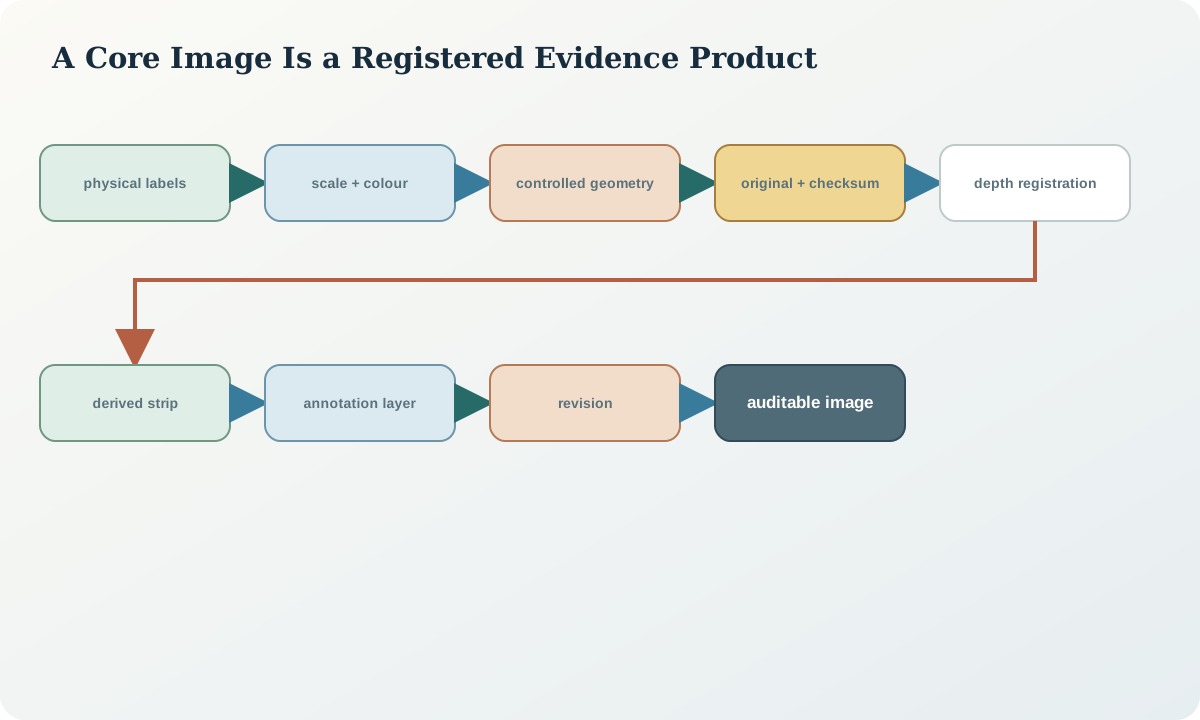
Prepare trays in known top-to-bottom and left-to-right order. Show hole identity, box identity, from- and to-depths, run boundaries, core loss, orientation line state and a unique capture identifier in a way that can be read without depending on the filename. Verify physical sequence against the run and box register before capture.
Keep camera position, focal length, working distance and tray alignment consistent enough to limit perspective variation. The optical axis should be controlled relative to the tray plane. Include a scale in the same plane as the core; a ruler at another height can be distorted. Record whether core is wet, dry, sawn, unsawn or treated.
Overlap between frames can support continuity, but duplicate material must be identified to prevent double depth assignment. If several trays appear in one image, each tray needs unambiguous identity and depth. Cropping should never remove the only physical labels.
Exposure, focus, scale and colour
Use stable diffuse illumination where practical and avoid reflections that obscure wet or sawn surfaces. Record camera and lighting settings or a reproducible capture profile. Focus and depth of field must cover the material plane. Assess blur at the resolution used for logging, not only in a thumbnail.
A neutral or characterised colour target can reveal exposure and colour drift, but it does not make every pixel a calibrated reflectance measurement. White balance, display profile, compression, wetness, surface roughness and ambient light all affect appearance. Preserve the original capture and any rendered derivative separately.
Scale bars support measurement only when lens distortion, plane, perspective and image resampling are controlled. A core diameter of known size is a useful check but may be elliptical in perspective. Do not calculate fracture aperture or grain size from a web thumbnail without an appropriate geometric calibration.
File identity and image provenance
Assign an image entity identifier independent of its filename. Store hole, box, depth range, capture time, device identity, settings, condition, orientation, operator role, original checksum, file format, pixel dimensions, colour profile and linked physical labels. Do not use mutable folder position as the only relationship.
Retain the original file without destructive enhancement. Derivatives such as colour-corrected images, orthorectified tray strips, thumbnails and annotated views need parent links, software-independent transformation descriptions, parameters and checksums. An annotation is an interpretation layer, not part of the original pixels.
If images are stitched into a continuous depth strip, record seam positions, excluded gaps, geometric warp and source frame for every output region. Physical gaps must remain gaps. Stretching images to fill missing core creates false continuity.
Digital logs and revision control
Digital entry should validate types, controlled vocabularies, interval order and mandatory context at capture time without blocking legitimate uncertainty. Offline or interrupted work needs conflict-safe identity and synchronisation. Do not generate a second sample or feature ID merely because a device reconnects.
Use append-and-supersede revision. A corrected contact or lithology creates a new record version with prior value, reason, evidence and review status. Preserve who performed a role without making personal identity the scientific justification. Role and action support audit; observations and evidence support the claim.
Link annotations to image coordinates and depth through explicit registration. If a crop or warp changes coordinates, transform or invalidate the annotation deliberately. A freehand mark on a screenshot should not become the authoritative structural measurement.
Synthetic worked example
A synthetic box covers 120.0 to 124.8\,\mathrm m. Four rows are photographed under fixed geometry with a scale and colour target. The box label says 120.0–125.0\,\mathrm m, but run reconciliation shows 0.2\,\mathrm m of core loss and an adopted box end of 124.8\,\mathrm m. The mismatch is resolved in the box register before images are released; the original label remains visible.
Two frames overlap by one core piece. The stitching record maps that physical piece to one depth segment and marks the duplicate pixels as overlap, preventing double counting. A derived colour-balanced strip links to both originals and stores the transform. A later lithology-boundary edit references the strip region and source observations while preserving the earlier interpretation.
The image is useful because its physical and digital identities agree. Visual quality alone would not resolve the label discrepancy.
Practice and review checklist
- Are tray order, hole, box and depth readable in the image?
- Was physical sequence reconciled before capture?
- Are camera geometry, scale plane and material condition recorded?
- Are exposure, focus and colour consistency checked?
- Is the original file immutable with a checksum?
- Do derivatives record parents, transforms and parameters?
- Are overlaps and gaps represented without false duplication or stretching?
- Can every annotation return to source pixels and depth?
- Are digital-log edits versioned with evidence and review state?
- Can files be recovered without relying on names or folder order?
Reject images whose depth cannot be proven, and reject a digital log that overwrites prior observations without lineage.
Decision implications and integration
Photographs support condition review, relogging, feature location, training and audit. They are not substitutes for retained material, calibrated mineralogy or field-scale observations. Their resolution and capture state define what can be claimed.
An integrated viewer should show source image, derived view, depth axis, recovery gaps, run and box boundaries, logs, samples and annotations while retaining independent version identities. If the survey or box-depth register changes, image depth registration should be revalidated rather than silently shifted.
Sources
- Standardized method for logging drill core, provides a detailed public workflow for core storage, photographic capture and descriptive logs.
- Exploration-activity reporting guide, identifies photographs, digital images and unprocessed drill data as reportable records.
- General provenance ontology, defines entities, activities, derivation and revision relationships applicable to source and derived images.
- Geoscience information model, supplies interoperable concepts for boreholes, specimens, observations and results.