A2 · Publication Volume 3
Earth as a System
geosphere, hydrosphere, atmosphere, biosphere and coupled material cycles
Learning objectives
After this lesson, you should be able to define a system boundary, separate reservoirs from fluxes, identify feedbacks, compare residence times, and explain why a local geological observation may depend on processes operating far away or long before it formed.
Start with a puzzle
A carbonate bed contains carbon that once moved through the atmosphere or ocean. Its calcium may have been released by weathering of silicate or carbonate rock. Burial moved the material into the lithosphere; deformation may later have uplifted it; weathering can expose it again. No single sphere owns the material. The rock is a temporary state within a coupled history.
An Earth system is a defined collection of components, stores and interactions. The definition is chosen for a question. For a global carbon budget, the atmosphere, ocean, biosphere, soils, sediments, crust and mantle may all be relevant. For a one-day slope-stability problem, the immediate rock mass, pore water and rainfall boundary may be sufficient. A model is incomplete if its boundary excludes an important flux, but it is unusable if it includes everything without scale control.
Spheres are useful partitions, not sealed boxes
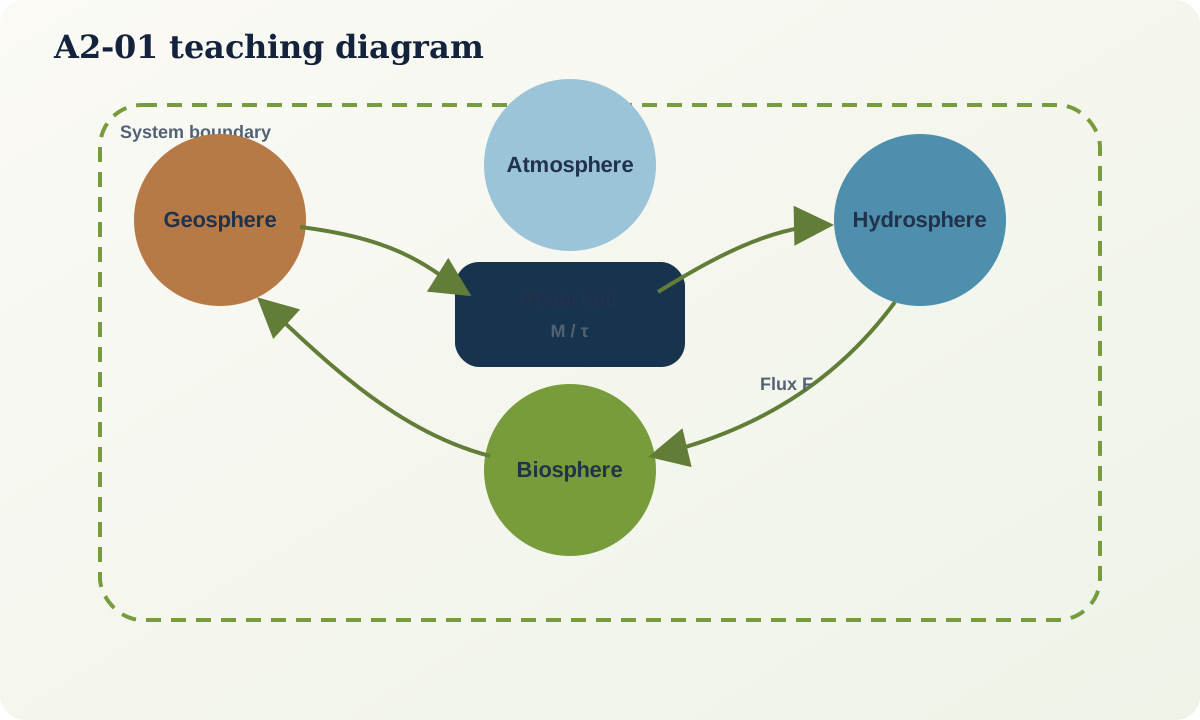
The geosphere includes Earth's solid materials and the processes acting in the crust, mantle and core. The hydrosphere includes liquid water at the surface and underground; the cryosphere is often treated separately because ice has distinctive dynamics and feedbacks. The atmosphere contains gases and aerosols. The biosphere comprises living systems and their products. These names organise observations, but real interfaces are mixed zones: soils combine minerals, water, gas and organisms; the seafloor couples ocean chemistry, sediment and crust; volcanoes transfer material from the solid Earth to air and water.
Earth-system research commonly treats atmosphere, biosphere, cryosphere, geosphere and hydrosphere as interacting domains. The point is not the number of boxes. The point is that a change in one reservoir can alter fluxes to others.
Reservoirs, fluxes and residence time
A reservoir is an amount of matter or energy stored within a defined compartment. A flux is a rate of transfer across a boundary. If a reservoir contains mass M and its approximately steady output is F, a characteristic residence time is
\tau = \frac{M}{F}
This ratio is a scale estimate, not a promise that every atom remains for exactly \tau. A well-mixed reservoir and a steady flux are assumptions. Geological reservoirs commonly violate both: groundwater follows heterogeneous pathways, sediment is stored and remobilised, and tectonic fluxes change through time.
Write mass balance before telling a story:
\frac{dM}{dt}=\sum F_{\mathrm{in}}-\sum F_{\mathrm{out}}+P-L
where P and L represent internal production and loss. For an element, a chemical reaction may redistribute species without creating the element. For heat, radiogenic production is a source and surface heat loss is an output. The accounting units and system boundary must be explicit.
Couplings and feedbacks
A coupling means that the state or flux of one component affects another. A feedback exists when the response returns to influence the initiating change. In a negative feedback, the return effect tends to oppose the disturbance; in a positive feedback, it tends to amplify it. Feedback labels are local to a defined loop and time interval—they do not mean “good” or “bad.”
For example, uplift can steepen slopes, increase physical erosion, expose fresh mineral surfaces and alter chemical weathering. Weathering products enter rivers and oceans; sediment accumulates in basins; the redistribution of mass can influence isostatic adjustment. Climate, vegetation, lithology, fracture density and relief all mediate the chain. A statement such as “uplift caused sedimentation” is therefore a hypothesis that needs intermediate mechanisms and evidence.
Energy crosses the partitions
Solar radiation drives atmospheric circulation, photosynthesis and much of the surface water cycle. Gravity drives runoff, sediment transport and density segregation. Internal heat drives mantle and core dynamics and contributes to magmatism and tectonics. Chemical potential drives reactions and diffusion. A material cycle is not necessarily powered by one energy source: water moving through fractured hot rock couples solar-powered recharge, gravitational head, rock heat and chemical reaction.
Worked example: from volcanic ash to a clay-rich sediment
Consider a region downwind of an eruption.
- Observation: an ash layer contains glass shards and crystals; younger soils and streams contain fine clay-rich material.
- Transfers: eruption moves silicate particles and gases from geosphere to atmosphere. Deposition moves particles to land and water. Weathering consumes water and redistributes dissolved ions and secondary minerals. Runoff transports the products to a basin.
- Possible archive: a dated ash bed may correlate separated sedimentary sections, while altered ash records post-depositional fluids as well as eruption age.
- Uncertainty: similar clay minerals may form from different parent materials; reworking can make grains older than the bed that contains them; wind direction and catchment boundaries may have changed.
The system model prevents a common error: equating the age of a grain with the depositional age of the sediment without testing transport and reworking.
Practical investigation
Draw a box-and-arrow model for a catchment-to-basin system. Include rock, regolith, soil, river, groundwater, atmosphere, organisms and basin sediment. Give every arrow a unit such as kilograms per year or cubic metres per second. Mark which fluxes are measured, inferred or unknown. Then redraw the boundary around only the basin and identify which earlier “internal” processes have become external inputs.
Mastery check
- Why can a reservoir be large while its observable flux is small?
- Give one example in which the same process is a source for one system boundary and an internal transfer for another.
- Explain why a residence-time estimate may be misleading in a poorly mixed reservoir.
- Convert “erosion causes basin fill” into a causal chain containing at least three testable links.
Sources and further reading
- Earth System Science Research, NASA Science.
- Geosphere research, NASA Science.
- What is the Earth's water cycle?, U.S. Geological Survey.