A2 · Publication Volume 3
Earth Interior and Physical Properties
crust, mantle, core, seismic evidence, density and pressure–temperature conditions
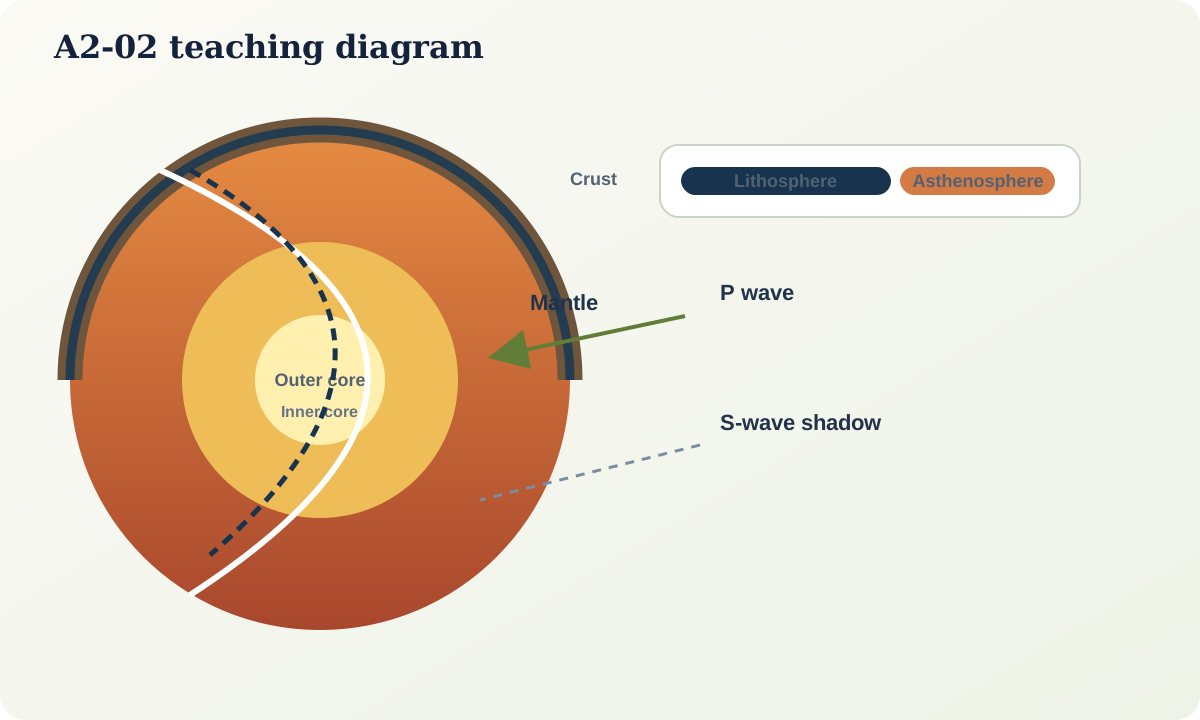
Learning objectives
After this lesson, you should be able to distinguish compositional from mechanical layering, explain what P and S waves constrain, locate the principal internal boundaries, and avoid treating a simplified cross-section as a direct image of Earth.
We infer the interior indirectly
Earth's mean radius is about 6,371 km, while even exceptional boreholes sample only a tiny fraction of the crust. Most knowledge of deeper structure comes from seismic wave travel times and amplitudes, normal modes, gravity, geomagnetism, surface heat flow, high-pressure experiments, meteorites and models of planetary formation. Each evidence type is sensitive to different combinations of composition, phase, temperature and mechanical behaviour.
The result is not one unique “inside picture.” It is a family of models constrained by many observations. Model resolution generally decreases where ray coverage is poor, and a seismic-velocity anomaly does not translate into temperature or composition without additional assumptions.
Two valid layer schemes
Compositional layers describe dominant chemistry:
- crust: a thin outer layer, compositionally distinct from the mantle; oceanic crust is typically thinner and more mafic than continental crust;
- mantle: silicate rock rich in magnesium and iron, extending to about 2,890 km depth; and
- core: an iron-rich central region divided into liquid outer core and solid inner core.
Mechanical layers describe how material responds over a selected time scale:
- the lithosphere is the relatively strong crust plus uppermost mantle that participates in plate motion;
- the asthenosphere is a weaker portion of the upper mantle that can flow over geological time;
- deeper mantle layers remain solid but deform; and
- the liquid outer core and solid inner core have distinct wave and dynamical behaviour.
Crust is not synonymous with lithosphere, and mantle is not synonymous with molten rock. Most of the mantle is solid. “Rigid plate” means approximately coherent on plate-motion time scales, not perfectly undeformable.
Seismic waves as probes
Body waves propagate through the interior. P waves involve compression and dilation and travel through solids and liquids. S waves involve shear and do not propagate through a fluid. Wave speed depends on density and elastic properties. In a simple isotropic material,
v_P=\sqrt{\frac{K+\tfrac{4}{3}\mu}{\rho}}, \qquad
v_S=\sqrt{\frac{\mu}{\rho}}
where K is bulk modulus, \mu is shear modulus and \rho is density. Because liquids cannot sustain static shear, \mu approaches zero and v_S vanishes.
Ray paths curve when velocity changes gradually with depth and refract at sharper contrasts. Global arrival-time patterns reveal discontinuities and shadow zones. The absence of direct S-wave transmission through the outer core supports a liquid outer core; P-wave behaviour constrains the core boundary and inner core. Seismic tomography uses many paths to estimate three-dimensional velocity variations, but its coloured sections are inversions with finite resolution, damping and reference-model choices.
Principal boundaries
The Mohorovičić discontinuity (Moho) is recognised seismically by an increase in velocity between crust and mantle. Its depth varies: oceanic crust is commonly only several kilometres thick, whereas continental crust is often several tens of kilometres and can be much thicker beneath major mountain belts. The mantle transition zone near 410–660 km depth reflects pressure-driven mineral phase changes. The core–mantle boundary lies near 2,890 km depth. The inner-core boundary lies near 5,150 km depth.
These depths are global reference values, not constants at every location. A “boundary” may be a transition interval rather than a mathematically sharp surface, and seismic, compositional and rheological boundaries need not coincide.
Pressure, temperature and phase
Pressure increases with the weight of overlying material. A local approximation is
\frac{dP}{dz}=\rho g
Both density and gravitational acceleration vary with depth, so global models integrate rather than apply one constant gradient. Temperature generally increases downward, but the gradient is steep in the conductive lithosphere and much smaller along an approximately adiabatic convecting mantle. Whether material melts depends on the relation among temperature, pressure, composition, volatile content and the solidus—not simply on being “deep and hot.” Decompression, volatile addition or heat transfer can produce partial melt while most surrounding mantle remains solid.
Worked example: interpreting a low-velocity zone
Suppose seismic tomography shows lower shear-wave velocity beneath a volcanic region.
- Observation: travel-time inversion estimates a negative velocity anomaly relative to a reference model.
- Possible interpretations: elevated temperature, partial melt, different composition, grain-scale anelasticity or some combination.
- Corroborating tests: electrical conductivity, attenuation, gravity, petrology, surface heat flow and volcanic chemistry.
- Resolution question: is the anomaly larger than the inversion's recoverable feature size, and is it stable under alternative parameterisation?
“A magma chamber was imaged” is too strong unless the data discriminate a melt-rich body from other low-velocity causes.
Practical investigation
Create a table with rows for crust, lithospheric mantle, asthenosphere, transition zone, lower mantle, outer core and inner core. Add columns for composition, physical state, characteristic deformation, principal evidence and important uncertainty. Then explain why one object can belong to both “mantle” and “lithosphere.”
Mastery check
- Why does the lack of S-wave transmission constrain the state of the outer core?
- What does the Moho define, and what does it not necessarily define?
- Why is “the mantle is molten” incorrect?
- List three non-temperature causes or contributors to a seismic-velocity anomaly.
Sources and further reading
- The Interior of the Earth, U.S. Geological Survey.
- Inside the Earth, U.S. Geological Survey.
- The Science of Earthquakes, U.S. Geological Survey.