A2 · Publication Volume 3
Thermal Evolution and Driving Forces
primordial heat, radiogenic heat, convection, mantle plumes and heat flow
Learning objectives
After this lesson, you should be able to identify major heat sources and transfer mechanisms, distinguish heat from temperature, explain why mantle convection does not mean a liquid mantle, and evaluate plate-driving explanations as a force balance rather than a single motor.
A cooling planet with continuing heat production
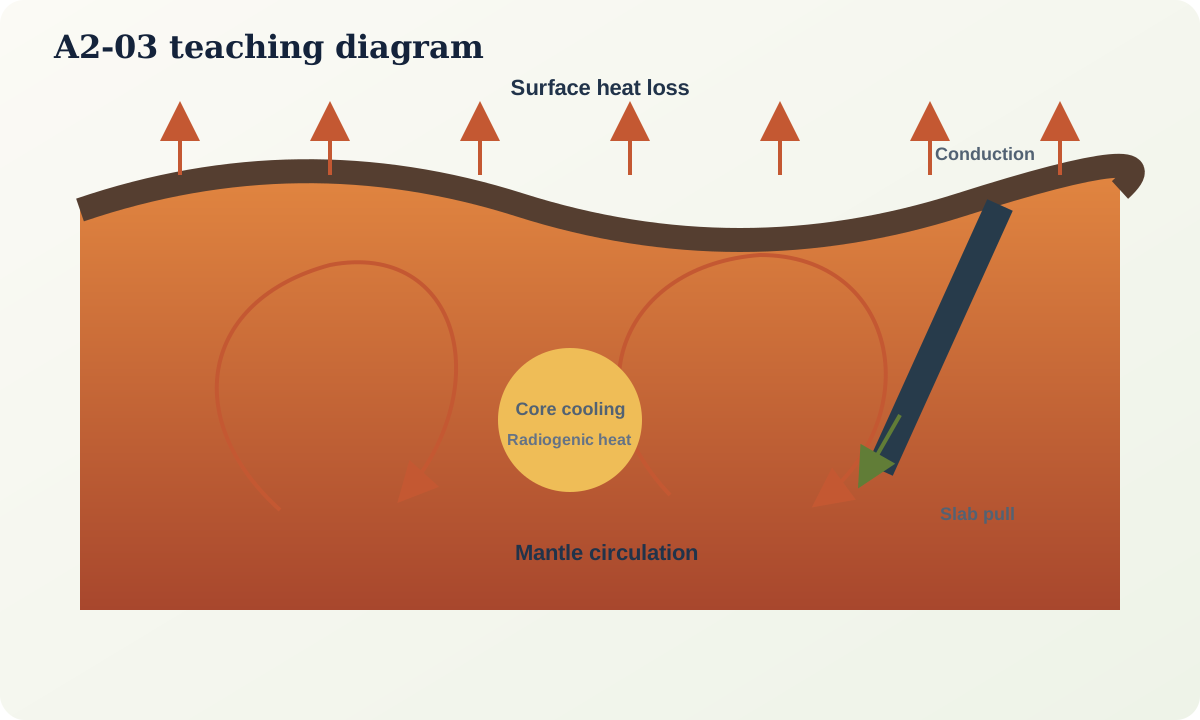
Earth inherited energy during accretion and differentiation. Gravitational energy released as material assembled and dense metal segregated toward the core contributed to early heating. Long-lived radioactive isotopes continue to produce heat. Crystallisation and secular cooling of the core release energy that helps maintain core convection and the magnetic field. Tidal dissipation is measurable but is not generally treated as the dominant driver of modern plate tectonics.
A heat budget must separate temperature, an intensive state variable, from heat, energy transferred because of temperature difference, and heat production, energy generated per unit time or volume. A small hot body can contain less total thermal energy than a much larger cooler one.
Conduction, advection and convection
In conduction, energy passes through material without bulk transport. Fourier's law in one dimension is
q=-k\frac{dT}{dz}
where q is heat flux and k is thermal conductivity. The minus sign indicates transfer down the temperature gradient. Conductive geotherms are especially important in the lithosphere.
Advection transports heat with moving material: magma ascent, hydrothermal fluid flow and plate motion are examples. Convection combines buoyancy-driven motion with heat transport. Solid mantle rock can convect because it deforms slowly over millions of years. The same material behaves elastically for a passing seismic wave, may fracture under rapid stress in the cold lithosphere, and flows viscously over geological time. Mechanical behaviour is time-, temperature-, pressure-, grain-size- and composition-dependent.
From buoyancy to circulation
Heating commonly lowers density through thermal expansion; cooling can increase it. Compositional differences and phase changes also affect buoyancy. A dimensionless measure of whether a layer is prone to thermal convection is the Rayleigh number,
Ra=\frac{\rho g\alpha\Delta T d^3}{\kappa\eta}
where \alpha is thermal expansivity, d layer thickness, \kappa thermal diffusivity and \eta viscosity. The equation shows why thick layers, large temperature differences and low viscosity favour convection. In Earth, properties vary strongly with depth, so one textbook value cannot capture the full circulation.
Mantle plumes are hypothesised buoyant upwellings used to explain some long-lived intraplate volcanic chains and large igneous events. Their depth, shape and role must be tested with tomography, geochemistry, plate reconstructions and volcanic age progressions. Not every intraplate volcano requires the same plume model.
What drives plates?
Plate motion is best represented as a torque and force balance. Important terms include:
- slab pull: negative buoyancy of cold, dense subducting lithosphere can pull the attached plate;
- ridge push or gravitational sliding: elevated ridge lithosphere cools and thickens away from the ridge, creating a potential-energy gradient;
- basal tractions: mantle flow can transmit shear to or from plates;
- trench suction and slab–mantle interaction: circulation around a slab can influence both plates and trench migration; and
- resistance: bending, fault friction, continental collision and viscous drag oppose motion.
“Convection currents carry plates like a conveyor belt” is an incomplete teaching metaphor. Plates are an active thermal boundary layer of mantle circulation. Subducting slabs can drive flow, and plates influence the circulation that also exerts traction on them.
Heat flow is a surface observation
Surface heat flow is estimated from the geothermal gradient and thermal conductivity. Local values are affected by groundwater movement, topography, recent sedimentation or erosion, radiogenic crustal rocks and magmatism. A high gradient in one borehole is not automatically evidence for shallow magma; low-conductivity rocks or fluid advection may contribute. Regional interpretation requires corrections, repeated measurements and geological context.
Oceanic lithosphere provides a powerful age–temperature relation: newly formed lithosphere near a ridge is hot and buoyant; as it moves away, it cools, thickens and subsides. Simple conductive cooling models predict systematic trends, while hydrothermal circulation and complex crustal structure create departures near ridges.
Worked example: competing explanations for a heat-flow anomaly
A cluster of boreholes has higher heat flow than surrounding measurements.
- Check units, conductivity method, borehole equilibrium and topographic correction.
- Map groundwater gradients and permeable structures; advective flow can redistribute heat.
- Examine radiogenic-element concentrations in crustal rocks.
- Compare volcanic ages, seismicity, electrical conductivity and seismic velocity before proposing active magma.
- State scale: a shallow local anomaly does not prove a mantle-scale plume.
The conclusion should rank explanations and name the observation that would discriminate them.
Practical investigation
Sketch temperature against depth for a conductive lithosphere overlying an approximately adiabatic convecting mantle. Add a second curve for a younger, thinner oceanic lithosphere. Mark where decompression melting might occur if upwelling mantle crosses its solidus. Explain every curve segment in words.
Mastery check
- How can solid mantle rock convect?
- What is the difference between a temperature gradient and heat flux?
- Why should slab pull, ridge forces and mantle traction be treated together?
- Name four causes of anomalous surface heat flow that do not require a deep plume.
Sources and further reading
- The Interior of the Earth, U.S. Geological Survey.
- This Dynamic Earth, U.S. Geological Survey.
- Earth tides, global heat flow, and tectonics, U.S. Geological Survey publication record.