A2 · Publication Volume 3
Geological Time and Deep-Time Thinking
eons, eras, periods, relative age, numerical age and the incomplete geological record
Learning objectives
After this lesson, you should be able to distinguish relative order from numerical age, use basic stratigraphic relations, read the hierarchy of the international time scale, explain what a dated mineral constrains, and represent hiatuses and age uncertainty honestly.
Time is inferred from records
Earth is approximately 4.54 billion years old. That number is an evidence-based estimate derived from isotopic systems in meteorites and ancient Earth materials, not a count of annual layers from the planet's beginning. Geological time is built by combining two complementary frameworks:
- relative chronology establishes older–younger relations and correlates records; and
- geochronometry estimates duration or time before present using calibrated physical clocks.
A geological history is strongest when several relations agree. A sedimentary bed may be older than a cross-cutting dyke, younger than the unit below an unconformity, correlated by fossils or magnetic polarity, and bracketed by dated ash beds. None of those observations should be silently replaced by a single “exact age.”
The hierarchy of time and rock
The International Chronostratigraphic Chart organises rock and time in nested ranks. A chronostratigraphic unit is a body of rock formed during a defined interval; the corresponding geochronologic unit is the interval itself. Common pairs are eonothem/eon, erathem/era, system/period, series/epoch and stage/age.
The present chart is maintained through an international stratigraphic governance process. Many Phanerozoic stage boundaries are defined by a Global Boundary Stratotype Section and Point (GSSP)—a physical reference point in a stratigraphic section chosen for correlatability. The numerical age beside a boundary is a calibrated estimate and may be revised; for the Phanerozoic and Ediacaran, the numerical value does not itself define the unit when a GSSP is ratified.
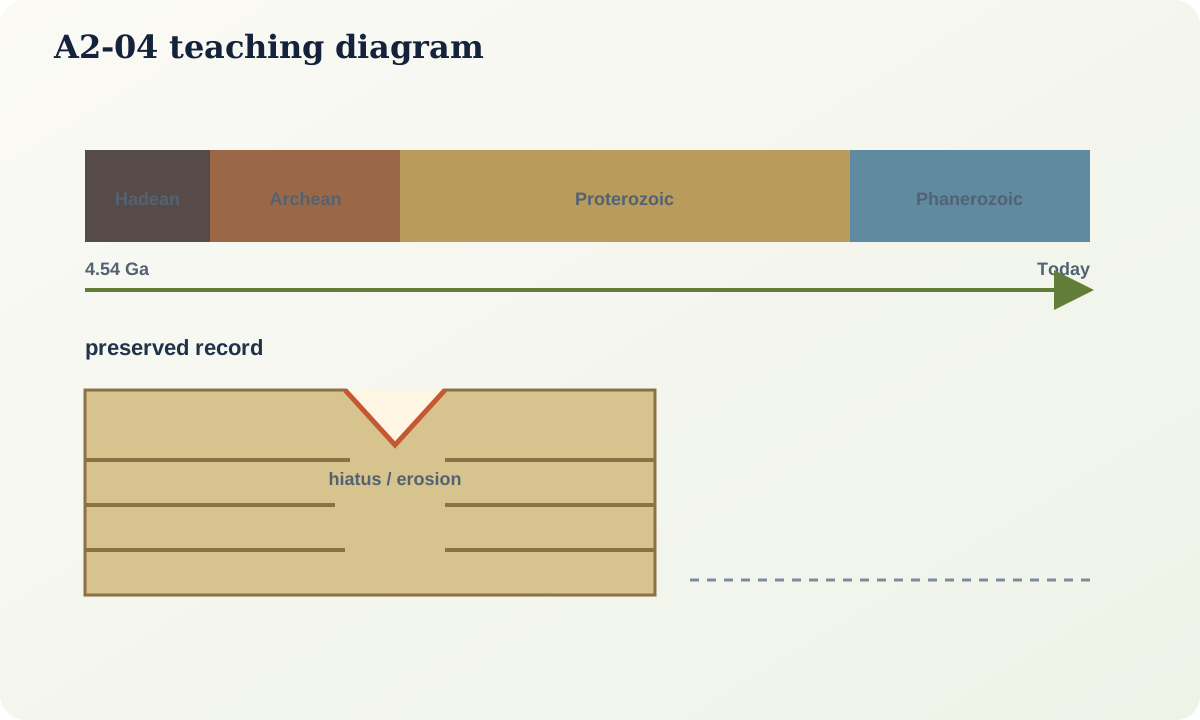
At broad scale, the Precambrian comprises the Hadean, Archean and Proterozoic eons; the Phanerozoic contains the Paleozoic, Mesozoic and Cenozoic eras. Memorising every boundary is less important than knowing how to consult the current chart and preserve its version.
Relative-age relations
Several principles turn geometry into order:
- superposition: in an undeformed sedimentary succession, lower beds are older than overlying beds;
- original horizontality and lateral continuity: sediments are commonly deposited in broadly horizontal, laterally connected layers, subject to primary slopes and facies changes;
- cross-cutting relations: a fault, dyke or erosion surface is younger than the features it cuts;
- inclusions: a clast is generally older than the rock that contains it; and
- fossil succession: characteristic fossil assemblages can order and correlate strata.
These are conditional rules, not mechanical shortcuts. Beds may be overturned, faults reactivated, clasts reworked and fossils redeposited. Contact metamorphism, way-up indicators, structural facing and regional continuity help test the assumptions.
Unconformities and missing pages
An unconformity records a surface or interval of non-deposition, erosion or both. Angular unconformities separate packages with different attitudes; disconformities separate broadly parallel sedimentary strata; nonconformities place sedimentary rock on eroded igneous or metamorphic basement. The missing duration can greatly exceed the time represented by adjacent preserved beds.
Absence is not a zero-duration event. A map that joins two ages across an unconformity must show the hiatus rather than interpolate a fictional continuous history. Preservation is selective: erosion removes records, metamorphism overprints them, and many environments leave little durable archive.
Numerical ages and what clocks record
Radioactive parent isotopes decay to daughter products at statistically predictable rates. In a simple closed-system formulation,
N=N_0e^{-\lambda t}, \qquad t_{1/2}=\frac{\ln 2}{\lambda}
Practical geochronology measures isotope ratios, uses mineral-specific systems and evaluates initial daughter components, common lead, alteration, inheritance and open-system behaviour. The analytical result has uncertainty; more importantly, its geological meaning depends on what event established or reset the isotopic system.
A zircon crystallisation age may date magma crystallisation. A metamorphic overgrowth may date later mineral growth. A cooling age may record passage through a temperature-sensitive retention interval. A detrital grain is older than or equal to the sediment that contains it; its youngest reliable population can constrain maximum depositional age, not automatically the exact deposition date. Different minerals in one rock can preserve different events.
Use Ma for a time before present (mega-annum) and Myr for a duration of one million years when the distinction matters; use Ga and Gyr analogously. State the reference convention and uncertainty.
Worked example: ordering an event sequence
An outcrop contains folded sandstone cut by a granite dyke. Both are truncated by an erosion surface and overlain by flat volcanic ash. Zircon from the dyke gives a crystallisation estimate of 410 \pm 3 Ma; zircon from the ash gives 252.1 \pm 0.2 Ma.
The defensible sequence is: sandstone deposition; lithification; deformation and folding; dyke intrusion at about 410 Ma; erosion and development of the unconformity; ash deposition at about 252 Ma; later exposure. The deformation is older than the dyke if the dyke is undeformed and cuts the folds. The hiatus spans an unknown portion of the interval between dyke emplacement and ash deposition. The data do not date sandstone deposition directly.
Scale exercise: compressing Earth history
If 4.54 Ga is represented by a 4.54 m line, 1 mm represents 1 Myr. The entire Phanerozoic occupies roughly the final half metre, and a human lifetime is visually negligible. This conversion helps expose a cognitive error: processes that appear slow at annual scale can transform plates, basins and mountain belts when integrated over millions of years.
Practical investigation
Build an event table for a published geological section. Columns should include event, direct relation, age constraint, dated material, interpreted geological meaning, uncertainty and alternative. Draw both a relative-order graph and a numerical timeline. If the evidence only brackets an event, show a range rather than a central point.
Mastery check
- Why are numerical boundary ages not always the formal definition of a time unit?
- What additional observations would you seek before applying superposition to steeply dipping beds?
- Explain the difference between a mineral age and the depositional age of its host sediment.
- Why must an unconformity be represented as an interval of missing record?
Sources and further reading
- International Chronostratigraphic Chart, International Commission on Stratigraphy.
- Global Boundary Stratotype Sections and Points, International Commission on Stratigraphy.
- Geologic Time, U.S. Geological Survey.
- Geologic age using radioactive decay, U.S. Geological Survey.