A2 · Publication Volume 3
Divergent, Convergent and Transform Settings
rifts, mid-ocean ridges, subduction, collision and transform boundaries
Learning objectives
After this lesson, you should be able to predict first-order structures and hazards at the principal boundary types, compare oceanic and continental convergence, relate relative-motion vectors to boundary geometry, and identify diffuse or evolving boundaries.
Classification begins with relative motion
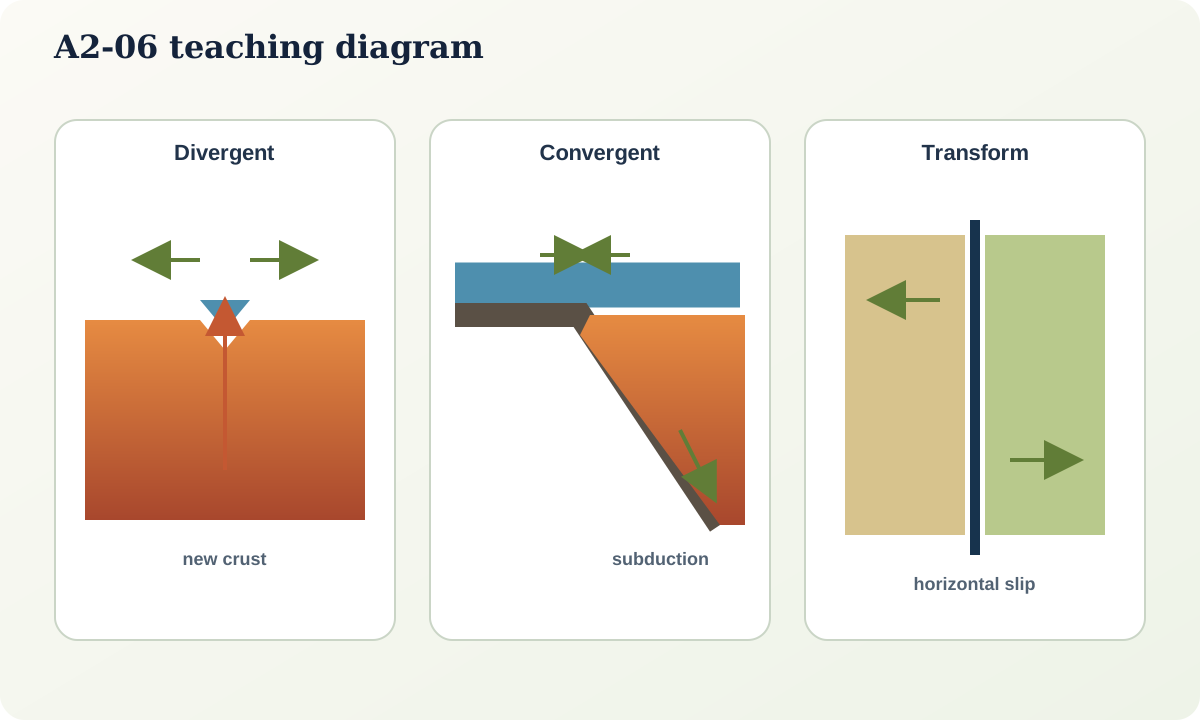
A boundary is divergent where plates separate across it, convergent where they approach, and transform where motion is predominantly parallel to the boundary. The categories describe kinematics. They do not, by themselves, specify every force, rock type or landform. Oblique motion can partition into strike-slip and dip-slip components, and a boundary can change character along strike or through time.
The local prediction comes from resolving relative velocity into components normal and parallel to the boundary. Convergence oblique to a margin may produce trench-normal shortening and margin-parallel shear. A map showing arrows without a reference frame or uncertainty cannot support that calculation.
Divergent settings
Continental rifting commonly begins with lithospheric extension, normal faulting, basin subsidence and possible magmatism. Extension thins crust and mantle lithosphere; asthenospheric upwelling can lead to decompression melting. Not every rift reaches breakup. Some become failed rifts preserved within continents.
Successful breakup develops a young ocean basin and spreading ridge. Ridge axes are segmented by transforms and non-transform offsets. Hydrothermal circulation removes heat and alters oceanic crust. Away from the ridge, cooling lithosphere thickens and subsides, allowing sediment to accumulate. Passive continental margins record rifting, breakup and post-rift thermal subsidence but are not active plate boundaries merely because continent meets ocean.
Typical first-order evidence includes normal faults, syn-rift wedges, high heat flow, mafic magmatism, axial bathymetry and shallow extensional earthquakes. Yet uplift can precede rifting and magmatism can be weak or absent; the evidence must be combined.
Oceanic subduction
At convergence involving oceanic lithosphere, the denser plate may descend into the mantle. The system can include an outer rise, trench, accretionary prism or erosive margin, forearc, volcanic arc and backarc. Earthquakes outline the plate interface and slab. Fluids released from the slab modify the mantle wedge and help generate arc magmas.
Subduction geometry varies with plate age, buoyancy, convergence rate, slab pull, overriding-plate motion and mantle flow. A shallowly dipping slab can shift deformation and magmatism far inland; rollback can extend the overriding plate and open a backarc basin. Accretion is not guaranteed: some margins remove material from the overriding plate.
Collision
When buoyant continental lithosphere reaches a subduction zone, sustained subduction of the continental crust is difficult. Shortening can thicken crust, stack thrust sheets, metamorphose rocks, uplift an orogen and redirect basins. Sutures may contain fragments of oceanic lithosphere, mélanges and high-pressure metamorphic rocks, but later deformation can obscure the original boundary.
Collision is a long sequence rather than one instant. Ocean closure, arc–continent interaction, initial continental contact, continued indentation, escape tectonics, gravitational collapse and erosion may overlap. The present topographic maximum need not coincide with the original suture.
Transform and strike-slip settings
Transform boundaries accommodate plate motion parallel to the boundary and connect other boundary segments. Oceanic transforms offset active ridge axes; the active transform lies between ridge tips, while the continuation beyond them is an inactive fracture zone recording past motion. Continental transform systems can be broad, branched and contain pull-apart basins or transpressional uplifts where bends or stepovers change the local motion.
Strike-slip faults are described by the apparent horizontal motion of the opposite block: right-lateral or left-lateral. Surface offset alone can be misleading if a feature was not originally straight or if multiple events occurred. Focal mechanisms, displaced markers, geodesy and mapped fault geometry should agree.
Triple junctions and diffuse boundaries
Where three plate boundaries meet, the geometry and boundary types control whether the junction can remain stable as plates move. Continental deformation commonly spreads across networks rather than a single line. Microplates, rotating blocks and distributed strain may be needed. A global plate polygon suitable for an ocean-basin reconstruction may erase deformation important to a city or mineral district.
Worked comparison
Suppose a coastal margin has a trench, landward volcanic chain, compressional focal mechanisms near the interface, deeper earthquakes dipping beneath the continent and GNSS vectors showing landward motion of the oceanic plate.
The joint evidence supports ocean–continent convergence with subduction. It does not by itself establish whether the margin is accreting or eroding, whether coupling is constant along strike, or when a future earthquake will occur. Those require sediment budgets, seismic imaging, geodetic locking models, palaeoseismology and explicit uncertainty.
Now suppose another coast has a thick passive-margin sedimentary wedge, no trench, little seismicity and oceanic crust that becomes older away from a distant ridge. The continent–ocean boundary there is a crustal transition inherited from breakup, not an active plate boundary.
Practical investigation
For each boundary type, build a prediction matrix with rows for topography, crustal thickness, heat flow, earthquake depth, focal mechanism, magmatism, basin type and metamorphic conditions. Mark each prediction as common, possible or diagnostic. Test the matrix against three public regional profiles and record exceptions.
Mastery check
- Why is a passive continental margin not necessarily a plate boundary?
- How can oblique convergence be partitioned?
- What distinguishes an active oceanic transform from a fracture zone?
- Name two observations needed to decide whether a subduction margin is accretionary or erosive.
Sources and further reading
- Understanding Plate Motions, U.S. Geological Survey.
- This Dynamic Earth, U.S. Geological Survey.
- Subduction Zone Science, U.S. Geological Survey.