A2 · Publication Volume 3
Crustal Formation, Accretion and Reworking
continental growth, island arcs, terrane accretion, cratons and orogeny
Learning objectives
After this lesson, you should be able to distinguish juvenile crustal addition from reworking, explain terrane accretion and cratonisation, use age and isotope evidence cautiously, and reconstruct a multi-event crustal history without treating a present map unit as a single-age object.
Continents are archives assembled through time
Continental crust is compositionally and mechanically heterogeneous. Some material represents addition from the mantle; some is older crust melted, metamorphosed, deformed or eroded and redeposited; much records mixtures. A continent therefore has no single formation age. Its map pattern is a palimpsest of crustal fragments, magmatic belts, sedimentary basins, sutures and younger cover.
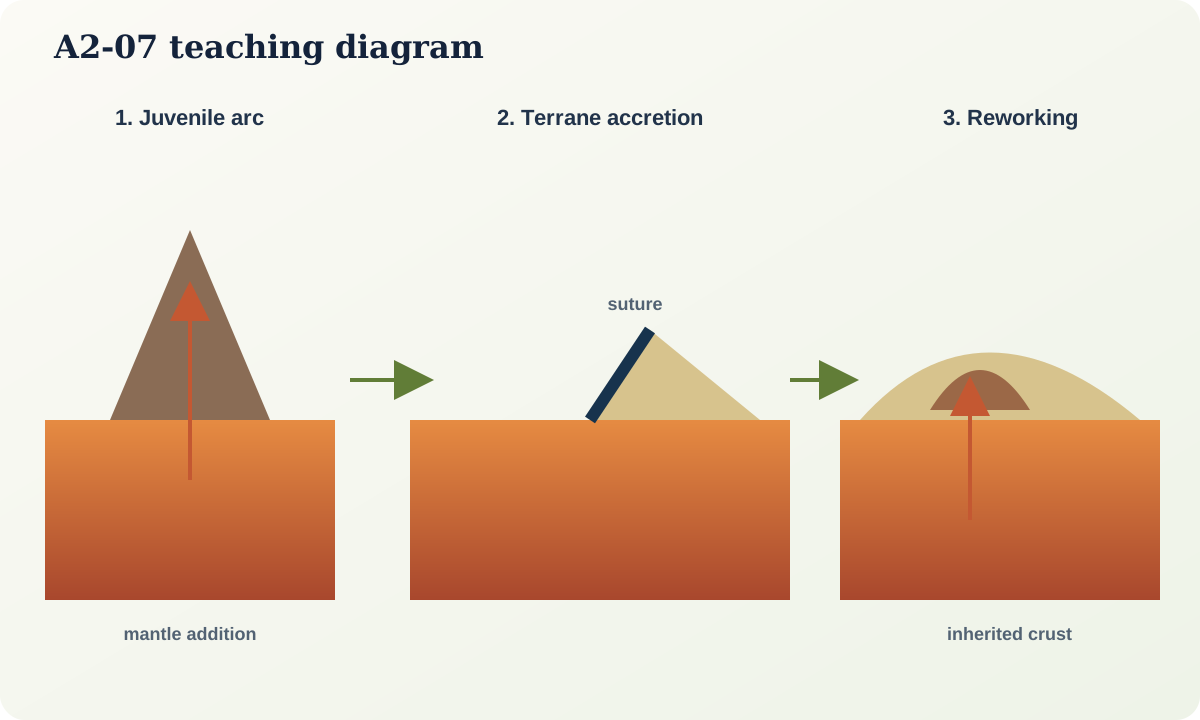
Juvenile crust refers to material newly separated from the mantle on the time scale of interest. Reworked crust contains a substantial inherited crustal component. A granite crystallisation age dates emplacement, but its magma may contain older crust. Detrital zircon ages can reveal source components that are not exposed at the present surface. Isotope systems and trace elements help estimate source character, but model ages depend on assumptions about reservoir evolution and mixing.
From oceanic arcs to continental material
Subduction-related magmatism transfers mantle-derived and slab-influenced material into arcs. Repeated intrusion, differentiation, sediment incorporation and lower-crustal processing can build compositionally evolved crust. Some arcs remain oceanic; some collide with a continent; some are removed by subduction erosion. Crustal growth is therefore a balance between addition and destruction, not a monotonic curve.
Arc rocks may be recognised by spatial relations, age progression, geochemistry, volcanic–plutonic associations and deformation history. No single discrimination diagram proves tectonic setting because composition can converge and alteration can move elements. Use multiple immobile-element ratios, petrography, isotope data and field relations.
Terranes and accretion
A terrane is a fault-bounded crustal block whose geological history differs from adjacent blocks enough to suggest displacement or independent evolution. It may include an arc, oceanic fragment, continental sliver or sedimentary complex. A terrane interpretation should specify the mismatch: stratigraphy, fossil province, palaeomagnetic latitude, metamorphic history, geochronology or structural boundary.
Accretion attaches such material to a continental margin. A suture may contain ophiolitic fragments, mélanges, high-pressure rocks and major shear zones, but later deformation and magmatism can blur it. Similar rocks on opposite sides do not rule out a suture; different rocks do not automatically prove one. The hypothesis is a regional reconstruction tested by timing and kinematics.
Cratons and lithospheric roots
A craton is a long-lived, relatively stable region of continental lithosphere, commonly containing Archean or Proterozoic crust and a thick mantle root. Stability is relative: cratons can be faulted, covered by basins, intruded, eroded and locally reactivated. The term should not imply that nothing happened after stabilisation.
Cratonisation involves development of strong, buoyant lithosphere through crustal differentiation, mantle depletion, cooling and tectonic assembly. Seismic velocity, xenoliths, gravity, heat flow and magnetotellurics constrain the root. Surface basement age alone does not map its full subsurface extent.
Orogeny as assembly and reworking
An orogeny is an extended episode of tectonic processes that builds and modifies an orogenic belt. Shortening, thickening, metamorphism, magmatism, strike-slip motion, uplift, erosion and later extension may all occur. The name of an orogeny is a regional organising label, not a universal synchronous event.
Metamorphic pressure–temperature–time paths can reveal burial and exhumation; igneous ages can track magmatic pulses; structural overprinting establishes sequence. These clocks may differ because they record different processes. A single “orogenic age” should be replaced by an event table.
Worked example: three age populations
A granitoid yields a crystallisation age near 520 Ma, inherited zircon cores near 1.8 Ga and a whole-rock isotope signature intermediate between depleted mantle and old crust. Nearby metasediment contains detrital zircon populations at 2.5 Ga, 1.8 Ga and 650–540 Ma.
A defensible interpretation is that 520 Ma magmatism incorporated older crustal material, while sediment sources included several crustal provinces. This does not prove that 2.5 Ga basement lies directly beneath the sample. Grains could have travelled through recycled sediment, and isotope mixing is non-unique. Mapping, Hf or Nd isotope data, xenocryst textures, regional geophysics and structural relations can discriminate models.
Practical investigation
Create a “crustal accounting” diagram for a chosen orogen. For each interval, estimate whether the dominant process is juvenile addition, recycling, lateral accretion, loss to the mantle, erosion or uncertain. Attach an observable to every classification. Where the same evidence supports two processes, show both paths.
Mastery check
- Why does granite crystallisation age not equal crust-formation age?
- What makes a terrane more than any fault-bounded map unit?
- Why is cratonic stability a relative concept?
- How can detrital grains record sources that are no longer exposed nearby?
Sources and further reading
- Australian Geological Provinces, Geoscience Australia.
- Continental Geology, Geoscience Australia.
- Precambrian: the story of the early Earth, U.S. Geological Survey.