A2 · Publication Volume 3
The Rock Cycle and Global Element Cycles
magmatism, sedimentation, metamorphism, weathering and cycle timescales
Learning objectives
After this lesson, you should be able to treat the rock cycle as a network rather than a loop, distinguish material state from process, connect tectonics to water and element cycles, and write a mass-balance model that respects different time scales.
Rocks are states within a process network
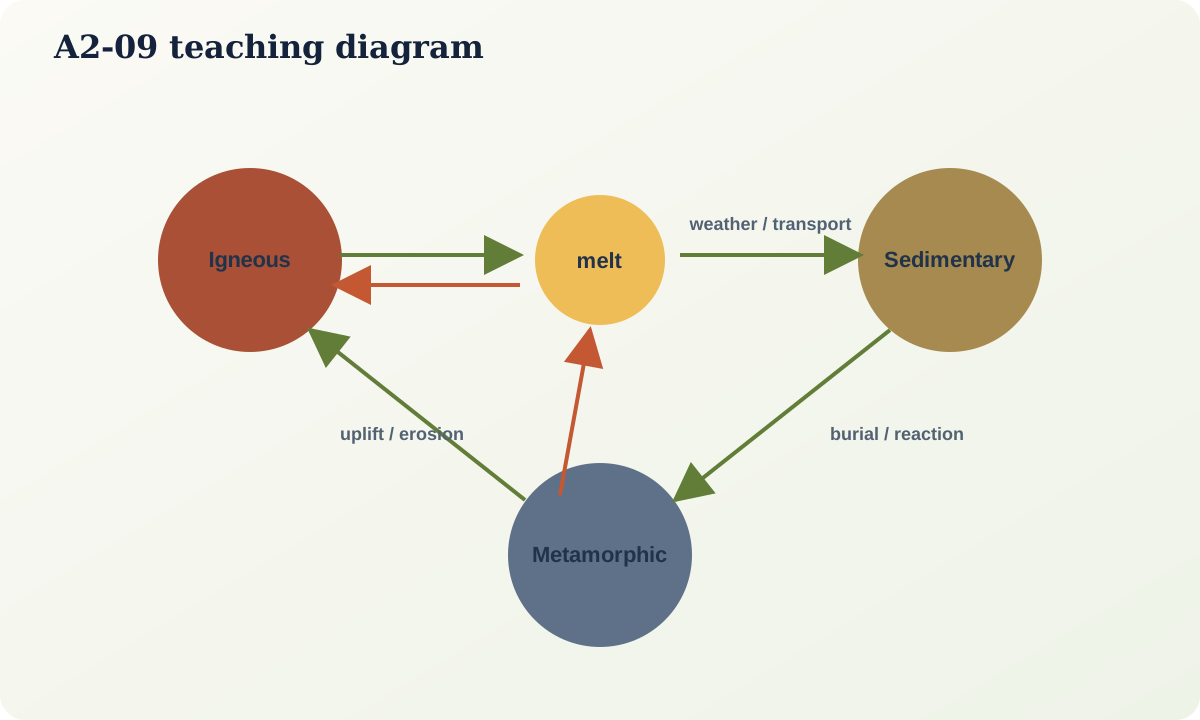
Igneous, sedimentary and metamorphic are origin-based rock classes. Igneous rocks crystallise from melt. Sedimentary rocks form by deposition and lithification of particles, chemical precipitates or biological material. Metamorphic rocks form when pre-existing rock is transformed in the solid state by temperature, pressure, stress and reactive fluids.
The familiar triangular rock cycle is useful only if its arrows are taken seriously. Any rock can follow several pathways; there is no required clockwise route. Granite can weather into sediment, melt, or metamorphose without first becoming sedimentary rock. Metamorphic rock can be exhumed and eroded without melting. Some material remains in one state for billions of years; another grain passes through several reservoirs rapidly.
Processes that move material
Key transitions include melting, crystallisation, eruption, intrusion, weathering, erosion, transport, deposition, burial, compaction, cementation, metamorphism, deformation, exhumation and uplift. These verbs should replace vague statements such as “rock turned into another rock.” Each process has boundary conditions and characteristic products.
Tectonics reorganises the network. Rifting and subduction generate magmatism; collision buries and metamorphoses crust; uplift exposes rock to weathering; basins preserve sediment; subduction carries altered crust and sediment into the mantle. Surface climate and life control weathering and sediment production, so the cycle couples internal and external energy systems.
The water cycle is a geological agent
Water is stored in oceans, ice, atmosphere, lakes, rivers, groundwater, minerals and pore spaces. Solar energy and gravity drive much of the surface cycle; permeability and pressure gradients control subsurface flow. Water reacts with minerals, transports solutes and particles, affects melting in subduction zones and facilitates metamorphic reactions.
Fluxes span enormous time scales. A storm hydrograph may change in hours, groundwater residence can extend much longer, and water incorporated into minerals can enter deep-Earth pathways. Combining these in one undifferentiated “water cycle” hides the controlling reservoirs.
Carbon and other elements
Carbon moves among atmosphere, ocean, organisms, soils, sediments, carbonate and organic rocks, magma and mantle. Silicate weathering consumes dissolved carbon dioxide through coupled reactions and ultimately transfers carbon to carbonate sediment, while metamorphism and volcanism can return carbon to the surface system. The strength and sign of feedbacks depend on rate, area, climate, erosion, biology and ocean chemistry.
Other elements have different affinities and transport mechanisms. Some remain in resistant minerals during weathering; some dissolve; some adsorb to iron oxides or clays; some partition into melt or fluid. “Element cycle” does not mean every atom samples every reservoir. It means the budget is traced across defined pathways.
For a reservoir i with concentration C_i and mass M_i, element inventory is I_i=C_iM_i. Transfer flux should preserve both material mass and concentration units. Mixing two sources gives, in a simple conservative case,
C_m=\frac{M_1C_1+M_2C_2}{M_1+M_2}
Reactions, phase separation and preferential transport break the conservative assumption and require additional terms.
Cycles, spirals and irreversible histories
At global scale matter is reused, but a local geological history is not perfectly cyclic. Plate configurations change, biological evolution introduces new processes, atmospheric composition evolves, and a specific mineral can be destroyed. It is often better to draw a network through time than a circle. The global budget may be approximately closed for an element while local systems are open.
Worked example: a volcanic arc sediment
An arc volcano produces ash. Weathering releases dissolved ions and clay; rivers move detritus to a forearc basin; burial compacts and cements the sediment; subduction later metamorphoses part of the package, while another part is accreted and uplifted.
Potential archives include zircon crystallisation ages, detrital grain populations, clay mineralogy, stable isotopes, sedimentary structures and metamorphic assemblages. Each samples a different transition. A zircon may survive several rock cycles, so its age can be much older than the sandstone, while cement isotope composition can record later pore fluid.
Practical investigation
Select one element—carbon, sulfur, phosphorus, iron or uranium. Draw reservoirs and fluxes for a specified spatial and temporal boundary. Give units, identify external inputs and outputs, and mark processes that fractionate isotopes or change oxidation state. Then state which observations could estimate the three largest fluxes.
Mastery check
- Why is the rock cycle better represented as a network?
- Give two ways plate tectonics changes a surface element cycle.
- Why can grain age and host-rock age differ greatly?
- What assumption underlies the simple two-source mixing equation?
Sources and further reading
- Rocks and Geology, U.S. Geological Survey.
- The Water Cycle, U.S. Geological Survey.
- Earth System Science Research, NASA Science.