C1 · Publication Volume 11
Ore, Gangue, Mineralisation and Deposit
terminology boundaries and the economic conditions attached to each term
Learning goals
After this lesson, you should be able to use ore, gangue, mineralisation, occurrence, deposit, resource and reserve without silently treating them as synonyms. You should be able to identify whether a statement is mineralogical, geological, estimational or economic, and rewrite claims whose evidential level is unclear.
The lesson also develops relational terminology. The same mineral can be a valuable product in one context, a gangue mineral in another and a penalty-bearing phase in a third. “Ore mineral” and “gangue” are therefore not permanent taxonomic ranks; they describe roles under stated objectives and processing conditions.
Mineral species, commodity and material role
A commodity is the material or property sought. It may be an element, mineral, compound, rock, industrial property or energy-bearing material. A commodity mineral hosts a desired component or provides the desired property. An ore mineral is a commodity-bearing mineral considered relevant to extraction under the stated context.
Gangue describes minerals or material not recovered as the target product in that context. Gangue is not necessarily worthless or harmless. It controls hardness, liberation, acid consumption, water behaviour, tailings properties and separation response. A phase treated as gangue in one flowsheet could become a by-product source in another, while a valuable mineral may be unrecoverable at the available grain size.
Use mineral names only when mineral identity is supported. An elemental assay cannot by itself distinguish sulfide, oxide, carbonate, silicate, adsorbed or lattice-bound forms. Those forms may have different geological origins and processing behaviour.
Occurrence, mineralisation and deposit
An occurrence is a documented presence of a mineral, element or material of interest. Mineralisation refers to a natural concentration or the processes and products that produced it. It can be weak, discontinuous or subeconomic and still be geologically informative. A mineralised intersection is a sampled interval, not automatically a mineralised body.
A mineral deposit has spatial and genetic coherence sufficient to describe a natural concentration. The boundary may be geological, grade based or both, but must be declared. Deposit names can refer to process, morphology, host, commodity or an analogue; those naming systems may overlap imperfectly.
The term ore deposit adds an economic implication. In careful writing, use it only when the context supports that implication or when referring to an established deposit class as a historical technical term. For early-stage evidence, “mineral occurrence,” “mineralised system” or “deposit hypothesis” is usually more precise.
Resources, reserves and modifying factors
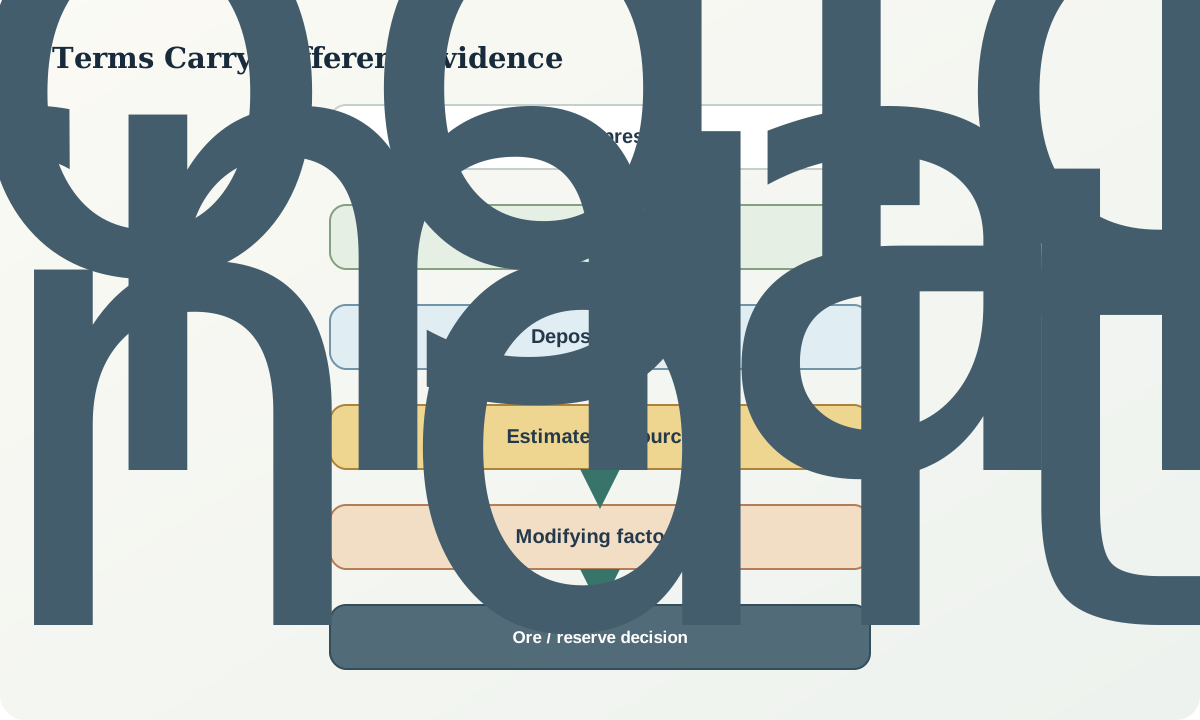
A mineral resource is not merely a sum of samples. Formal frameworks require geological evidence, continuity, quantity, grade or quality and reasonable prospects under defined competence and disclosure rules. A reserve is not all of a resource; it is the economically mineable part supported by study and modifying factors under the applicable code.
Modifying factors can include mining method, dilution, recovery, processing, infrastructure, marketing, legal, environmental, social and governmental considerations. This list is not a calculation template and does not guarantee approval or feasibility. It shows why geology is necessary but insufficient for an economic conclusion.
Terminology must follow the jurisdiction and purpose. This tutorial does not assign formal classifications. Its role is to teach the evidence boundaries that make formal terms meaningful.
Relational and temporal meanings
Economic labels change with knowledge and context. Improved metallurgy may make a previously unusable mineral assemblage relevant; costs, prices, infrastructure or regulation may change; further drilling may increase or reduce continuity. The geology does not retroactively change, but the justified decision category can.
This temporality is why an archive should preserve geological observations independently of economic labels. If a database field records only “ore” or “waste,” later users cannot reconstruct the mineralogy, grade, density, recovery assumptions or decision basis. Store measured properties and decision versions separately.
Relational language also avoids moral or quality judgements. “Gangue” does not mean geologically unimportant. Gangue assemblages may record fluid composition, temperature, wall-rock reaction and paragenesis more clearly than the commodity minerals.
Evidence and reporting design
Write each claim with an object, qualifier and basis. “Chalcopyrite occurs in quartz veins” is mineralogical and textural. “The interval contains 0.8% copper over 4 m downhole” is analytical and geometric, but requires sampling details and true-width caution. “The domain is a resource” is a formal estimation claim. “The material is ore” is an economic claim.
Do not infer a formal category from colour coding, internal jargon or historical labels. A mine map may use “ore” operationally; an old report may use “orebody” descriptively. Quote the original term when needed, then state the meaning supported by current evidence.
Negative assays do not necessarily mean absent mineralisation if the wrong commodity, mineral form, size fraction or analytical method was tested. Conversely, a geochemical anomaly does not demonstrate a deposit. The evidence must be appropriate to the claim.
Worked synthetic example
A synthetic outcrop contains visible sulfide grains. Three channel samples return 0.12%, 0.09% and 0.15% of commodity X over one metre each. Mineralogy confirms that most X is hosted in mineral P, and mapping traces the altered horizon for 80 m, but its thickness and continuity below cover are unknown. No density, recovery or processing work exists.
The observations support the following statement: “Mineral P-bearing mineralisation occurs within an altered horizon and is confirmed by three one-metre channel samples.” They may support a mineralised occurrence and a testable deposit hypothesis.
They do not support “an orebody contains economic grade.” “Orebody” assumes spatial coherence and economic relevance; “economic grade” requires a context-dependent cut-off and modifying-factor understanding. Even the arithmetic mean, 0.12%, needs a sampling-support caveat. A responsible next step is to test geometry, continuity, mineral variability and background, not to strengthen the adjective.
Interpretation workflow
- Identify whether the statement concerns mineral identity, concentration, geometry, estimation or economics.
- Define the object and observation support.
- Use occurrence and mineralisation for documented geological evidence.
- Use deposit when spatial coherence is supported and the intended meaning is clear.
- Reserve formal resource and reserve terms for compliant work under the applicable framework.
- Treat ore and gangue as context-dependent material roles.
- Preserve original measurements separately from changing decision labels.
- Replace promotional adjectives with quantities and uncertainty.
- State what evidence would be required to move to the next category.
Practice and review
- Classify ten statements from a technical report as mineralogical, geological, estimational or economic.
- Rewrite “high-grade ore was discovered” when the only evidence is one anomalous grab sample.
- Give two examples in which a gangue mineral is essential evidence for the mineralising process.
- Explain why a by-product can change the role of a mineral without changing its crystal structure.
- Design database fields that preserve both measured geology and a versioned material-destination decision.
Sources and further reading
- Introduction to Mineral Deposit Models, discusses the scope and naming of deposit models.
- Ore and gangue terms in the Mineral Deposit Models index, a public technical index illustrating historical usage.
- Geochemical anomaly guidance in Mineral Deposit Models, shows why an anomaly is evidence to investigate rather than proof of a deposit.
- CRIRSCO International Reporting Template, formal distinctions among exploration results, resources and reserves.