C1 · Publication Volume 11
The Mineral Systems Framework
source, pathway, trap, preservation and critical processes
Learning goals
After this lesson, you should be able to formulate a mineral system as linked source, transport, focusing, trap and preservation processes operating at appropriate scales. You should distinguish critical processes from convenient descriptive features and convert a process hypothesis into predicted observations.
You should also be able to build competing system models. A mineral-systems framework is most valuable before a deposit is classified, because it asks what must have happened and what evidence could remain. It is not a licence to label every favourable-looking feature as part of one preferred story.
System boundary, scale and event sequence
A mineral system is a set of geological processes that mobilises, transports and concentrates material, then preserves enough of the product to be observable. Its boundary depends on the question. A source region may extend across crustal domains; a pathway network may span a basin or orogen; a trap may operate at vein, intrusion-contact or stratigraphic scales.
Scale mismatches are diagnostic. A district-scale heat source cannot be inferred from a centimetre vein alone. A regional fault may create permeability yet never carry the mineralising fluid. A local chemical trap cannot form a deposit if the upstream system supplied insufficient metal or ligand.
Sequence matters. Source preparation may precede fluid generation; pathways can be repeatedly opened and sealed; traps can migrate; later deformation may dismember the system. Build an event graph with relative and, where available, absolute time constraints.
Source, driver and transport medium
The source supplies commodity components, sulfur or other reactive species, water, carbon, salts or ligands. A source is not established merely because it contains the element: mass, release mechanism and timing must be adequate. Potential sources include magmas, devolatilising rocks, basinal sediments, evaporites, seawater, meteoric water or weathered parent material, depending on the system.
The driver supplies energy or potential gradients. Cooling magma, metamorphic devolatilisation, topography, compaction, density contrast and pressure change can move melts or fluids. Transport requires a medium and chemical capacity. Ligands, oxidation state, temperature, pH and salinity govern what can be carried.
Evidence may include source fertility, melt or fluid inclusions, isotopes, mineral chemistry, alteration mass balance and temporal coincidence. Each line has non-unique interpretations, so source attribution should be expressed probabilistically and tested against mass balance.
Pathway, focusing, trap and preservation
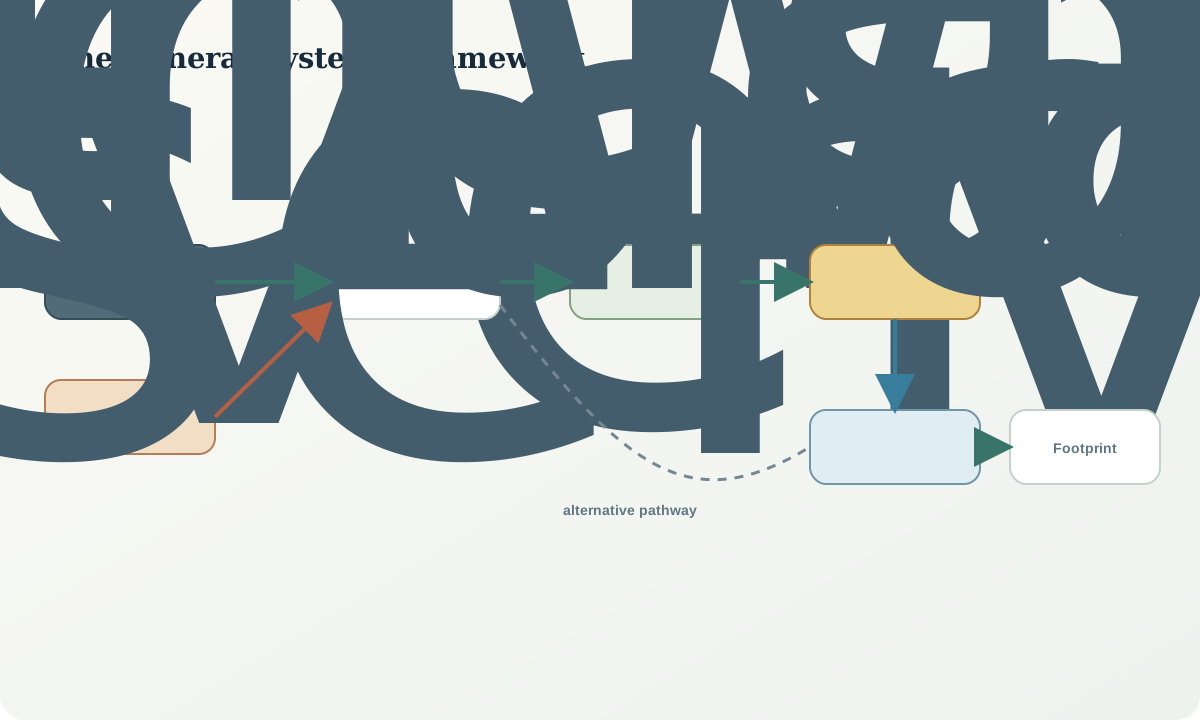
Pathways include permeable strata, faults, fractures, intrusive contacts, porous regolith, melt conduits and fluidised zones. Permeability is dynamic: reaction, deformation and pressure can open or seal it. A mapped fault is therefore a candidate pathway, not proof of transport.
Focusing converts distributed flux into local throughput. Fault intersections, permeability contrasts, conduit geometry and buoyancy can focus flow. A trap causes concentration through cooling, depressurisation, fluid mixing, boiling, redox change, sulfidation, neutralisation, crystallisation, immiscibility, adsorption or mechanical sorting.
Preservation protects or transforms the product. Burial may preserve a seafloor system; uplift may erode it; metamorphism can redistribute minerals; weathering can destroy primary sulfides yet create supergene enrichment. Exploration observes the surviving system, not the original system unmodified.
Critical processes and mappable proxies
A critical process is one whose failure prevents the targeted concentration at the required scale. It is not simply a common attribute. For example, a source of metal is necessary, but high source concentration may not be; efficient extraction from an ordinary source could suffice. A large fault may be helpful but not necessary if distributed permeability carried fluid.
Because processes are rarely observed directly, exploration uses proxies. A proxy is valuable when its causal link, scale and preservation are understood. Magmatic age can proxy timing, alteration mineralogy can proxy fluid-rock conditions, structural architecture can proxy focusing, and geochemical gradients can proxy transport or reaction.
Classify proxies as necessary, supporting, ambiguous or refuting. A necessary proxy must be expected if the model is true and detectable if preserved. “Absent” evidence is only refuting when detection power is adequate. This prevents untested absence from being treated as proof.
Evidence architecture and test design
Build a matrix with models as columns and observations as rows. Include source lithology, age, structure, alteration, mineralogy, geochemistry, geophysics, depth extent and preservation indicators. For every cell record the predicted sign, scale, detectability and alternative causes.
Choose tests by discrimination, not by the amount of data they produce. A test that all candidate models predict has low discriminatory value even if precise. A modest observation that one model requires and another forbids may be decisive. Sequence tests so that inexpensive, broad observations first constrain system architecture before narrowly targeting a product.
The framework also reveals missing links. A perfect trap without a plausible source and transport path is incomplete. A fertile source and pathway without a precipitation mechanism predicts dispersion rather than concentration. Do not fill a missing link with an analogue; mark it as a hypothesis.
Worked synthetic example
In a synthetic covered district, magnetic intrusions of unknown age occur beneath a basin margin. Regional faults cut the basement, and scattered copper-bearing veins occur in cover rocks. Three competing models are proposed:
- Model A: intrusion-driven hydrothermal system; predicts coeval intrusive and alteration ages, outward alteration zoning and focused upward pathways.
- Model B: basin-brine system; predicts stratigraphic fluid reservoirs, basin-scale brine indicators and fault-controlled discharge unrelated to intrusion age.
- Model C: mechanically reworked older mineralisation; predicts detrital or clastic textures, age inheritance and no coherent hydrothermal alteration halo.
Magnetics alone support none uniquely. A cross-cutting alteration vein dated younger than sedimentation but matching the intrusion would favour A. Saline inclusions plus basinward alteration gradients might favour B. Rounded mineralised clasts and an older inherited mineral age would favour C. The example produces a test plan, not a winner: first determine textures and age relations, then choose fluid and geochemical analyses targeted to the remaining alternatives.
Interpretation workflow
- Define the commodity-independent process question and system boundary.
- Draw the event sequence from source preparation to preservation.
- Specify source mass, release mechanism and timing.
- Identify driver, transport medium, ligand or carrying mechanism.
- Map candidate pathways and focusing structures at compatible scales.
- State the trap reaction or physical concentration mechanism.
- Predict preservation, destruction and overprint.
- Build at least two competing models with discriminating observations.
- Update the model only after recording both supporting and contrary evidence.
Practice and review
- Convert a deposit-description checklist into source, pathway, trap and preservation processes.
- Identify a scale mismatch in a model that links one mineral grain directly to a continental source.
- Design one high-discrimination test for each pair among Models A, B and C.
- Explain when absence of alteration is refuting and when it is merely unobserved.
- Draw an event graph for a primary deposit later weathered and structurally displaced.
Sources and further reading
- Wyborn, Heinrich and Jaques, Australian Proterozoic mineral systems, formulates essential ingredients and mappable criteria.
- Geoscience Australia record of the mineral-systems framework, a public primary document for the framework.
- McCuaig, Beresford and Hronsky, Mineral systems and exploration targeting, develops scale, process and targeting implications.
- Mineral Deposit Models, Bulletin 1693, a complementary collection of descriptive and genetic models.