C1 · Publication Volume 11
Magmatic Deposits
nickel–copper–PGE, chromite and iron–titanium–vanadium systems
Learning goals
After this lesson, you should be able to compare magmatic nickel-copper-PGE sulfide, stratiform chromite and iron-titanium-vanadium oxide systems using melt source, saturation, segregation, transport, accumulation and preservation. You should understand why magma composition alone does not determine a deposit.
You should also be able to use textures and mass balance to test whether minerals crystallised from silicate melt, segregated as an immiscible liquid, accumulated mechanically, were modified by later fluids, or record several stages.
Fertile magma and dynamic conduits
A potentially fertile magma must contain or acquire the relevant components, but concentration commonly depends on dynamic flow. Partial melting controls initial metal budget; sulfide retention in the source can suppress chalcophile transfer; chromite or oxide saturation depends on pressure, oxygen state, temperature and melt composition.
Conduits repeatedly replenished by magma can process a mass far larger than the final intrusion. Country-rock assimilation may change sulfur or silica activity and trigger saturation. Mixing of magmas can move composition across a phase boundary. Cooling and decompression also change solubility.
Therefore, a small mineralised body may record a large through-flow system, while a large intrusion may remain weakly mineralised. Architecture, replenishment indicators and mass balance are as important as the final rock composition.
Sulfide saturation and nickel-copper-PGE systems
When an immiscible sulfide liquid separates from silicate melt, chalcophile elements can partition strongly into it. The outcome depends on when saturation occurs, how much silicate melt interacts with the sulfide, whether droplets settle or are advected, and whether fresh magma replenishes the system.
The R factor is the mass ratio of silicate melt that equilibrates with a mass of sulfide liquid. High R can expose sulfide to a large metal reservoir, but a numerical R inferred from metal ratios depends on partition coefficients, initial composition and equilibrium assumptions. Early sulfur saturation in the mantle or deep plumbing system can strip metals before the prospective level.
Textures include disseminated droplets, net-textured sulfide between silicate grains, massive accumulations and remobilised veins. Cross-cutting sulfide may be late magmatic or structurally remobilised; texture, mineral chemistry and timing must decide.
Chromite and iron-titanium-vanadium oxide accumulation
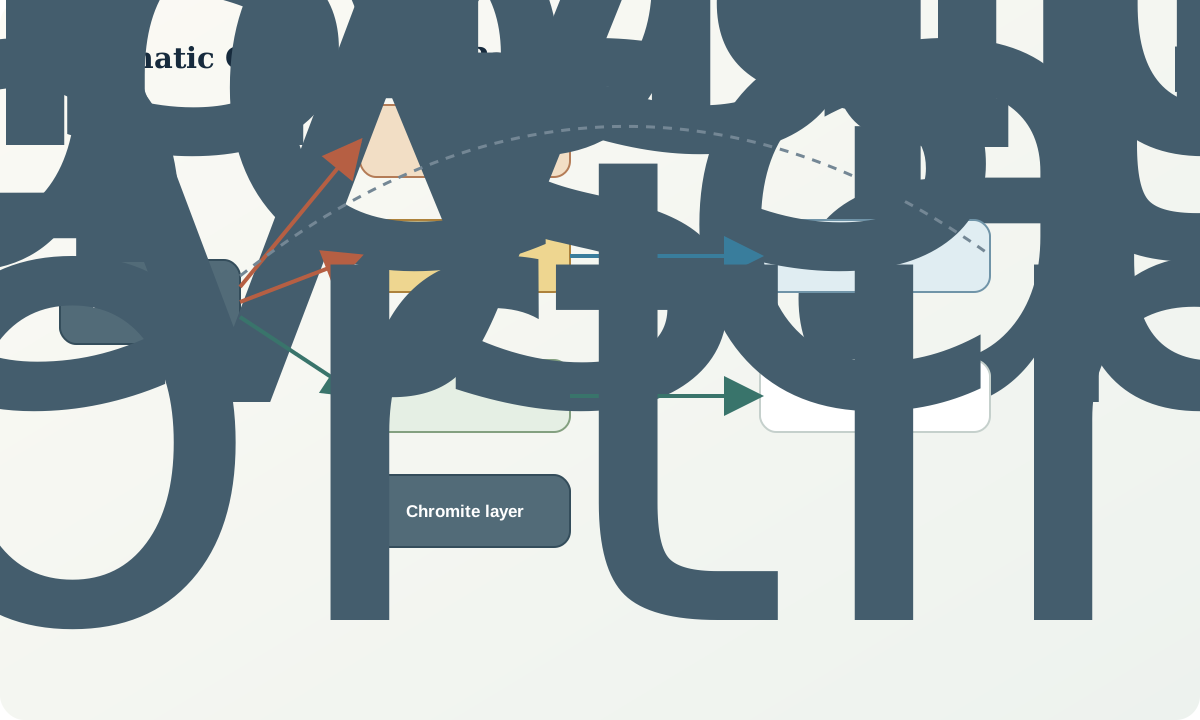
Chromite layers in layered intrusions can reflect changes in magma composition, pressure, oxygen state, mixing, contamination and crystal sorting. A laterally extensive seam need not represent simple quiet settling. Nucleation, re-equilibration and density currents can organise crystals.
Iron-titanium oxides may crystallise as cumulates from evolved magma, form oxide-rich layers or segregations, or be modified by exsolution and subsolidus re-equilibration. Vanadium distribution depends strongly on oxidation state and mineral chemistry. Bulk magnetic response can help map oxide-rich rock but cannot identify grade or mineral chemistry by itself.
For both families, distinguish cumulus grains formed and accumulated during crystallisation from intercumulus minerals, trapped liquid products and later alteration. Textural order can be modified after accumulation, so use multiple scales.
Evidence for process and timing
Field architecture should establish contacts, feeder relationships, layering, cross-cutting bodies and deformation. Petrography tests droplet shapes, grain boundaries, cumulus frameworks, inclusions, exsolution and replacement. Mineral chemistry maps zoning and element residence. Whole-rock data provide mass balance only when representative and corrected for alteration.
Isotopes and country-rock xenoliths may test contamination, but mixed sources can produce non-unique signatures. Ages should target the event of interest: intrusion emplacement, sulfide crystallisation or later remobilisation may not be recorded by the same mineral.
Potential-field data constrain geometry and physical contrast, not deposit class. A magnetic anomaly may reflect barren magnetite, lithological background or remanence. Conductivity may reflect sulfide, graphite, saline fluid or clay. Geological calibration is essential.
Worked synthetic example
A synthetic magma batch of 1,000,000 t contains 120 ppm nickel. After early crystallisation, 70% of the original nickel remains in 600,000 t of mobile silicate melt. The mobile melt therefore contains
$C_{Ni}=\frac{(1000000)(120\times10^{-6})(0.70)}{600000}=140\ ppm.$
Suppose 1,200 t of sulfide liquid segregates and the simplified effective sulfide/silicate partition coefficient is 400. If a mass M_s of silicate melt equilibrates fully with the sulfide, a closed two-reservoir balance would be required; simply multiplying 140 ppm by 400 to claim 5.6% nickel ignores depletion of the silicate reservoir and the interacting mass.
For illustration, let 60,000 t of melt interact (R=50). With equilibrium C_{sulf}=DC_{sil} and total nickel =(60000+1200)(140\ ppm) before segregation, the final silicate concentration is
$C_{sil}=\frac{(61200)(140)}{60000+(400)(1200)}=15.87\ ppm,$
and C_{sulf}=0.6348\%. The calculation is synthetic and highly simplified. It demonstrates why R, partitioning and mass balance interact; it does not predict a natural grade or prove equilibrium.
Interpretation workflow
- Define the magma batches, source and intrusive architecture.
- Test fertility and whether sulfide or oxide phases were retained earlier.
- Locate conduits, replenishment surfaces and contamination sites.
- Identify the saturation trigger and expected phase relation.
- Describe droplet, cumulate, intercumulus and remobilised textures.
- Map mineral chemistry and element hosts.
- Close a mass balance across plausible interacting reservoirs.
- Test geophysical interpretations against rock properties and geology.
- Separate primary accumulation from later deformation, alteration and redistribution.
Practice and review
- Recalculate the synthetic sulfide concentration for
R=10andR=200, holding other assumptions fixed. - List three processes that could generate a chromite-rich layer and one discriminating observation for each.
- Explain why a magnetic high cannot by itself distinguish a prospective oxide layer from barren magnetite-bearing rock.
- Design observations to distinguish late magmatic sulfide veins from tectonic remobilisation.
- Draw a mass-flow diagram showing where early sulfide saturation could remove metal from a later intrusion.
Sources and further reading
- Arndt, Lesher and Czamanske, Mantle-derived magmas and magmatic Ni-Cu-(PGE) deposits, a process synthesis of source, magma and sulfide accumulation.
- U.S. Geological Survey model for magmatic sulfide-rich nickel-copper deposits, a public descriptive and environmental model.
- Stratiform chromite deposit model, evidence and assessment framework for chromite systems.
- Descriptive model for magmatic iron-titanium oxide deposits, public synthesis of oxide-rich magmatic systems.