C1 · Publication Volume 11
Porphyry, Skarn and Epithermal Systems
magmatic–hydrothermal architecture and alteration zoning
Learning goals
After this lesson, you should be able to compare porphyry, skarn and epithermal mineralisation as connected or separate parts of magmatic-hydrothermal systems. You should be able to interpret intrusive architecture, vein generations, alteration assemblages and metal zoning without assuming that an idealised section occurs everywhere.
You should also be able to distinguish a spatial association from a genetic link, use paragenesis to reconstruct evolving fluid conditions and design tests for whether observed alteration belongs to the mineralising event.
Magmatic-hydrothermal architecture
Hydrous magma can exsolve a volatile-rich fluid as pressure, temperature and crystallisation change. Repeated intrusion, volatile accumulation, fracture opening and pressure release create pulses rather than one steady plume. Porphyry-style systems commonly develop around shallow intrusions and cupolas where magmatic fluids interact with wall rocks and, at shallower levels, external waters.
Architecture matters at several scales: source batholith, intrusive complex, individual stocks and dykes, vein networks, breccias, lithological contacts and permeability barriers. The youngest visible intrusion is not necessarily the causative phase. Pre-mineral, syn-mineral and post-mineral intrusions must be separated by cross-cutting relations, alteration and age evidence.
Fluid inclusions, mineral chemistry and isotopes can constrain temperature, salinity and source contributions, but each samples a particular mineral and time. A district may record several fluid populations that should not be averaged into one “ore fluid.”
Porphyry vein and alteration systems
Porphyry systems are characterised by large hydrothermal footprints and stockwork, sheeted or disseminated mineralisation associated with intrusions. Alteration assemblages often include combinations described as potassic, sodic-calcic, propylitic, phyllic and advanced argillic. Those names compress mineral assemblages and reactions; they are not concentric colours guaranteed to occur in a fixed order.
Vein generations may record early high-temperature quartz, later sulfide-bearing events, overprinting sericite-rich alteration and late barren fractures. Cross-cutting relations and mineral inclusions establish paragenesis. Vein density alone is insufficient: timing, sulfide content, orientation and host competence matter.
Zoning can arise from temperature, fluid composition, wall-rock buffering, permeability and erosion level. Telescoping places assemblages formed at different levels close together after rapid uplift, collapse or repeated intrusion. Structural tilt and faulting can rotate or juxtapose zones.
Skarn and carbonate replacement
Skarn forms through metasomatic reaction between fluid and reactive rocks, commonly carbonate-bearing lithologies, near or away from intrusions. Prograde calc-silicate minerals may record high-temperature fluid-rock reaction; retrograde hydrous alteration and sulfides may overprint them during cooling. The commodity may be concentrated during a stage different from the most visually prominent garnet or pyroxene growth.
Reaction fronts follow permeability and chemical gradients. Bedding, faults, intrusive contacts and earlier karst can localise flow. Endoskarn develops in intrusive rock and exoskarn in wall rock, but the boundary may be complicated by assimilation, brecciation and replacement.
Mineral composition can map reaction conditions and fluid evolution. However, a calc-silicate rock can also be metamorphic rather than hydrothermal. Demonstrating skarn requires replacement textures, spatial and temporal relationships, and a plausible fluid source and pathway.
Epithermal environments and vertical overprint
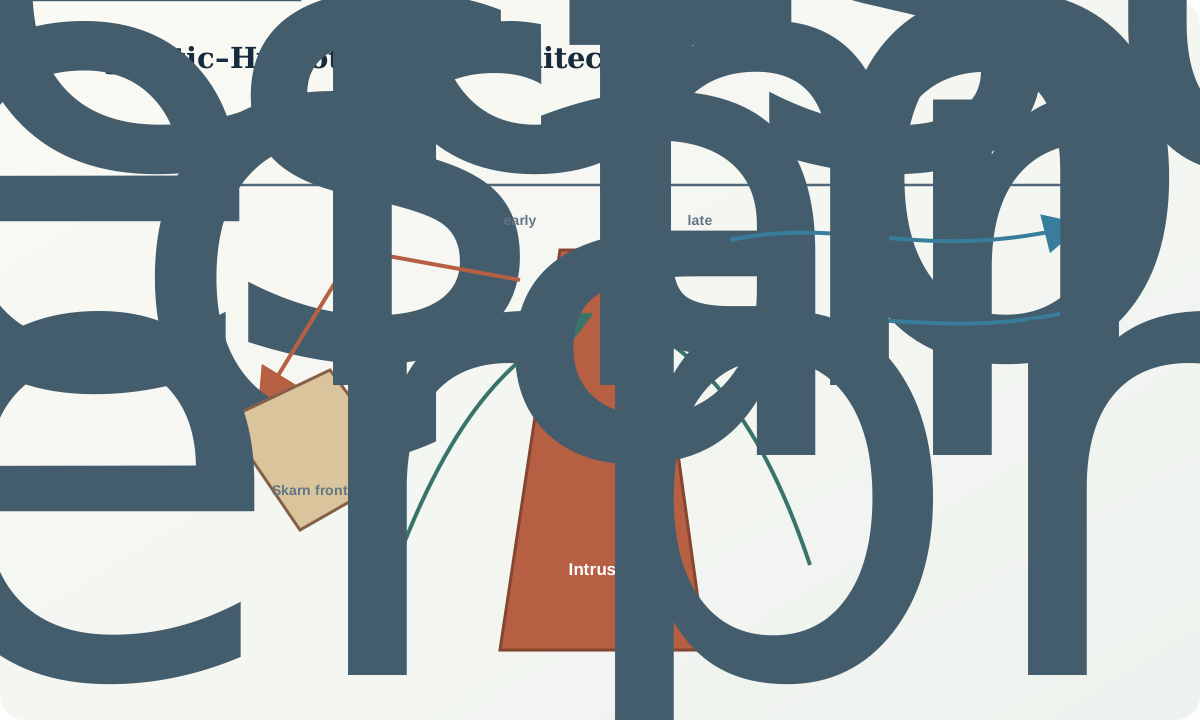
Epithermal systems form at shallow crustal levels from hydrothermal fluids whose pressure, temperature, phase state and chemistry can change rapidly. Boiling, fluid mixing, cooling, sulfidation and wall-rock reaction can precipitate metals. Low-sulfidation and high-sulfidation classifications refer to mineral assemblages and fluid-rock states, not simply sulfur abundance.
Vein textures, hydrothermal breccias, replacement bodies, silica forms and alteration minerals can constrain level and process. Preservation is critical: erosion may remove the shallow expression while exposing deeper roots, or preserve a steam-heated cap above weak mineralisation. Paleosurface indicators must be demonstrated rather than assumed from modern elevation.
Porphyry and epithermal mineralisation can be genetically related, telescoped or entirely separate events. Age overlap within uncertainty, compatible fluid chemistry and cross-cutting relations are needed to link them.
Evidence integration and common ambiguities
Map minerals, not only alteration labels. Record primary lithology, intensity, replacement texture, vein generation, structural orientation and confidence. Spectral or geophysical proxies require mineralogical ground truth. Distinguish minerals formed by weathering from hydrothermal clays.
Geochemical halos depend on mobility, lithology, erosion and analytical support. A distal pathfinder pattern can guide vectoring but may also reflect background lithology or a separate event. Ratios hide absolute concentration and denominator effects; examine both.
Timing is decisive. An alteration age may date cooling, crystallisation, resetting or analytical mixing. Combine relative paragenesis with multiple suitable minerals and uncertainty. A neat age match cannot repair an inconsistent cross-cutting relationship.
Worked synthetic example
A synthetic tilted volcanic-intrusive section contains an altered stock, a carbonate bed with garnet-pyroxene replacement and shallow quartz veins. Mapping defines three overprinting stages: (1) potassic feldspar alteration cut by quartz veins, (2) sulfide-bearing veins that also replace the carbonate bed, and (3) clay-rich fractures cutting both. Synthetic ages are 101.2\pm0.6 Ma for the stock, 100.7\pm0.5 Ma for hydrothermal mineral growth and 92\pm3 Ma for the clay event.
The field relations and overlapping first two ages support a linked porphyry-skarn event. They do not prove that the shallow quartz veins are part of that system. If those veins cut the clay fractures and contain a distinct meteoric-fluid signature, they would represent a younger epithermal event despite spatial proximity.
A mass-balance comparison shows copper gained in the sulfide stage while potassium gain preceded it. Thus potassic alteration is a vector to the system, not a direct grade proxy. The next discriminating tests are vein-paragenesis mapping, mineral-hosted age work and fluid evidence on the shallow veins.
Interpretation workflow
- Reconstruct primary lithology and intrusive phases.
- Establish cross-cutting order among intrusions, veins, breccias and alteration.
- Name alteration from verified mineral assemblages and reactions.
- Map permeability architecture and reactive wall rocks.
- Separate prograde, mineralising, retrograde and weathering stages.
- Test zoning in restored three-dimensional orientation.
- Link ages to specific minerals and textural domains.
- Compare porphyry, skarn, epithermal and unrelated-event hypotheses.
- Choose tests that resolve genetic linkage rather than mere proximity.
Practice and review
- Draw two sections that yield the same surface alteration pattern: one upright and one tilted.
- List observations that distinguish hydrothermal skarn from regional calc-silicate metamorphism.
- Explain why an alteration halo can be larger than the economically interesting mineralised body.
- Create a vein-paragenesis table with at least three generations and an explicit uncertain relationship.
- Design one test capable of refuting a proposed porphyry-epithermal genetic link.
Sources and further reading
- Sillitoe, Porphyry Copper Systems, synthesis of system architecture, alteration and deposit expression.
- Porphyry Copper Deposit Model, public descriptive, genetic and assessment framework.
- Meinert, Dipple and Nicolescu, World Skarn Deposits, synthesis of skarn processes, mineralogy and zonation.
- Epithermal gold-silver deposit model, public framework for epithermal attributes and environmental considerations.
- Hedenquist, Arribas and Gonzalez-Urien, Exploration for Epithermal Gold Deposits, process-based interpretation of shallow hydrothermal systems.