C1 · Publication Volume 11
Weathering, Laterite, Placer and Supergene Deposits
supergene enrichment and mechanical concentration
Learning goals
After this lesson, you should be able to explain how chemical weathering, residual enrichment, dissolution-reprecipitation and mechanical sorting create near-surface mineral concentrations. You should distinguish a residual laterite, a transported sediment concentration and a supergene enrichment blanket using mass balance, mineralogy and geomorphic history.
You should also be able to recognise that present topography may postdate mineralisation, that weathering can both reveal and conceal primary systems, and that vertical profiles require landscape and hydrological context.
Weathering fronts and residual concentration
Weathering changes minerals through dissolution, hydrolysis, oxidation, reduction, hydration and biological interaction. Mobile components leave in solution or particles; relatively immobile components become residually enriched. New clay, oxide, hydroxide, carbonate and sulfate minerals may form. The result depends on parent rock, climate, drainage, relief, permeability, time and erosion.
A concentration increase does not necessarily mean mass was added. If half the original rock mass is removed while a component is retained, its concentration doubles. To distinguish residual enrichment from addition, use an immobile reference and volume or strain constraints:
$\tau_j=\frac{(C_j/C_i)_{weathered}}{(C_j/C_i)_{parent}}-1,$
where i is a justified immobile element. A positive \tau_j indicates gain relative to the reference and a negative value indicates loss, but the result fails if i moved or the parent was misidentified.
Weathering fronts can be sharp or gradational and may migrate. Relict textures preserve parent-rock fabric even after mineral replacement, helping link horizons to protolith.
Laterite, bauxite and supergene profiles
Lateritic profiles can concentrate nickel, cobalt, iron or aluminium through prolonged weathering and hydrological organisation. Nickel laterites commonly partition metal among limonite-rich upper zones, clay-rich intervals and saprolite silicates, with profile form controlled by ultramafic protolith, drainage and erosion. Bauxite represents strong desilication and aluminium enrichment under suitable conditions.
Supergene sulfide enrichment begins when oxidation of primary sulfides releases metals and acid. Descending solutions may precipitate secondary sulfides near a redox boundary, potentially enriching material below a leached cap. Carbonate or oxide minerals may form under other chemical conditions.
Vertical zoning is not universal. Water-table movement, faulting, palaeotopography, erosion, burial and renewed weathering can stack, truncate or invert profiles. Mineralogy and reaction fronts are stronger evidence than colour alone.
Mechanical concentration and placer systems
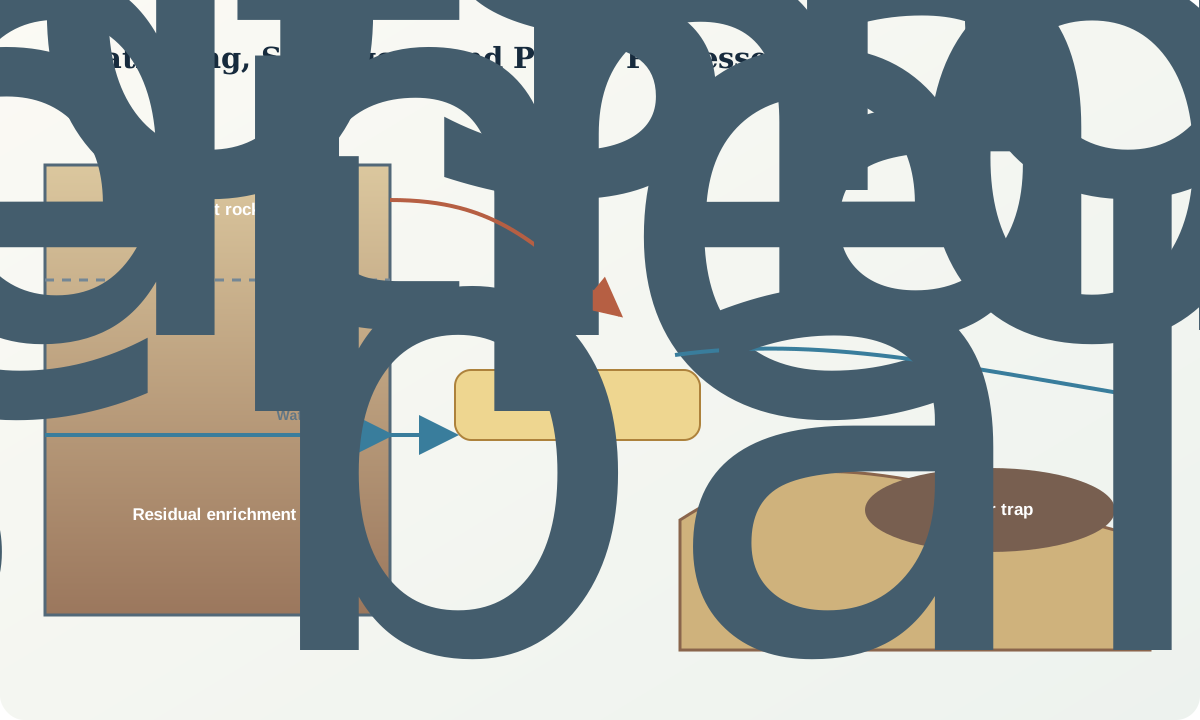
Mechanical weathering releases resistant grains. Transport by rivers, waves, wind or gravity sorts particles by size, density, shape and hydraulic behaviour. Heavy-mineral concentrations can form in channel lags, point bars, beach ridges, dune systems or submerged palaeochannels.
The source must supply durable commodity minerals at a rate and grain size that survive transport. Reworking can progressively upgrade or disperse a concentration. A placer may be much younger than its bedrock source, and the nearest source today may not be the actual source after drainage reversal or shoreline migration.
Hydraulic equivalence means a fine dense grain can travel with a coarser light grain. Therefore, bulk sediment grain size alone does not predict heavy-mineral distribution. Sample the relevant size and density fractions and preserve recovery information.
Landscape evolution and preservation
Regolith and placer models require a time-aware surface. Stable, low-relief landscapes may permit deep weathering; incision can expose and redistribute profiles; burial can preserve palaeosurfaces; glaciation or mass wasting can remove them. Modern drainage may cut older alluvial systems at an angle.
Use geomorphic surfaces, weathering indices, palaeomagnetic or age constraints where appropriate, stratigraphic relationships and sediment provenance. Digital terrain helps map form but does not date it. A flat surface can be depositional, erosional or structurally controlled.
Preservation bias matters. The most complete profile may survive where erosion was weakest, not where primary mineralisation was strongest. Conversely, transported anomalies may lie downslope or downstream from a concealed source.
Sampling and analytical design
Log regolith materials by process and parentage, not only depth. Record transported versus residual status, texture, clasts, pisoliths, mottles, cement, moisture, horizon boundaries and evidence of groundwater. Preserve size fractions for placer work and measure recoveries for coarse or dense minerals.
Sample parent rock and the complete profile to support mass balance. Multi-element data can identify leaching and accumulation, while mineralogy shows host changes. Bulk assays without mineralogy can confuse residual concentration with secondary addition.
Orientation surveys should compare media: soil, lag, stream sediment, heavy-mineral concentrate, groundwater or vegetation may respond differently. A concentrate is deliberately enriched and cannot be compared numerically with bulk soil without accounting for preparation and mass yield.
Worked synthetic example
A synthetic parent rock contains 0.30% nickel and 45% of immobile reference element I. A weathered horizon contains 0.90% nickel and 60% I. The relative mass-transfer value is
$\tau_{Ni}=\frac{(0.90/60)}{(0.30/45)}-1=1.25.$
Nickel increased by 125% relative to I, suggesting addition or greater retention than the reference-normalised parent, not merely the threefold concentration apparent from raw grade. If I was mobile or the parent sample is unrepresentative, the inference fails.
In a synthetic stream sample, a 20 kg bulk sediment yields 80 g of heavy-mineral concentrate containing 2% commodity mineral. The concentrate contains 1.6 g of that mineral, equivalent to 80 ppm of the original bulk mass if recovery were complete. Reporting “2% grade” for the stream sediment would confuse concentrate and bulk support. Neither value predicts a placer body without volume, continuity and hydraulic context.
Interpretation workflow
- Reconstruct parent material and pre-weathering geology.
- Distinguish residual, transported and reworked materials.
- Map weathering and redox fronts using minerals and textures.
- Apply immobile-element mass balance with sensitivity tests.
- Restore palaeolandscape, drainage and erosion history.
- For placers, model liberation, transport, sorting and trap geometry.
- Track sample mass, size fraction, concentrate yield and recovery.
- Compare primary, residual, supergene and transported explanations.
- State how preservation bias affects targeting.
Practice and review
- Recalculate
\tau_{Ni}if reference element I in the weathered sample is 75%. - Draw two profiles with identical vertical chemistry but different water-table histories.
- Explain why a heavy-mineral concentrate assay cannot be treated as bulk sediment grade.
- Design observations that distinguish transported lateritic gravel from in-place saprolite.
- Trace how one primary sulfide body could produce a leached cap, enrichment blanket and downstream sediment anomaly.
Sources and further reading
- Nickel-cobalt laterite deposit model, public synthesis of profile development, mineralogy and assessment.
- Bauxite deposit model, descriptive framework for residual aluminium enrichment.
- Grade and tonnage model of placer gold, quantitative population model with explicit sampling context.
- Force, Geology of Titanium-Mineral Deposits, synthesis of heavy-mineral concentration and source controls.
- Laterite-saprolite gold model, descriptive framework for weathering-related gold redistribution.