C1 · Publication Volume 11
Using and Misusing Deposit Models
analogues, classification, confirmation bias and model flexibility
Learning goals
After this lesson, you should be able to use descriptive, genetic, grade-tonnage, mineral-systems and exploration models for their proper purposes. You should recognise confirmation bias, circular classification, scale mismatch, analogue overreach and false negative evidence.
You should also be able to construct a model-comparison matrix, update it when contradictory evidence appears and communicate a provisional classification without turning it into a fact.
What a model is for
A model is a structured simplification. A descriptive model organises common observed attributes. A genetic model proposes processes and causal links. A grade-tonnage model describes a reference population under specific inclusion rules. A mineral-systems model organises critical processes and scale. An exploration model converts these into testable spatial predictions.
These products answer different questions. A descriptive match does not prove genesis. A genetic explanation does not estimate tonnage. A grade-tonnage distribution does not establish that an occurrence belongs to its population. An exploration footprint does not guarantee a deposit at its centre.
Model names are communication tools, not natural boxes with sharp boundaries. Hybrid, overprinted and transitional systems occur. Keep the underlying observations even when classification changes.
Analogues and transferability
An analogue is useful when the compared attributes are causally relevant and scale compatible. Host rock, tectonic setting, age, alteration, geometry, commodity association or physical response may be compared, but no single analogue transfers all properties.
Similarity must be paired with difference. For every analogue, list which features are observed locally, which are predicted but untested, which are absent with adequate detection and which are irrelevant. A famous example can bias attention toward visually memorable features while hiding base rates and alternative systems.
Transferability also depends on preservation and observation level. A deeply eroded system should not be expected to retain the same shallow footprint as a preserved one. Metamorphism and weathering alter proxies without necessarily erasing the primary process.
Confirmation bias and circular reasoning
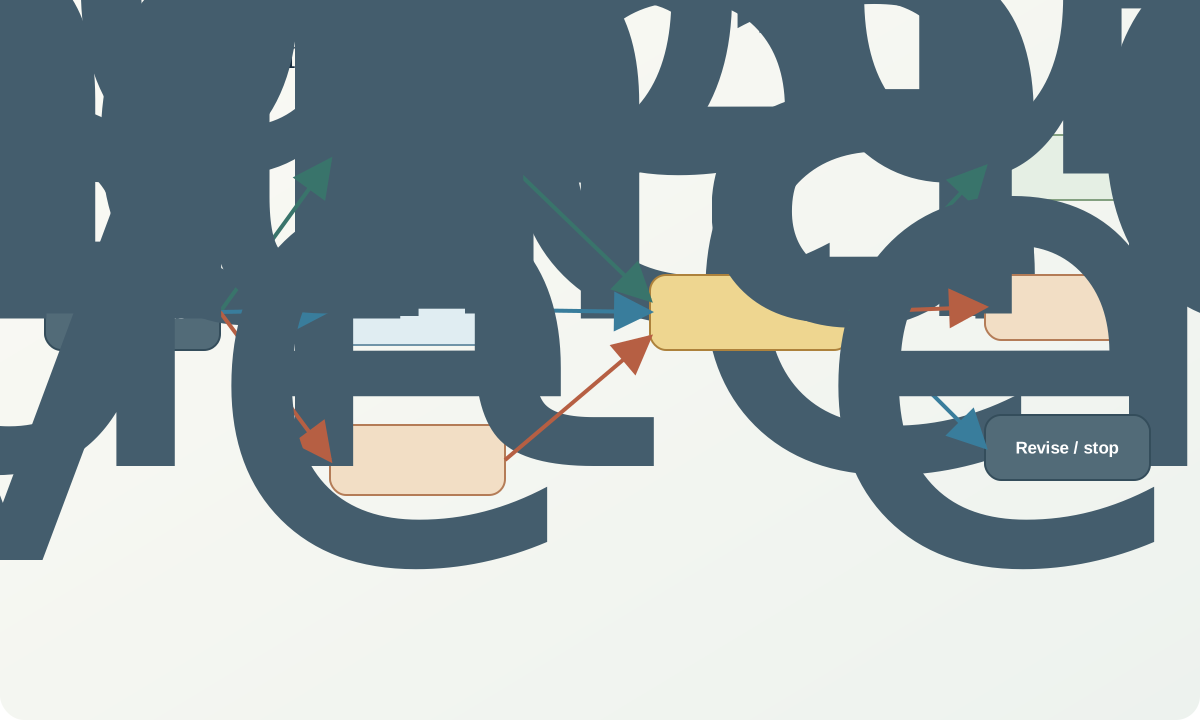
Confirmation bias occurs when observations supporting a preferred model are sought or weighted more strongly than contrary observations. Circular reasoning occurs when data are selected because they fit a model and then used to prove the model. Relabelling ambiguous features can make a model unfalsifiable.
Countermeasures include pre-registering predictions, maintaining at least two live alternatives, blind or independent logging of key textures, recording negative results, and defining a stopping or revision rule. A model should lose confidence when a necessary prediction fails under adequate detection.
Do not count correlated observations as independent evidence. Alteration mineral, spectral response and an element anomaly may all arise from the same underlying reaction. Three maps do not necessarily provide three independent confirmations.
Classification, probability and base rates
Classification is often provisional. Express confidence and evidence, for example: “The mapped architecture is consistent with a basin-brine replacement model, but syngenetic and later structural alternatives remain unresolved.” Avoid pseudo-precise probabilities unless the model, prior information and likelihood calibration are defensible.
Base rates matter. If many barren systems share a feature, that feature has low diagnostic value even if most known deposits contain it. Selection bias in published examples can exaggerate apparent uniqueness because unsuccessful targets are underdescribed.
A likelihood-ratio view is helpful conceptually: evidence is discriminating when it is much more expected under one model than another. The point is not to manufacture a number, but to ask the comparative question explicitly.
Designing discriminating tests
For each model, identify necessary process evidence, predicted spatial gradients, temporal relationships and forbidden observations. Then rank tests by ability to change the decision. High-resolution data may have low value if all models predict the same result.
Separate detection failure from geological absence. A deep feature may be invisible to a shallow method; a mineral may be below detection; poor core orientation may erase a structural test. Record detection power and coverage with every negative result.
Use staged tests. First constrain architecture and preservation; next test process and timing; finally test the expected product at the right scale. This sequence avoids drilling a model whose necessary regional components are already contradicted.
Worked synthetic example
A synthetic anomaly contains magnetite alteration, copper traces and a regional fault. Model A is an iron-oxide-rich hydrothermal system; Model B is altered mafic volcanic rock with unrelated late veins; Model C is a porphyry margin.
All three predict magnetite and structure, so those observations do not discriminate. A requires a coherent hydrothermal iron-oxide paragenesis and regionally linked alteration. B predicts primary igneous magnetite textures and veins younger than alteration. C predicts an intrusive centre, porphyry-style vein chronology and systematic alteration zoning.
The first new thin sections show replacement magnetite cutting igneous texture, lowering confidence in B. Age work shows veins 40 million years younger than magnetite, weakening a single-event A model. No intrusive centre is yet constrained, leaving C incomplete. The correct update is not to force a winner; it is to split A into multistage and unrelated-vein variants and select a test for intrusive and regional alteration architecture.
Interpretation workflow
- State the decision and select the appropriate model type.
- Preserve observations independently of classification.
- Propose at least two credible alternatives and a barren explanation.
- List shared, necessary, discriminating and refuting predictions.
- Record scale, preservation and detection power.
- Seek contrary evidence deliberately.
- Update confidence without rewriting earlier observations.
- Stop or revise when a necessary prediction fails.
- Communicate provisional status and the next discriminating test.
Practice and review
- Identify whether five published figures are descriptive, genetic, grade-tonnage, systems or exploration models.
- Build a three-model matrix for the synthetic anomaly and add one test that all models predict; explain why it has low value.
- Rewrite a circular argument in which “porphyry-style alteration” is defined by samples selected from a presumed porphyry target.
- Give an example of false negative evidence caused by inadequate detection depth.
- Define a stopping rule for a model whose required host unit is absent in a well-constrained section.
Sources and further reading
- Introduction to Mineral Deposit Models, explicitly treats model names as conveniences rather than constraints.
- Geochemical anomaly guidance in Mineral Deposit Models, separates anomalous evidence from deposit proof.
- McCuaig, Beresford and Hronsky, Mineral systems and exploration targeting, process-scale approach to prediction and targeting.
- Mineral deposit model collection, public collection illustrating distinct model families and their intended uses.