C1 · Publication Volume 11
Geological Potential versus Economic Value
grade, tonnage, geometry, metallurgy, location and risk
Learning goals
After this lesson, you should be able to separate geological potential, exploration results, resource concepts, modifying factors and economic value. You should be able to explain how grade, tonnage, geometry, mineralogy, metallurgy, location and risk interact without reducing them to a single unsupported score.
You should also be able to audit a preliminary claim, identify missing decision layers and write a conclusion that remains scientifically valid when prices, technology, regulation or social context change.
Geological potential and evidence maturity
Geological potential is the possibility that a defined area or system contains a concentration of a specified type and scale. It may be supported by favourable processes, footprints, occurrences or partial intersections. It is not a resource estimate and has no automatic economic meaning.
Evidence matures from regional context to mapped system, sampled body, geological model and estimate. Each stage can reduce some uncertainties while revealing others. More assays do not compensate for incorrect geometry; precise geometry does not establish mineral recovery; metallurgical tests on unrepresentative material do not characterise a body.
State the spatial and conceptual support of every conclusion. “Potential for a mineral system in the district” differs from “continuity of a body between drill sections.” Keeping these scales separate prevents prospectivity language from becoming an implied inventory.
Grade, tonnage and geometry
Grade and tonnage are coupled by geology, domaining and cut-off assumptions. Raising a cut-off commonly reduces included tonnage and changes geometry; it does not simply remove uniform low-grade material. Grade-tonnage models describe reference populations and are not predictions for an individual occurrence.
Geometry controls access, selectivity, dilution, geotechnical behaviour and sampling. A thin steep body, broad disseminated body and irregular network can have equal contained quantity but different uncertainty and extraction implications. Continuity must be modelled at the scale relevant to the question.
Density, moisture, voids and weathering affect tonnage. High grades near detection or sampling extremes require appropriate quality control and top-cut or capping decisions only after geological and statistical analysis. No mechanical rule substitutes for understanding the population.
Mineralogy, metallurgy and product
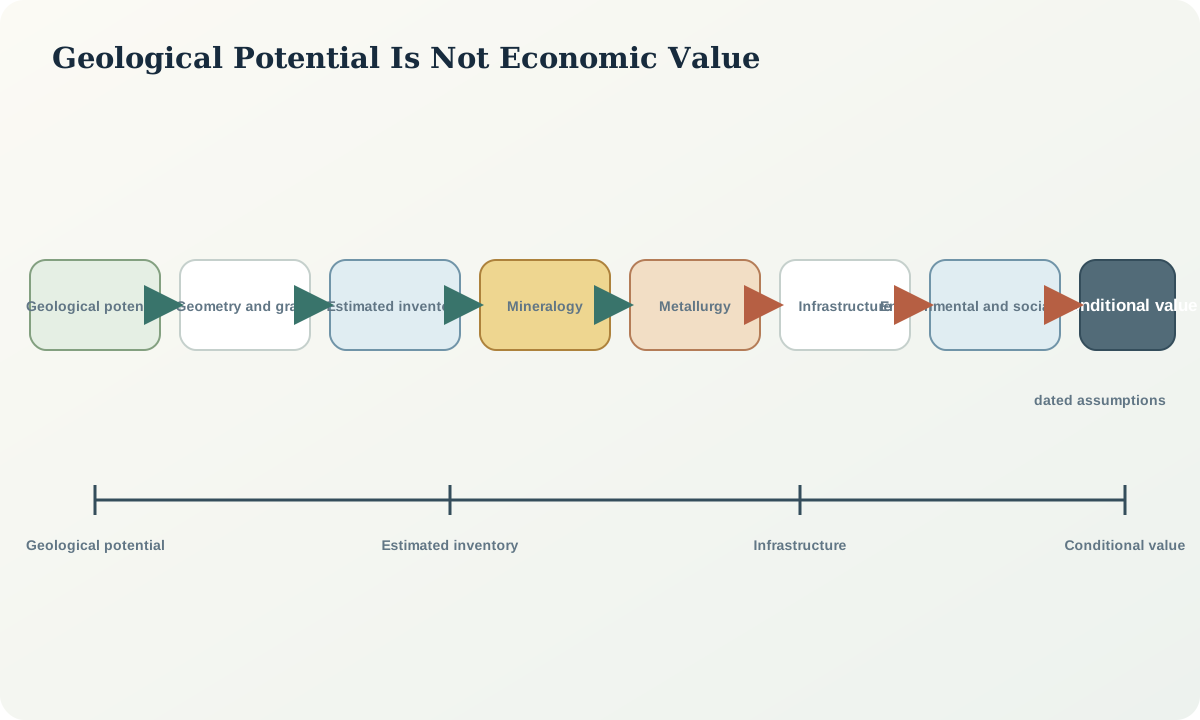
Contained commodity is not recovered commodity. Mineral host, grain size, locking, oxidation, hardness, clay, deleterious components and water interaction influence processing. Recovery varies with material type and operating conditions; a single test result should not be applied across a heterogeneous body without representativity.
The intended product has specifications. An element may be present but not in a saleable form; a concentrate may carry penalties; a by-product may require a circuit and market. Testwork needs sample provenance, mass, preparation, mineralogical domain and uncertainty.
Metallurgy can also change the geological model by revealing domains invisible in grade alone. Two samples with equal assay may have different recovery because one hosts the commodity in liberated grains and the other in refractory lattice sites.
Location, infrastructure and modifying factors
Location affects access, energy, water, transport, climate, topography and competing land uses. Environmental baselines, cultural values, community decisions, legal rights and closure responsibilities cannot be inferred from geology. They require direct, current and legitimate processes.
Technical studies integrate mining, processing, infrastructure, marketing, legal, environmental, social, governmental and financial factors at an appropriate level. This tutorial does not perform those studies. It teaches why omission of a layer prevents an economic conclusion.
Uncertainty is not one percentage. Geological, sampling, analytical, geotechnical, metallurgical, price, schedule, regulatory and social uncertainties have different structures and correlations. Scenarios should expose the variables and decision thresholds rather than hide them in a composite “risk score.”
Conditional value and changing context
Economic value is conditional on a valuation date, assumptions, prices or forecasts, costs, recovery, production schedule, taxes, discounting, approvals and other factors. A positive calculation under one scenario is not an intrinsic rock property. Sensitivity and scenario analysis reveal which assumptions control the decision.
Avoid false precision. Early-stage inputs may support only broad ranges or decision thresholds. A detailed spreadsheet cannot create information absent from geology or testwork. Correlated uncertainties, such as depth affecting both drilling confidence and mining cost, should not be varied independently without thought.
Scientific records should remain stable when economic assumptions change. Preserve assays, mineralogy, geometry and uncertainty separately from price decks, design versions and decisions.
Worked synthetic example
Two synthetic bodies each contain 10,000 t of commodity before recovery.
- Body A is broad and regular; 85% of the commodity is in a liberatable mineral, with a synthetic test recovery of 80% on representative material.
- Body B is narrow and discontinuous; 95% is in fine refractory grains, with a synthetic test recovery of 35% from one selected high-grade sample.
The simple recovered quantities would be 8,000 t for A and 3,500 t for B if the recoveries applied. But confidence differs: A has representative testwork, while B's selected sample cannot establish domain recovery. Geometry may create additional dilution and loss for B.
It would still be wrong to declare A economic. No cost, product quality, infrastructure, environmental, legal, social or market evidence is supplied. The defensible result is: A has the stronger synthetic geological-and-metallurgical evidence under stated assumptions; economic value remains unassessed for both.
Interpretation workflow
- Define whether the decision concerns prospectivity, continuity, estimation or economics.
- Audit grade, tonnage, density and geometry with support and uncertainty.
- Identify mineral hosts, domains and representative testwork.
- Separate contained, recoverable and saleable quantities.
- List modifying factors and identify which remain untested.
- Version all economic assumptions and valuation context.
- Analyse sensitivities and correlations instead of one composite score.
- Keep geological facts independent of changing decisions.
- Report the strongest supported conclusion and explicitly withhold stronger ones.
Practice and review
- Construct three bodies with equal contained commodity but contrasting geometry and mineral hosts.
- Explain why one metallurgical recovery number may be less reliable than a grade estimate.
- Sort a list of inputs into geological, technical, environmental, social, legal and economic layers.
- Rewrite “the deposit is valuable” as a conditional statement with a defined evidence level.
- Design a scenario table that changes density, continuity and recovery without combining them into one risk percentage.
Sources and further reading
- CRIRSCO International Reporting Template, international reference for distinctions and modifying factors in public reporting.
- JORC Code 2012, one jurisdictional example of evidence, competence and classification requirements.
- Economic filters for mineral-resource assessment, public methodology showing conditional economic screening after geological assessment.
- Singer, Quantitative mineral resource assessments, framework for probabilistic geological assessment rather than project valuation.
- Updated analysis of grade-tonnage relationships, recent study of population relationships and their statistical interpretation.