D6 · Publication Volume 22
Professional Ethics and Responsibility
scope, conflict, uncertainty, consent and whistleblowing
Learning objectives
By the end of this lesson, the learner should be able to frame a defensible decision about scope, conflict, uncertainty, consent and whistleblowing; distinguish observation, interpretation, assumption, obligation and decision; construct a causal pathway with explicit spatial and temporal boundaries; use quantitative evidence without false precision; identify distributional and long-duration consequences; specify controls with triggers and accountable responses; and design a versioned evidence package that can be independently reviewed.
The objective is transferable reasoning, not memorisation of a jurisdiction, organisation or operating procedure. A learner must state where current law, rights, permits, engineering authority or specialist review governs a real decision. The tutorial supplies no universal threshold and authorises no field activity, disclosure, facility or closure outcome.
Decision context
The decision is how a practitioner should act when technical instructions, evidence, competence, public consequence and organisational pressure conflict. Ethical responsibility begins before misconduct: define scope, disclose limitations, seek informed agreement, manage conflicts, preserve evidence, communicate uncertainty and escalate when a material risk cannot be resolved within authority.
Write a decision contract before analysis. It should name the decision owner as a role rather than a person, affected systems, lifecycle phase, spatial and temporal support, applicable authority to be verified, evidence cut-off, alternatives, uncertainty, dependencies, irreversible choices and review trigger. Separate what the analysis can inform from what it cannot approve. If the boundary excludes a pathway or affected group, record the reason and the evidence needed to reconsider it.
Core concept: system and boundary
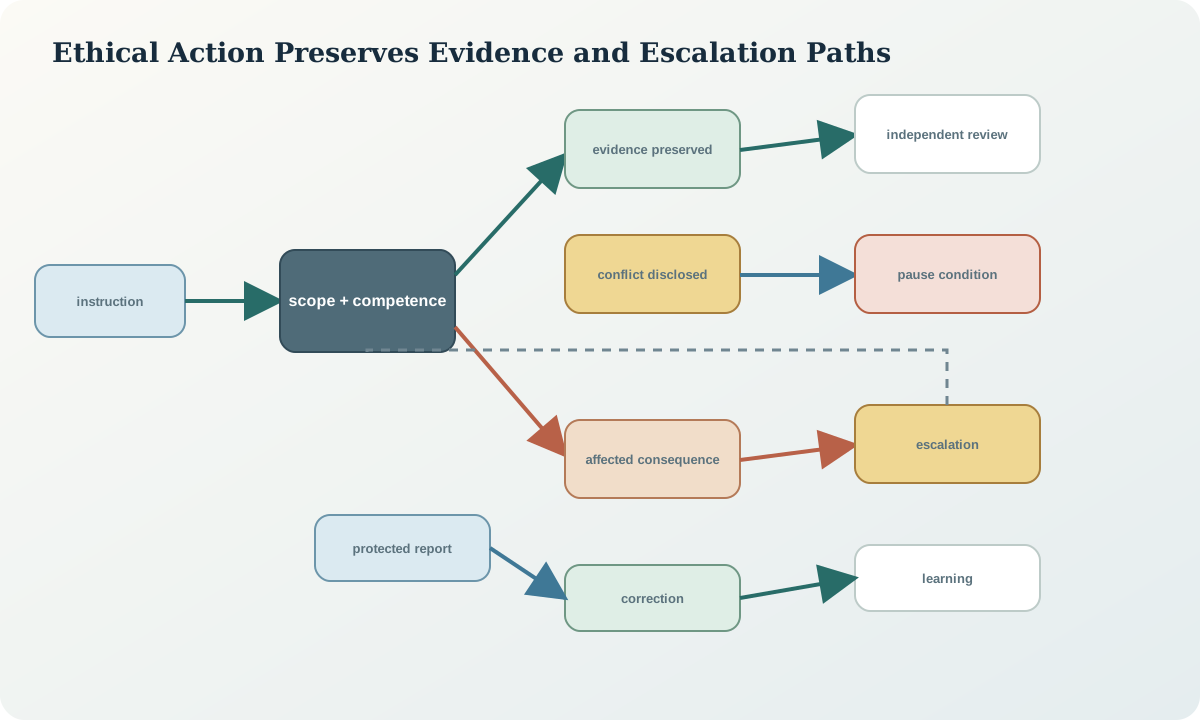
Competence is task-, context- and time-specific. Training in one method does not confer authority in safety, rights, engineering, legal compliance or public disclosure. A practitioner must recognise the boundary, obtain appropriate review and avoid language that implies assurance beyond the work performed. Delegation changes who performs a task, not the accountability chain.
Map the system as linked objects rather than a flat issue list. For every object, ask what state can change, which process causes the change, how quickly it propagates, what feedback exists and which observations could distinguish competing explanations. Keep physical, ecological, social, legal and governance relationships connected without pretending that one discipline can decide for another.
Core concept: pathways and obligations
A conflict of interest may be financial, relational, career-based, intellectual or created by prior advocacy. Disclosure is necessary but may not be sufficient; mitigation can require independent review, recusal, separation of duties or refusal. Consent must be informed, specific, voluntary, current and within the giver’s authority. Whistleblowing routes require evidence care and protection from retaliation.
Obligations and controls also have a lifecycle. Record their origin, exact wording, intended outcome, affected interest, responsible role, dependencies, start condition, evidence, review point and release condition. Do not convert a conditional commitment into an unconditional claim, or a professional recommendation into an approved requirement. Where rights or consent apply, preserve the conditions and authority attached to them.
Quantitative reasoning
Ethical judgement cannot be solved by multiplying ordinal scores. Quantitative evidence can clarify exposure, uncertainty, affected population, reversibility and urgency, but values and rights remain explicit constraints. Decision records should show options, consequences, uncertainties, conflicts, duties, consultation, authority and the reason an option was accepted or rejected.
Before calculating, declare system boundary, support, units, time zone, reporting period, denominator, treatment of missing and censored data, uncertainty model and rounding. Compare raw, adjusted and modelled values rather than overwriting one with another. Sensitivity analysis should vary plausible drivers jointly where they are dependent. A neat number is not evidence that the underlying model is complete.
Evidence and uncertainty
Preserve contemporaneous observations, calculations, instructions, review comments, conflicts, approvals and communications without selectively editing the record. Distinguish fact, interpretation, allegation and unresolved concern. Collect only information needed for legitimate review, protect identities where required and avoid conducting an unauthorised investigation that could harm people or evidence.
Classify evidence as direct observation, laboratory result, derived value, model output, stakeholder or rights-holder input, requirement, expert judgement or assumption. Attach method, date, location or population support, quality state, access restriction and lineage. Confidence should explain both variability in the system and knowledge uncertainty. Conflicting evidence remains visible until a documented decision resolves or bounds it.
Lifecycle controls
Practical controls include scope statements, competence checks, peer review, conflict declarations, separation of preparation and approval, uncertainty language, stop-work authority, escalation ladders, protected reporting channels, correction and non-retaliation monitoring. A process that exists only on paper is not a control; people must be able to use it safely.
Use a control record with unwanted event, causal pathway, prevention or mitigation function, performance requirement, leading and lagging indicators, verification frequency, trigger, immediate response, escalation authority, recovery action and evidence of effectiveness. Controls must survive foreseeable change in climate, schedule, staff, contractors, data availability and lifecycle phase. A monitoring point without a response rule observes risk but does not control it.
Interfaces and data
Use immutable source records, versioned analysis, reason-coded changes and role-based access. Approval must capture what was reviewed, not just a name and date. Sensitive reports require minimal distribution and retention rules, while decision provenance must survive personnel change. Audit logs cannot substitute for a culture that permits challenge.
The minimum exchange contract specifies identifier, geometry or population support, coordinate and vertical reference where relevant, time basis, unit, vocabulary, null semantics, method, uncertainty, quality status, sensitivity, licence or use condition, version and checksum. Preserve raw evidence and make transformations reproducible. A dashboard, map or report is a view of controlled evidence; it must not become the only surviving record.
Integration checkpoint
The lesson checkpoint passes only when another reviewer can follow the chain from decision and affected interest through scope, conflict, uncertainty, consent and whistleblowing, evidence, uncertainty, alternatives, control and residual obligation. Every claimed control must have an observation that can test it, and every material observation must have a pre-agreed response path.
Ask four integration questions: What can change the conclusion? Who experiences the outcome and who has authority? Which lifecycle handover could lose the evidence or obligation? What remains after the proposed control succeeds? If any answer is hidden in narrative, convert it to a controlled record before advancing.
Synthetic worked example
A synthetic analyst is asked to remove two adverse monitoring periods because an instrument later failed calibration. The failure date is uncertain, and removing both periods changes a public conclusion. The learner preserves the raw series, models alternative validity windows, discloses the conflict and uncertainty, seeks independent technical review and escalates the reporting decision rather than silently deleting data.
The numbers and labels are synthetic and intentionally incomplete. Recalculate them from the stated basis, show any residual, and create at least two plausible explanations before selecting an action. Mark the evidence that would discriminate among explanations. Do not transplant the illustrative quantities, triggers or acceptance language to real work.
Practice task
Write an ethical decision record for a fictional conflict between schedule pressure and uncertain evidence. State scope, competence boundaries, affected interests, options, conflicts, evidence preservation, consultation, escalation, protection and correction route. Include a condition under which work must pause.
Submit the artefact with a one-page decision statement, data dictionary, assumptions register, alternative explanation, control table and change log. A peer should be able to locate every input and challenge every conditional step. The task is incomplete if it relies on an unnamed rule, a private conversation, an unexplained score or a figure that cannot be traced to versioned evidence.
Common failure modes
Common failures are assuming employment instruction overrides professional duty, working outside competence without review, treating disclosure as complete conflict management, hiding uncertainty to appear decisive, seeking consent from someone without authority, deleting inconvenient evidence, escalating publicly before protecting sensitive facts and relying on a reporting channel that exposes the reporter.
A cross-cutting failure is institutional storytelling: wording that implies a named organisation, person or website owns, endorses or supplies the tutorial or its conclusions. Another is site mimicry, where an invented example looks like a real property and borrowed parameters appear authoritative. Keep examples explicitly synthetic, roles anonymous, external names in source notes only and every real application dependent on current local evidence and authority.
Lesson summary
Professional responsibility is disciplined action under imperfect authority and evidence. It requires honest scope, competence, independence, protected challenge, preserved records, proportionate escalation and correction, with affected people and public consequences kept visible.
The durable output is not a final-looking score. It is a reviewable chain connecting purpose, affected systems, evidence, uncertainty, alternatives, decisions, controls, responsibilities and remaining obligations. That chain must be capable of change without erasing the earlier state.
Review questions
- What boundary and decision contract are required for scope, conflict, uncertainty, consent and whistleblowing?
- Which observations would distinguish the two most plausible causal explanations?
- Which quantities can be conserved or reconciled, and which judgements cannot be reduced to a score?
- How can a missing observation differ from a confirmed absence or zero?
- Which control has the earliest useful trigger and what action follows it?
- What evidence and obligation must survive the next lifecycle handover?
- How would you communicate the residual consequence without implying approval or certainty?
Sources
- Recommendation on Science and Scientific Researchers, public source used to identify current concepts and review questions; applicability must be checked for the actual decision.
- Guiding Principles on Business and Human Rights, public source used to identify current concepts and review questions; applicability must be checked for the actual decision.
- International Reporting Template, 2024, public source used to identify current concepts and review questions; applicability must be checked for the actual decision.
- Performance Standards on Environmental and Social Sustainability, 2012, public source used to identify current concepts and review questions; applicability must be checked for the actual decision.