D6 · Publication Volume 22
Sensitive Data and Responsible Systems
heritage, personal, commercial and environmental sensitivity
Learning objectives
By the end of this lesson, the learner should be able to frame a defensible decision about heritage, personal, commercial and environmental sensitivity; distinguish observation, interpretation, assumption, obligation and decision; construct a causal pathway with explicit spatial and temporal boundaries; use quantitative evidence without false precision; identify distributional and long-duration consequences; specify controls with triggers and accountable responses; and design a versioned evidence package that can be independently reviewed.
The objective is transferable reasoning, not memorisation of a jurisdiction, organisation or operating procedure. A learner must state where current law, rights, permits, engineering authority or specialist review governs a real decision. The tutorial supplies no universal threshold and authorises no field activity, disclosure, facility or closure outcome.
Decision context
The decision is how to make environmental and social evidence useful without exposing people, heritage, vulnerable species, commercial rights or critical systems. Openness is not the same as unrestricted access. Responsible systems classify by harm, rights, purpose, licence, precision, time and aggregation, then apply the least access consistent with the agreed use.
Write a decision contract before analysis. It should name the decision owner as a role rather than a person, affected systems, lifecycle phase, spatial and temporal support, applicable authority to be verified, evidence cut-off, alternatives, uncertainty, dependencies, irreversible choices and review trigger. Separate what the analysis can inform from what it cannot approve. If the boundary excludes a pathway or affected group, record the reason and the evidence needed to reconsider it.
Core concept: system and boundary
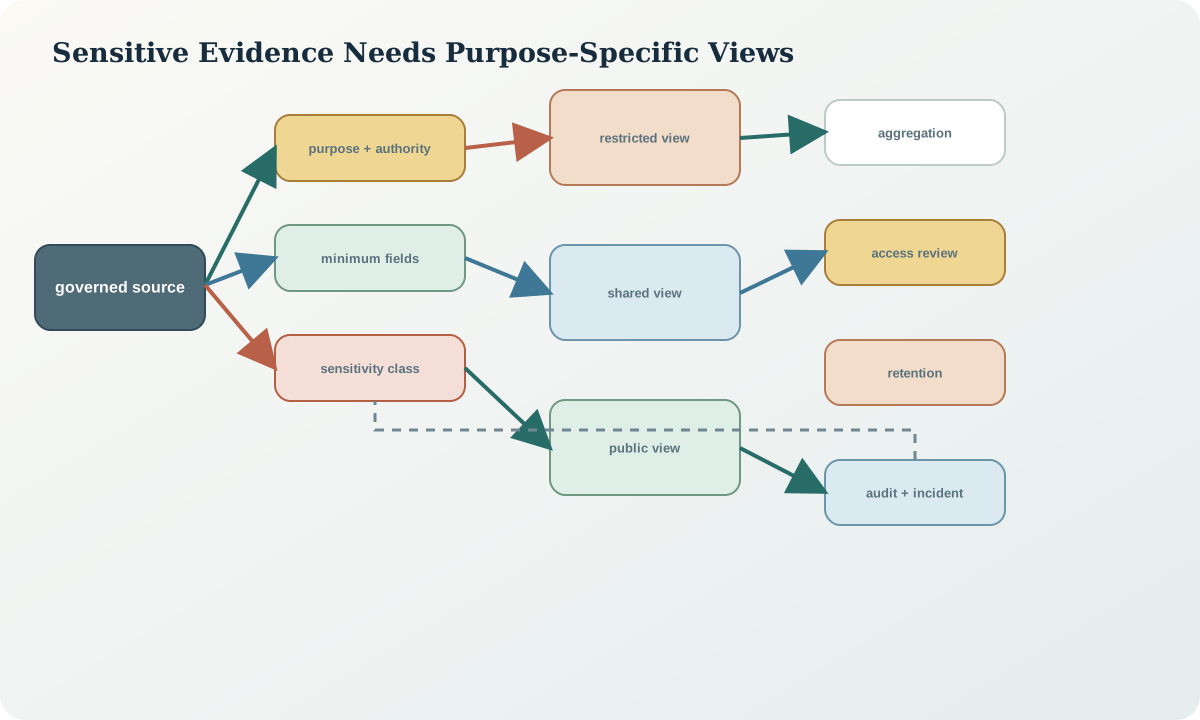
Sensitivity is contextual. A coordinate may be harmless for a common monitoring station but damaging for a sacred place, a threatened population or a complainant. Combining benign fields can re-identify a person or location. Classification therefore considers content, linkage, audience, timing and foreseeable misuse rather than file format alone.
Map the system as linked objects rather than a flat issue list. For every object, ask what state can change, which process causes the change, how quickly it propagates, what feedback exists and which observations could distinguish competing explanations. Keep physical, ecological, social, legal and governance relationships connected without pretending that one discipline can decide for another.
Core concept: pathways and obligations
Responsible data practice joins purpose limitation, minimum collection, lawful or agreed authority, informed conditions, data quality, access control, secure exchange, retention, correction, withdrawal, incident response and accountable reuse. Findability and interoperability can be achieved through metadata while the payload remains restricted. “Open by default” is unsafe for many evidence classes.
Obligations and controls also have a lifecycle. Record their origin, exact wording, intended outcome, affected interest, responsible role, dependencies, start condition, evidence, review point and release condition. Do not convert a conditional commitment into an unconditional claim, or a professional recommendation into an approved requirement. Where rights or consent apply, preserve the conditions and authority attached to them.
Quantitative reasoning
A risk register may compare sensitivity, exposure and consequence, but ordinal products are only prioritisation aids. Quantitative checks include unique-combination counts, spatial generalisation distance, group-size thresholds, access frequency, failed authorisations and retention age. A threshold must be justified against the harm model and cannot guarantee anonymity.
Before calculating, declare system boundary, support, units, time zone, reporting period, denominator, treatment of missing and censored data, uncertainty model and rounding. Compare raw, adjusted and modelled values rather than overwriting one with another. Sensitivity analysis should vary plausible drivers jointly where they are dependent. A neat number is not evidence that the underlying model is complete.
Evidence and uncertainty
Evidence includes data inventory, purpose and authority, consent or agreement conditions, licence, sensitivity assessment, data-flow map, access list, encryption or transfer controls, audit events, retention actions, quality incidents, complaints and impact review. Test both normal use and plausible misuse. Keep a record of what was deliberately not collected.
Classify evidence as direct observation, laboratory result, derived value, model output, stakeholder or rights-holder input, requirement, expert judgement or assumption. Attach method, date, location or population support, quality state, access restriction and lineage. Confidence should explain both variability in the system and knowledge uncertainty. Conflicting evidence remains visible until a documented decision resolves or bounds it.
Lifecycle controls
Controls include separation of identity and analysis, pseudonymous identifiers, precision reduction, aggregation, field masking, role and attribute access, approval workflow, time-limited links, secure transfer, offline custody, retention expiry, deletion verification, backup treatment and incident response. Access must be reviewed when role, purpose, agreement or risk changes.
Use a control record with unwanted event, causal pathway, prevention or mitigation function, performance requirement, leading and lagging indicators, verification frequency, trigger, immediate response, escalation authority, recovery action and evidence of effectiveness. Controls must survive foreseeable change in climate, schedule, staff, contractors, data availability and lifecycle phase. A monitoring point without a response rule observes risk but does not control it.
Interfaces and data
Design separate public, shared and restricted views from one governed source without copying sensitive values into uncontrolled files. Metadata can advertise that a dataset exists, its custodian, quality and request path without revealing protected content. Derived models require sensitivity review because predictions can recreate restricted locations or attributes.
The minimum exchange contract specifies identifier, geometry or population support, coordinate and vertical reference where relevant, time basis, unit, vocabulary, null semantics, method, uncertainty, quality status, sensitivity, licence or use condition, version and checksum. Preserve raw evidence and make transformations reproducible. A dashboard, map or report is a view of controlled evidence; it must not become the only surviving record.
Integration checkpoint
The lesson checkpoint passes only when another reviewer can follow the chain from decision and affected interest through heritage, personal, commercial and environmental sensitivity, evidence, uncertainty, alternatives, control and residual obligation. Every claimed control must have an observation that can test it, and every material observation must have a pre-agreed response path.
Ask four integration questions: What can change the conclusion? Who experiences the outcome and who has authority? Which lifecycle handover could lose the evidence or obligation? What remains after the proposed control succeeds? If any answer is hidden in narrative, convert it to a controlled record before advancing.
Synthetic worked example
A synthetic dataset combines monitoring coordinates, rare-species observations, anonymous grievance themes and land-access notes. Each table appears low risk alone, but date and location joins can identify a household and a sensitive habitat. The learner designs purpose-specific views, generalises geometry, suppresses sparse combinations and records an authorised request path while preserving scientific provenance.
The numbers and labels are synthetic and intentionally incomplete. Recalculate them from the stated basis, show any residual, and create at least two plausible explanations before selecting an action. Mark the evidence that would discriminate among explanations. Do not transplant the illustrative quantities, triggers or acceptance language to real work.
Practice task
Classify a fictional lifecycle dataset by content, rights, licence, harm, spatial precision, time and audience. Draw the data flow, minimise fields, define three access views, set review and retention triggers, test one linkage attack, plan an incident response and document how a legitimate researcher can request controlled access.
Submit the artefact with a one-page decision statement, data dictionary, assumptions register, alternative explanation, control table and change log. A peer should be able to locate every input and challenge every conditional step. The task is incomplete if it relies on an unnamed rule, a private conversation, an unexplained score or a figure that cannot be traced to versioned evidence.
Common failure modes
Common failures are equating useful with public, collecting data before agreeing purpose, keeping precise locations in exports, assuming removal of names prevents re-identification, applying one file-level permission to mixed fields, forgetting backups and derived models, retaining data indefinitely, granting access by job title alone and publishing a catalogue that reveals the sensitive fact itself.
A cross-cutting failure is institutional storytelling: wording that implies a named organisation, person or website owns, endorses or supplies the tutorial or its conclusions. Another is site mimicry, where an invented example looks like a real property and borrowed parameters appear authoritative. Keep examples explicitly synthetic, roles anonymous, external names in source notes only and every real application dependent on current local evidence and authority.
Lesson summary
Responsible systems preserve usefulness, provenance and review while preventing foreseeable harm. They treat sensitivity as contextual and dynamic, minimise collection, separate views, constrain reuse, audit access and give correction, withdrawal, retention and incident handling the same status as technical quality.
The durable output is not a final-looking score. It is a reviewable chain connecting purpose, affected systems, evidence, uncertainty, alternatives, decisions, controls, responsibilities and remaining obligations. That chain must be capable of change without erasing the earlier state.
Review questions
- What boundary and decision contract are required for heritage, personal, commercial and environmental sensitivity?
- Which observations would distinguish the two most plausible causal explanations?
- Which quantities can be conserved or reconciled, and which judgements cannot be reduced to a score?
- How can a missing observation differ from a confirmed absence or zero?
- Which control has the earliest useful trigger and what action follows it?
- What evidence and obligation must survive the next lifecycle handover?
- How would you communicate the residual consequence without implying approval or certainty?
Sources
- FAIR Principles, public source used to identify current concepts and review questions; applicability must be checked for the actual decision.
- CARE Principles for Indigenous Data Governance, public source used to identify current concepts and review questions; applicability must be checked for the actual decision.
- United Nations Declaration on the Rights of Indigenous Peoples, public source used to identify current concepts and review questions; applicability must be checked for the actual decision.
- Recommendation on Open Science, public source used to identify current concepts and review questions; applicability must be checked for the actual decision.