C3 · Publication Volume 13
Laboratory Methods
digestion, assay methods, multi-element packages and limitations
Learning goals
The learner should be able to distinguish preparation, extraction and measurement; explain why different digestions or selective extractions produce different measurands; choose a method by carrier mineral, concentration range, limits, interference and decision rather than by element-list length; audit calibration, dilution and batch controls; and prevent results from unlike methods from being treated as directly interchangeable.
A laboratory result is operationally defined. The reported number depends on what portion was submitted, how it was reduced, what chemical fraction was released, how response was measured and how the result was qualified. “Multi-element analysis” does not imply complete recovery of every element or mineral. Method metadata are part of the observation.
Preparation and subsampling
Preparation may include drying, disaggregation, sieving, crushing, milling, homogenisation and splitting. Each step changes particle distribution and can introduce loss, contamination or mix-up. Drying temperature may affect volatile or labile species. Sieving defines a fraction. Crushing exposes surfaces. Milling media can contribute elements. Fine dust can be lost or transferred between samples. Cleaning must be appropriate to expected concentration and carrier hardness.
Mass reduction should preserve the composition of a heterogeneous lot within required uncertainty. A riffle or rotary split is generally more reproducible than an informal scoop when particles segregate, but performance must be demonstrated for the material. Coarse rare carriers may require a larger preparation mass, screened fractions, replicate splits or a method designed for larger aliquots.
Record parent–child identity and mass at each split. Retained reject and pulp allow limited reanalysis, but a pulp repeat cannot revisit field representativity or coarse splitting error. Preparation duplicates beginning before milling diagnose more of the chain than repeats drawn from one finished solution.
Extraction, digestion and operational meaning
An extraction may target exchangeable, adsorbed, oxide-bound, sulphide-associated or other operational fractions. A partial digestion may dissolve many phases but leave resistant minerals. A near-total digestion aims at broader recovery yet can still lose volatile species or incompletely attack refractory phases. Fusion can decompose resistant material but changes dilution and may be less suitable for some trace-level or volatile determinations.
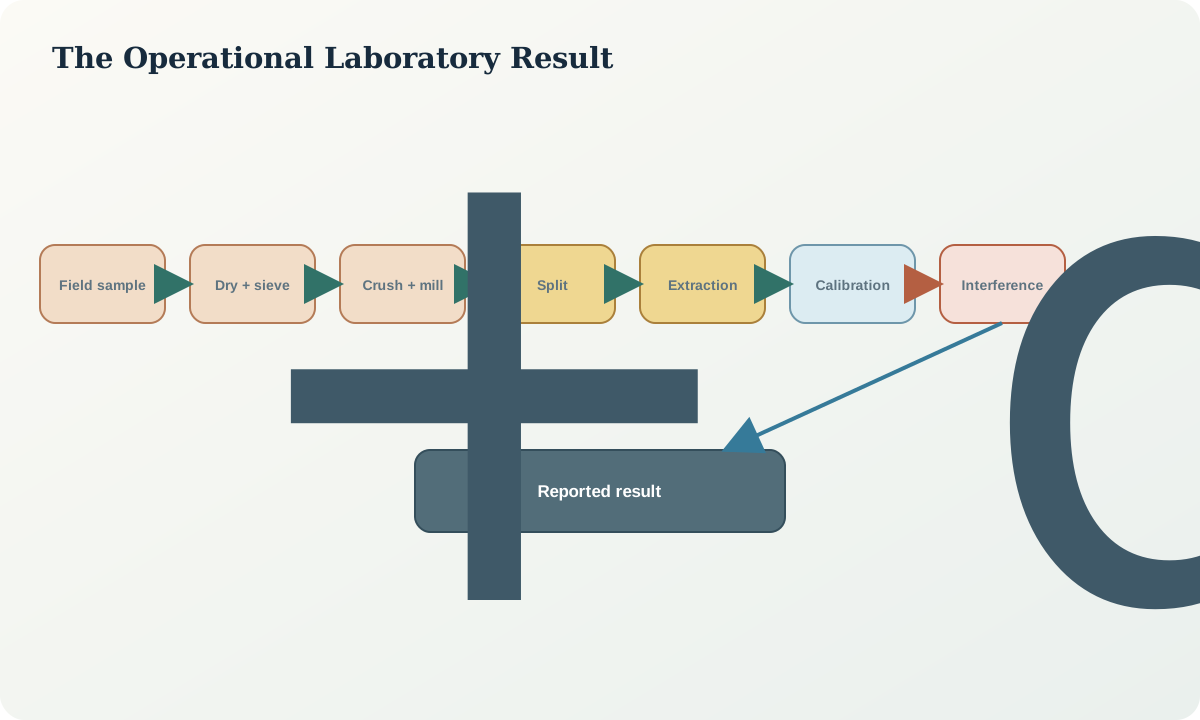
Method choice follows mineral residence and question. If the target element sits in a resistant mineral, a weak extraction may report little even when bulk concentration is high. That can be failure for total characterisation but deliberate selectivity for detecting reactive coatings. State whether the method is intended to estimate bulk content or a process-sensitive fraction.
Recovery is composition-dependent. A reference material similar in concentration but unlike in mineralogy may not test decomposition of the relevant carrier. Use multiple materials where necessary and interpret bias by element, matrix, concentration and batch. Do not correct routine results by a single recovery factor unless the correction model is validated and retained as a separate derived value.
Measurement, calibration and interference
Measurement methods convert physical response into concentration through calibration. Relevant properties include working range, sensitivity, selectivity, precision, detection and quantification capability, drift, carry-over, matrix effects and spectral or chemical interference. A low nominal detection limit is not useful if preparation contamination or field heterogeneity dominates.
Calibration should bracket relevant concentrations and include independent checks. Results above range require validated dilution or alternate measurement; results below reporting limit retain their qualifier. Internal signals, spikes or interference monitors can identify suppression or enhancement, but the rule and acceptance limits must be method-specific and documented.
Multi-element packages combine analytes with different carriers, recoveries and interference risks. Review each decision-critical element, not just overall batch acceptance. A package may be fit for broad screening while one critical element requires another preparation or method. Cross-method comparisons need paired samples across the relevant matrix and range.
Method selection and validation
Write a method-requirement table: element or ratio; expected carrier; medium and fraction; expected background and anomaly range; required reporting limit; required upper range; acceptable bias and precision at decision points; known interference; control material; and action if performance fails. This turns a catalogue choice into a testable specification.
Validation demonstrates fitness for the intended use. It can include selectivity, range, calibration model, detection capability, precision under repeatability and intermediate conditions, bias, recovery, robustness, carry-over and measurement uncertainty. Verification confirms that an established method performs acceptably for the actual material and laboratory context. Neither is replaced by accreditation status or a method name.
When methods change between campaigns, build an overlap study. Randomise paired materials, span domains and concentrations, preserve qualifiers and evaluate concentration-dependent bias and variance. A high correlation can coexist with a large slope or intercept bias. Decide whether to keep methods separate, transform with stated uncertainty, or use only directional agreement.
Worked synthetic example
Three synthetic reference materials contain accepted concentrations of 10, 100 and 500 mg/kg of element X. A partial extraction reports 8.8, 91 and 470 mg/kg. Recoveries are 88%, 91% and 94%. A near-total method reports 10.4, 98 and 505 mg/kg, or 104%, 98% and 101%. The first method has lower recovery but a monotonic concentration response; this does not automatically make it unsuitable if the intended measurand is the extractable fraction and routine samples share comparable mineral residence.
For a synthetic routine sample, the partial extraction gives 45 mg/kg and the near-total method gives 72 mg/kg. Reporting “the concentration is 58.5 mg/kg,” their average, has no physical meaning. The two methods measured different operational fractions. Their ratio 45/72=0.625 may be useful as an orientation descriptor only after precision and matrix dependence are established.
Suppose a critical decision threshold for the partial method is 50 mg/kg and intermediate precision near that level is 8% relative. A result of 49 mg/kg should not be treated as categorically different from 51 mg/kg. Report the measurement uncertainty and use geological continuity, controls and follow-up rather than a false exact boundary.
Laboratory audit workflow
- Define the measurand and decision-critical concentration range.
- Identify carrier minerals, matrix and possible volatile or refractory behaviour.
- Trace drying, fraction selection, crushing, milling, splitting and retained masses.
- Match extraction or digestion selectivity to the intended fraction.
- Confirm calibration range, limits, dilution, interference and carry-over controls.
- Review blanks, reference materials and duplicates by element, batch and sequence.
- Separate original reports from validated derived corrections.
- Keep unlike methods distinct until an overlap study supports comparability.
- Record failures, reanalysis, alternate methods and superseded results without deletion.
- Decide fitness for each intended use, not for the dataset in the abstract.
Practice and review
- Write two different measurands for the same soil: one using a weak extraction and one using near-total digestion.
- Calculate recoveries for a reference material accepted at 250 mg/kg with results 232, 241 and 238 mg/kg, then separate bias from repeatability.
- Explain why a pulp repeat cannot diagnose poor field representativity.
- Design a cross-method overlap study that spans background, transitional and anomalous materials.
- Identify three cases where a lower reporting limit would not improve the geological decision.
Review questions: Which physical fraction entered the method? Which chemical fraction was recovered? What range and interference controls apply? Are methods operationally equivalent? Does method uncertainty change the decision?
Sources and further reading
- Compendium of analytical methods for solid and aqueous materials, provides official method scopes, preparation concepts and quality practices.
- Sample preparation manual for geochemical materials, documents crushing, milling, splitting and contamination considerations.
- Fitness for purpose of analytical methods, details validation characteristics and intended-use decisions.
- General requirements for competent testing and calibration, defines internationally recognised laboratory competence requirements.