C3 · Publication Volume 13
Geochemical Interpretation and Targeting
process-based interpretation, false positives and negative evidence
Learning goals
The learner should be able to translate a mapped geochemical pattern into alternative process hypotheses; distinguish observation anomaly, source hypothesis and exploration target; combine supporting and negative evidence without double counting; evaluate data quality, detectability and transport before interpreting absence; rank follow-up by discrimination and uncertainty reduction; and write a targeting statement that remains conditional and auditable.
Interpretation is an inverse problem: many source, transport, medium and analytical combinations can produce similar observations. The goal is not to name the most attractive geology from one pattern. It is to construct a small set of viable explanations, derive risky predictions and choose a follow-up that can separate them.
From observation to process hypotheses
Begin with an observation statement free of cause: medium, support, method, domain, spatial pattern, element or ratio contrast, quality status and uncertainty. Then propose alternatives at comparable detail. Typical classes include local geological source, transported geological material, ordinary lithological or regolith variation, hydromorphic redistribution, external material, preparation or analytical artefact, and data-handling error.
Each hypothesis must predict location, direction, carrier phase, element association, depth or horizon response, cross-medium relation and negative evidence. A hypothesis that can accommodate any outcome is not testable. Record auxiliary conditions such as preservation and method sensitivity so a failed prediction cannot be excused silently.
Separate the anomaly geometry from the inferred source and target. A drainage anomaly may support an upstream catchment. A transported soil anomaly may support a corridor opposite the transport direction. The target can be deeper or offset. Preserve uncertainty envelopes and alternative geometries.
Evidence integration and dependence
Group evidence by causal origin: field geology, regolith process, independent medium, mineralogy, geochemical association, spatial pattern, and quality controls. Several correlated elements from one carrier or several maps derived from the same assay table are dependent. Count them as one evidence family or model their dependence.
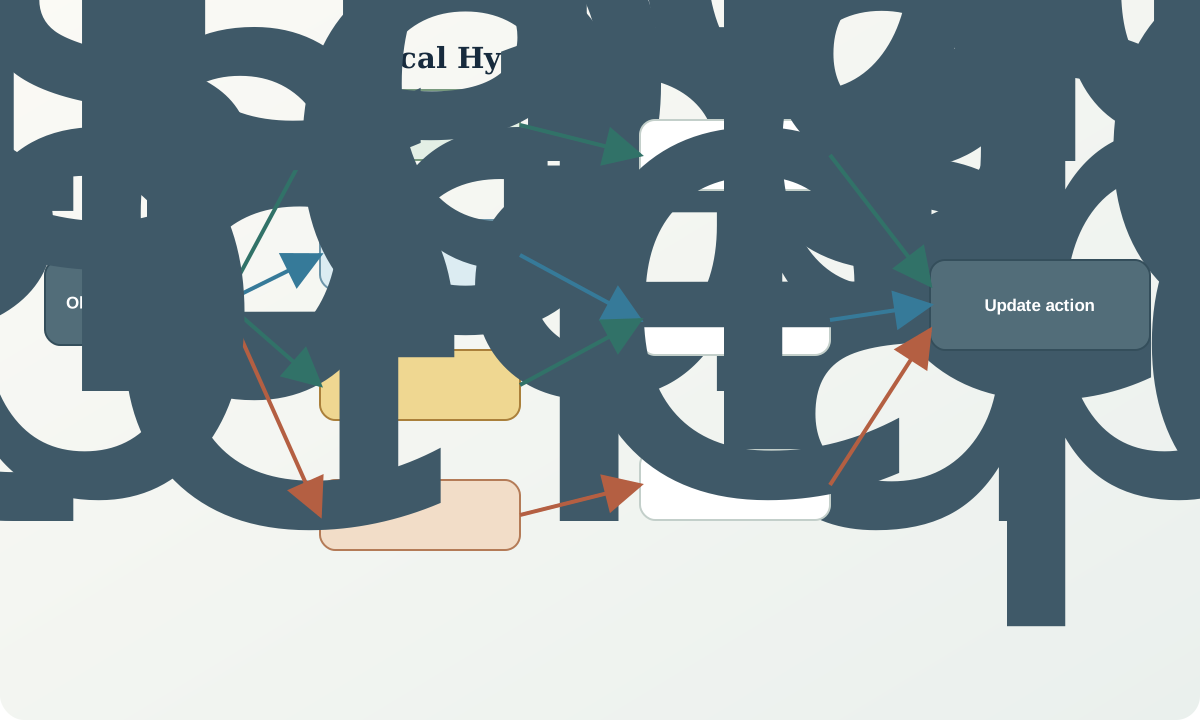
Evidence can support, contradict or remain uninformative. A high-quality absence is negative evidence only when the hypothesis predicts a detectable observation at the sampled support. A failed method, thick masking cover or wrong fraction makes the observation indeterminate rather than negative. State detection adequacy explicitly.
Use conditional-probability updates or transparent evidence matrices when calibrated probabilities are defensible; otherwise use bounded scenarios. Scores are not probabilities. A high score cannot override a failed necessary quality gate or a refuting process observation. Sensitivity analysis should reveal which assumption controls rank.
False positives, false negatives and follow-up
A false positive is not simply a high value without a discovery. It is an observation classified as the target process when another process generated it. False-negative risk arises when the target process exists but the chosen signal chain does not produce a detectable result. Orientation evidence, controls and process models estimate these risks.
Follow-up should maximise discrimination, not just repeat density. If transport and local-source hypotheses predict different grain fractions, analyse paired fractions. If hydromorphic and detrital processes differ by phase, compare selective and broader extraction with mineralogy. If an artefact predicts batch alignment, reprepare retained material in random order and collect independent field checks.
Consider burden and disturbance. A lower-impact observation that can reject a major alternative may be preferable to an intrusive test that produces ambiguous evidence. Legal permission, safety and environmental controls are gates, not quantities a strong geochemical score can compensate.
Target statements and decision gates
A defensible target statement includes: observation footprint and version; leading and alternative source hypotheses; geological and transport geometry; necessary process conditions; supporting and refuting evidence; quality and detectability status; unresolved data gaps; predicted outcomes of the next test; and actions for positive, negative and indeterminate results.
Use maturity states such as observation, anomaly under review, process-supported anomaly, follow-up target and tested target. Promotion requires evidence defined in advance. Downgrade or pause when controls fail, alternative explanations strengthen, access is unresolved or a test cannot change action.
Keep economic and resource conclusions outside the scope of geochemical targeting. Concentration in a surface medium is not grade, continuity, recoverability or value. Target rank means priority under a stated exploration decision, not a promise of discovery.
Worked synthetic example
A synthetic coherent X–Y anomaly has three hypotheses: H_1, a local bedrock-related process; H_2, transported material; and H_3, preparation contamination. Initial weights are 0.40, 0.35 and 0.25. A mineralogical observation has likelihoods 0.70, 0.45 and 0.10. Unnormalised weights become 0.280, 0.1575 and 0.025; their sum is 0.4625. Normalised weights are 0.605, 0.341 and 0.054.
A cross-slope profile then aligns with transport direction. Conditional likelihoods are 0.25, 0.75 and 0.30. Updated unnormalised weights are 0.1513, 0.2558 and 0.0162; after normalisation they are approximately 0.357, 0.604 and 0.038. The leading explanation changes from local source to transport. The result should move follow-up up-transport, not simply increase sampling around the highest value.
These numbers are synthetic judgments, not calibrated discovery probabilities. A robust decision test varies each likelihood over defensible ranges. If H_2 remains leading, the direction is stable; if rank changes easily, the appropriate output is tied hypotheses and a more discriminating test.
Interpretation audit workflow
- Write a cause-free observation statement with quality and support.
- Construct local-source, transport, ordinary-background and artefact alternatives.
- Derive spatial, mineralogical, medium and analytical predictions for each.
- Test detection adequacy before treating absence as contradiction.
- Group dependent observations by causal origin.
- Apply necessary quality and process gates before scoring support.
- Evaluate sensitivity to thresholds, domains, censoring and likelihood assumptions.
- Separate anomaly, inferred source and target geometries.
- Choose a safe and lawful follow-up that best separates hypotheses.
- Record positive, negative and indeterminate actions before results arrive.
Practice and review
- Recalculate the synthetic update using equal initial weights and compare the final order.
- Write distinct predictions for a residual source, downslope transport and preparation contamination.
- Identify three maps derived from the same assay table that should not be counted as independent evidence.
- Design a follow-up where a negative result would genuinely reduce the local-source hypothesis.
- Rewrite “the anomaly proves a target” as a conditional, auditable target statement.
Review questions: What was observed without causal language? Which viable alternatives remain? Is negative evidence detectable? Are evidence groups independent? Which next result would change the action?
Sources and further reading
- Process-based interpretation of exploration geochemistry, develops geological interpretation beyond threshold exceedance.
- Geochemical exploration strategies in deeply weathered terrain, compares process-sensitive follow-up under transported cover.
- Primary-halo interpretation using compositional methods, links multivariate patterns to process and targeting.
- Characterising background and anomalous populations90085-9), examines ambiguity between background and anomaly populations.