B5 · Publication Volume 10
Fluid–Rock Reaction and Alteration
reaction fronts, buffering, mobility and mass transfer
Learning goals
After this lesson, you should be able to describe alteration as a coupled process of fluid transport, mineral reaction, porosity change and mass transfer. You should be able to distinguish open-space filling from replacement, use textures to order reactions, calculate an immobile-reference mass balance, and design a profile that separates pathway, reaction front and host-rock control.
The lesson avoids treating colour or a single mineral as a universal alteration label. The same mineral may form under different temperatures, fluid compositions and reaction progress; the same fluid can produce different assemblages in different host rocks. A defensible interpretation states reactants, products, geometry, timing and alternatives.
Transport, reaction and feedback
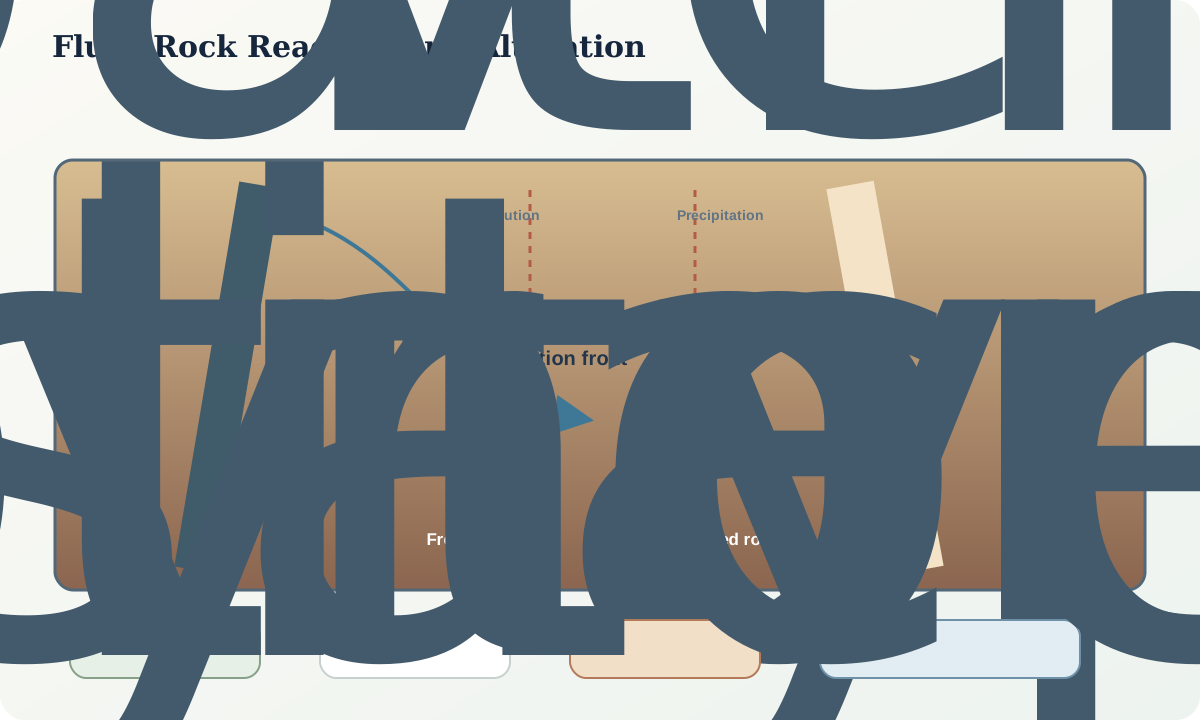
Fluid reaches a reaction site by advection through connected permeability, diffusion along chemical-potential gradients, or a combination. Reaction consumes and produces aqueous species and minerals. Dissolution can increase porosity; precipitation can clog pathways; fracturing can reopen them. Permeability therefore evolves with reaction instead of remaining a fixed input.
The relative rates of transport and reaction control front geometry. Rapid reaction relative to supply can create a sharp front. Slow reaction, dispersion, heterogeneous flow or repeated pulses can create broad overlapping zones. A mapped alteration width is not a direct clock unless transport, kinetics and boundary conditions are independently constrained.
Temperature, pressure, fluid composition, water-rock ratio, redox state, host composition, surface area and deformation all matter. “Hydrothermal” describes involvement of hot aqueous fluid but does not specify source, temperature, duration or economic significance.
Replacement, veins and reaction textures
Open-space filling precipitates in a cavity, fracture or pore. Replacement consumes a precursor while a product grows, often through dissolution-precipitation at an interface. A pseudomorph preserves external form but not necessarily internal composition or crystallographic continuity. Ghost grains, embayments, rims, porous fronts and cross-cutting relations can reveal the sequence.
Replacement can be approximately volume preserving even when mass and composition change. It can also generate or destroy porosity. A sharp optical boundary is not automatically an equilibrium boundary; it may be a kinetic interface or a permeability contrast. Imaging across the front should pair mineral identity, texture and chemistry.
Veins record opening, sealing, replacement or several repeated events. A vein mineral may be younger than its wall-rock alteration, coeval with a selvage, or reopened later. Separate vein generations before pooling chemistry or ages. Fragments in breccia, crack-seal bands and cross-cutting veinlets provide relative order independent of geochemical similarity.
Reaction progress and mass transfer
A balanced mineral reaction is a bookkeeping hypothesis. It conserves elements and charge, but it does not by itself demonstrate that the listed minerals coexisted or that equilibrium was reached. Reaction progress \xi can describe how far a specified reaction advances, while external fluxes account for components entering or leaving.
For altered and precursor rocks, a conserved reference r gives
$M_f/M_0=C_{r,0}/C_{r,f}.$
The transfer of component i per initial mass is
$\Delta m_i=C_{i,f}\frac{M_f}{M_0}-C_{i,0}.$
Concentrations and masses must share a compatible basis. Positive transfer is gain under the stated sign convention; negative is loss. Report both absolute transfer and relative change because a large percentage can represent a small inventory near detection limits.
Water-rock ratio is not a directly observed universal number. It depends on whether the ratio is cumulative or instantaneous, mass or volume based, and which fluid parcel is represented. Reactive transport may allow a small standing fluid volume to process a large rock mass through repeated flow.
Mapping and analytical design
Map least-altered host, fracture network, veins, selvages, replacement fronts and weathering separately. Sample perpendicular and parallel to pathways, across host lithologies and through overprinting relations. A single “background” sample cannot represent a heterogeneous precursor. Use petrography to test precursor equivalence before mass-balance modelling.
Pair whole-rock chemistry with mineral abundance and composition. Whole-rock gain of potassium, for example, should have plausible potassium-bearing products and textures. A decrease in sodium should correspond to destroyed or modified sodium-bearing phases or an explained dilution effect. Spatially resolved analyses test whether components reside in alteration minerals, inclusions or remnant host.
Use multiple candidate immobile components and inspect their mineral hosts. Mechanical concentration of resistant grains can violate immobility even without chemical transport. Include blanks, duplicates and matrix-appropriate reference materials. If samples cross veins or reaction fronts, record the sampled proportions rather than treating them as homogeneous rock.
Worked synthetic example
A synthetic precursor contains 100 mg/kg Zr, 65.0 wt% SiO2 and 2.00 wt% K2O. An altered sample contains 120 mg/kg Zr, 62.0 wt% SiO2 and 4.50 wt% K2O. If Zr is conserved and both samples represent equivalent precursor volumes before reaction,
$M_f/M_0=100/120=0.8333.$
The final silica inventory relative to the initial inventory is
$0.8333\times\frac{0.620}{0.650}=0.7949,$
indicating 20.5% silica loss. The potassium-oxide inventory ratio is
$0.8333\times\frac{0.045}{0.020}=1.875,$
indicating 87.5% gain. Raw concentration alone would show silica decreasing by only 4.6% and potassium increasing by 125%; neither describes mass transfer because total rock mass changed.
The interpretation remains conditional. Zr may reside in resistant grains that were mechanically concentrated, and the selected precursor may not match the altered protolith. A second reference, mapped mineral proportions and a spatial trend across the front are required before the gain-loss model is accepted.
Interpretation workflow and uncertainty
- Establish relative timing from contacts, cross-cutting, replacement and overgrowth textures.
- Define fluid pathways and distinguish them from reaction products.
- Identify precursor and products at mineral and whole-rock scales.
- Write candidate reactions and check element and charge balance.
- Select and test several immobile references.
- Calculate total-mass and component-transfer ranges.
- Link gains and losses to observed mineral hosts and complementary reservoirs.
- Test transport-reaction predictions across distance, lithology and structure.
- Preserve alternative sequences and model boundaries.
Failure modes
Colour-only logging, one-sample background subtraction, universal alteration-zone sequences and vein pooling are common failures. Another is calling an element mobile because its concentration fell, without correcting for total-mass change. Equilibrium diagrams can identify possible assemblages but cannot replace textural evidence for reaction direction and timing.
Uncertainty includes precursor heterogeneity, sampled proportions, mineral modal estimates, analytical basis, reference mobility, reaction stoichiometry and unobserved fluid flux. Structural uncertainty in pathway topology may dominate numerical analytical uncertainty. Report maps and section geometry with the chemical calculation.
Practice and review
- Draw three textures that distinguish open-space filling, interface-coupled replacement and late fracture coating.
- Recalculate the synthetic example using a reference that changes from 50 to 55 mg/kg and compare conclusions.
- Design a transect that tests whether an alteration halo is controlled by distance from a fracture or by host lithology.
- Balance a simple dissolution-precipitation reaction and list the aqueous components that must enter or leave.
- Create an evidence matrix for two competing sequences: early alteration cut by vein, and vein with later wall-rock replacement.
For the completion exercise, construct a synthetic cross-front dataset with six samples, two lithologies and two vein generations. Calculate mass transfer with two references, map mineral hosts and write an event sequence that states which links are observed and which are inferred.
Sources and further reading
- Putnis, Mineral replacement reactions, textural and mechanistic basis of dissolution-precipitation replacement.
- Putnis, Mineral replacement reactions in the geological record, expanded treatment of interfaces, porosity and reaction fronts.
- Ferry and Gerdes, Chemically reactive fluid flow during metamorphism, integration of transport, reaction and field evidence.
- Gresens, Composition-volume relationships of metasomatism90004-6), quantitative mass and volume basis for alteration.
- Lasaga, Chemical kinetics of water-rock interactions, rate controls that limit equilibrium interpretations.