E1 · Publication Volume 23
CRS Failure Modes and Validation
wrong datum, swapped axes, feet versus metres and zone errors
Learning objectives
diagnose wrong datum, wrong zone, swapped axes, unit mismatch, false origin, missing epoch, vertical-reference and raster-alignment failures; rank hypotheses from residual signatures; design independent controls; and release only a reproducible correction.
The objective is transferable reasoning, not operation of a named product or performance of regulated survey work. Every real decision must use current applicable requirements, authorised control and competent review.
Decision context
The decision is whether a spatial anomaly is caused by the Earth model, CRS definition, coordinate operation, data parsing, local grid, vertical reference, geometry support or source observation. Moving a layer until it looks right destroys evidence. The analyst freezes the symptom, defines expected location and accuracy, builds competing hypotheses and chooses tests that discriminate among them.
Failure diagnosis is a scientific process. A single observed offset can have several causes: datum generation, zone, axis order, units, sign, false coordinates, local-grid parameters, raster origin, height type, epoch or control error. Tests should target distinctive magnitude, direction, spatial variation, dimensionality and metadata signatures.
Core concept
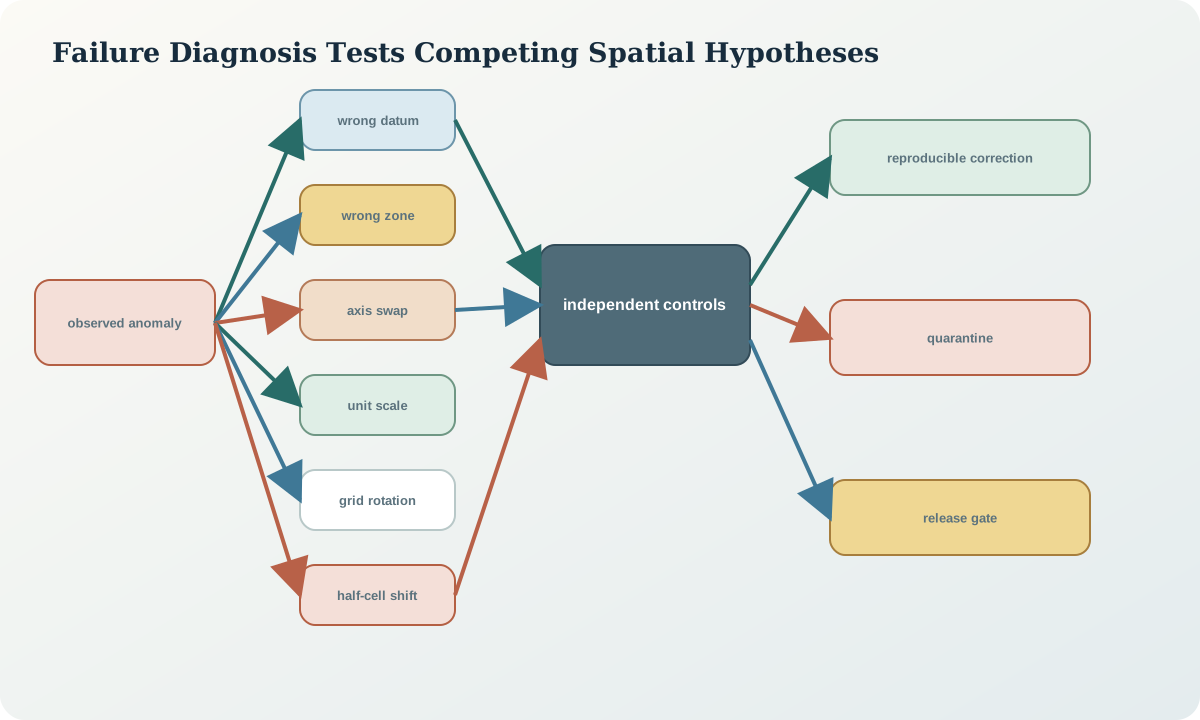
Wrong datum often produces a coherent regional vector; wrong zone can cause very large east-west displacement while numeric ranges remain plausible; swapped axes can move data far away or fail latitude bounds; feet-versus-metres causes a scale ratio; degrees-versus-radians changes magnitude dramatically; a wrong local rotation creates residuals growing with distance; a half-cell raster shift is constant in cell units; vertical mismatch affects Z without necessarily moving plan position.
Signatures overlap. A constant offset could be false origin, datum change or moved control. Rotation may arise from local grid convention or wrong axis orientation. Therefore diagnosis combines numeric fingerprints with provenance and independent controls rather than relying on one pattern.
Reference frames and metadata
The incident record captures affected dataset and version, raw checksum, first observed symptom, expected reference, coordinate samples, bounding box, CRS claims, axis and unit claims, horizontal and vertical definitions, epoch, operation resources, software or runtime version, controls, hypotheses, tests, evidence, correction, validation and downstream impact.
Do not edit the failed source. Create a quarantined copy for tests, preserve each hypothesis and record any manual exploration as a non-authoritative diagnostic step. A successful correction becomes a new version with a machine-readable operation, not an undocumented shifted file.
Quantitative reasoning
Useful fingerprints include coordinate ratios, bounding-box aspect, displacement vectors, residual versus distance from origin, residual versus longitude, rotation of a known baseline, cell-index offsets and vertical differences. For candidate operation k, compare independent residuals using both magnitude and structure; a simple score might combine robust centre, spread and trend tests, but no score replaces scientific review.
A two-dimensional Procrustes or similarity diagnostic can estimate whether translation, rotation and scale explain the anomaly. It is a diagnostic hypothesis, not permission to adopt an arbitrary transform. If fitted parameters match a known unit conversion or grid definition, seek documentary confirmation.
Evidence and uncertainty
Evidence includes immutable source files, original survey or acquisition report, producer statement, CRS definitions, export logs, control points, neighbouring independent datasets, map-sheet graticules, raster transforms, vertical records, operation resources and previous validated versions. Background maps are useful for coarse orientation but may have their own generalisation and reference limitations.
Validation must be independent of the evidence used to infer the repair. If three controls estimate a shift, different controls should test it. Where independent control is unavailable, status remains provisional and the delivery must expose that limitation.
Transformation and control
The response workflow freezes data, scopes downstream exposure, prevents further use, classifies severity, generates ranked hypotheses, performs non-destructive tests, obtains independent control, implements a reproducible correction, reruns full CRS and topology checks, compares residuals and releases through a versioned gate. Descendants created from the failed version are invalidated through lineage.
Stop when multiple hypotheses remain indistinguishable, correction requires arbitrary rubber-sheeting, controls disagree, vertical reference is unresolved, a real safety or legal decision is affected, or the source authority must clarify the data. Escalation is a successful control, not a failure of automation.
Interfaces and data
Validation services return structured findings: rule, severity, evidence, affected dimensions, candidate causes, required information, repair status and downstream scope. They never silently modify coordinates. Range checks, area-of-use checks, axis checks, unit checks and operation availability are deterministic gates; spatial plausibility and control comparison require evidence.
Release manifests include source and target checksums, correction operation, validation controls, residual summaries, unresolved limitations, superseded versions and notification status. Cached tiles and derived tables are rebuilt rather than left to mix versions.
Integration checkpoint
The checkpoint passes when at least three competing hypotheses were considered, tests distinguish the selected cause, the correction is reproducible from immutable source, independent controls pass the declared decision tolerance and all descendants are traced. If no hypothesis is proven, quarantine remains the correct status.
The learner must explain why visual nudging, changing a code, deleting outliers or adding decimal places would hide rather than solve the failure.
Synthetic worked example
A synthetic collar layer appears about 1.7 m from a terrain control, while one raster is displaced by half a cell and an old local-grid line rotates away from control with distance. The learner separates three incidents rather than applying one shift. Candidate datum operations address the coherent collar vector; raster transform metadata explains the half-cell offset; mine-grid parameter review identifies rotation convention.
Independent controls validate each new version. A fourth dataset with missing vertical reference remains quarantined. The patterns and magnitudes are synthetic and are not diagnostic guarantees for real data.
Practice task
Diagnose a synthetic failure pack containing wrong datum, wrong zone, swapped axes, feet-versus-metres, a half-cell raster shift, a local-grid rotation error and one unresolved vertical field. Build a hypothesis matrix before looking at answer metadata, run discriminating tests and implement corrections only for supported cases.
Submit immutable inputs, diagnostic calculations, residual maps, correction operations, independent validation, lineage impact and unresolved quarantine report.
Common failure modes
The following failures are treated as evidence or process defects, not cosmetic issues:
- nudging layers by eye.
- changing a CRS code without changing coordinates.
- using one offset for unrelated incidents.
- validating with controls used to infer the repair.
- deleting residual outliers without cause.
- ignoring cached descendants.
- releasing an unresolved vertical reference.
For each failure, preserve the original evidence, identify its downstream reach, define a discriminating test and record whether the case is corrected, rejected or still unresolved.
Review questions
- Which residual signatures suggest translation, rotation, scale or cell alignment?
- Why must competing hypotheses be written before repair?
- What makes a control independent?
- When is quarantine the correct final status?
- How does lineage limit the impact of a CRS incident?
Answer with definitions, evidence, a calculation or test where relevant, and the condition that would reverse the conclusion. A product screenshot or unexplained code is not an answer.
Assessment artefact
The assessment artefact is a CRS incident diagnosis and release dossier. It contains frozen evidence, hypothesis matrix, tests, rejected causes, supported correction, independent controls, error budget, downstream lineage, release or quarantine decision and a prevention rule added to the ingestion gate.
Sources and further reading
- GDA2020 Technical Manual, version 1.8, official technical definitions, formulae and worked computations; confirm the current version before operational use.
- Well-known text representation of coordinate reference systems, official standard landing page for structured CRS and coordinate-operation definitions.
- EPSG Dataset terms and completeness guidance, authoritative cautions on complete CRS descriptions, parameter conventions and dataset use.
- Geodetic transformations and conversions, official description of parameter and grid-based transformation options.
- GeoTIFF standard, official requirements for exchanging georeferenced raster imagery and CRS metadata.