A4 · Publication Volume 5
Relative Sequence of Geological History
cross-cutting relationships, superposition, unconformities and event order
Learning objectives
After this lesson, you should be able to convert mapped relationships into a partial event order, use superposition and cross-cutting cautiously, identify unconformities and distinguish what is older/younger from an unsupported numerical age.
Maps preserve relations, not a complete movie
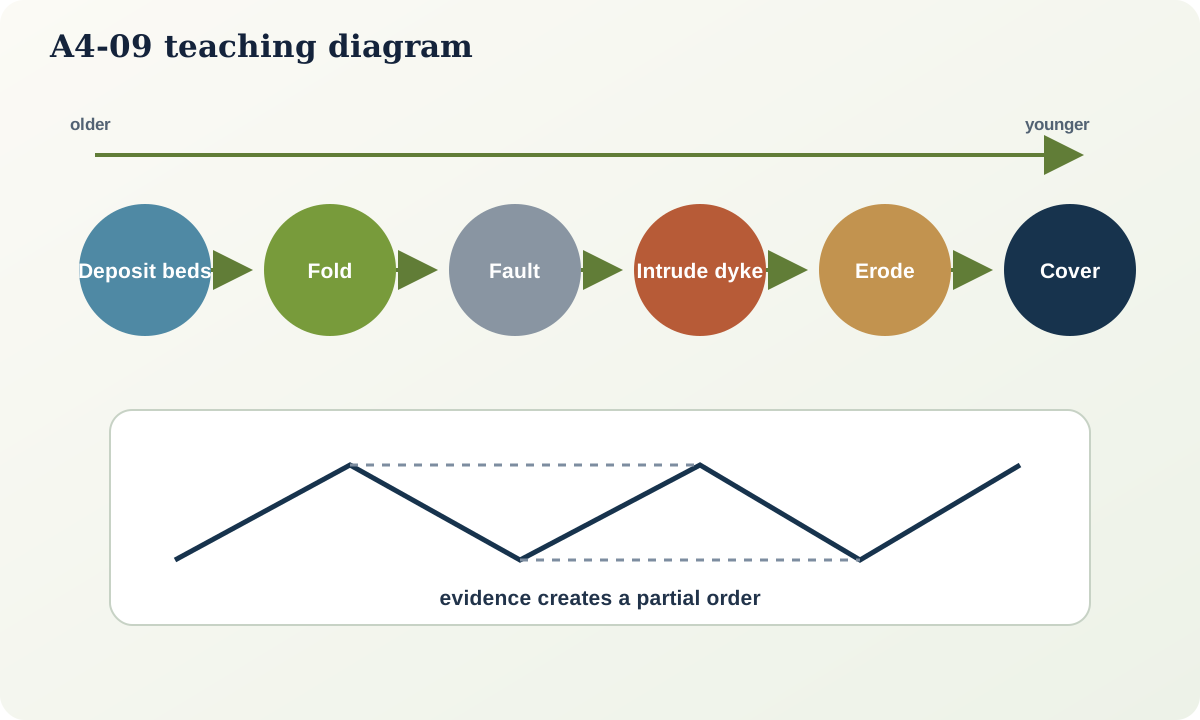
Geological history is reconstructed from surviving relationships. Relative dating orders events without assigning calendar ages. It often yields a partial order: event A is older than B, and C is older than D, while the relation between B and C remains unknown.
Core principles
Superposition: in an undeformed stratigraphic sequence, overlying beds are younger than underlying beds. Establish younging direction before applying it to overturned strata.
Original continuity: a layer may once have extended across an erosional gap, but continuity is a hypothesis to test using lithology, position, fossils, age and thickness.
Cross-cutting: a feature that cuts another is younger than the cut feature. The rule requires a real cross-cutting relationship, not mere map overlap.
Inclusions: fragments are older than the host that contains them, though reworking may give a complex history.
Unconformity: erosion or non-deposition separates older rocks from younger deposits and may truncate structures. The surface is younger than the rocks it truncates and older than the overlying material.
Overprinting: a fabric, mineral assemblage or alteration that modifies another is younger than the affected feature, provided replacement is demonstrated.
Build a relation table
For each observation, write a pairwise statement and evidence:
| Older | Younger | Evidence | Confidence | |---|---|---|---| | Unit Psh | Unit Trl | Trl overlies Psh; younging indicators upward | high at two stations | | Units Psh–Kf | Dyke d | Dyke cuts bedding and contacts | high where exposed | | Fold | Erosion surface | folded beds are truncated | high | | Erosion surface | Qs | deposit rests on surface | moderate under cover |
The table can be converted into a directed acyclic graph. If a cycle appears—A older than B, B older than C, C older than A—at least one correlation or relationship is wrong, or the named “event” combines multiple episodes.
The Open Ridge sequence
Synthetic evidence supports this order:
- deposition of Psh, Trl, Jm and Kf;
- lithification;
- folding and development of measured bedding orientations;
- faulting that offsets the marker bed;
- dyke intrusion across both beds and fault;
- erosion forming the present bedrock surface; and
- deposition of Qs in the valley.
If the dyke trace appears continuous across the fault with no demonstrable offset, it may postdate faulting, or later fault slip may be too small to resolve. The correct statement is a confidence-bearing relation, not an absolute narrative.
Separate event from feature
A fault surface may record several slip events. A dyke may exploit an older fracture. An unconformity may include weathering, erosion, non-deposition and later burial. Do not make one mapped feature equal one instantaneous event. The sequence can include formation, reactivation, alteration and exposure as separate nodes where evidence supports them.
Numerical ages enter carefully
A radiometric result dates a specific isotopic system in a specific material under assumptions. It may constrain crystallisation, cooling, metamorphism or alteration rather than the mapped event directly. Insert it into the relative graph with its geological meaning and uncertainty. A detrital grain age provides a maximum depositional constraint, not usually the deposition age itself.
Alternative histories
Where Unit X touches Unit Y only along a fault, their depositional order may be unknown. Do not order them because of legend position unless the legend explicitly encodes age. Keep unordered branches. A good history shows what is not known.
Practical investigation
Draw six synthetic features on transparent layers: three beds, a fold, a fault, a dyke and an erosional surface. Exchange the stack with another learner. They must derive pairwise relations, identify any ambiguous pair and propose one observation that would resolve it.
Common failure modes
- Applying superposition to overturned beds without younging evidence.
- Treating map overlap as cross-cutting.
- Assuming separated look-alike units were continuous.
- Reading legend position as age without checking.
- Equating one fault with one event.
- Assigning numerical ages to events that the dated material does not record.
- Forcing a complete sequence where only a partial order is supported.
Mastery check
- What prerequisite does superposition need in deformed strata?
- Why is a cross-cutting graph useful?
- Where does an unconformity lie in the relative order?
- What alternatives explain an apparently unoffset dyke across a fault?
- Why might two units in fault contact have no known depositional order?
Sources and further reading
- USGS, *Geologic Maps and Mapping Principles*: https://pubs.usgs.gov/of/1998/of98-487/haug1.html
- FGDC, *Geologic Map Symbol Standard*: https://ngmdb.usgs.gov/fgdc_gds/geolsymstd/download.php