B4 · Publication Volume 9
Chemical and Physical Weathering
hydrolysis, oxidation, leaching and disintegration
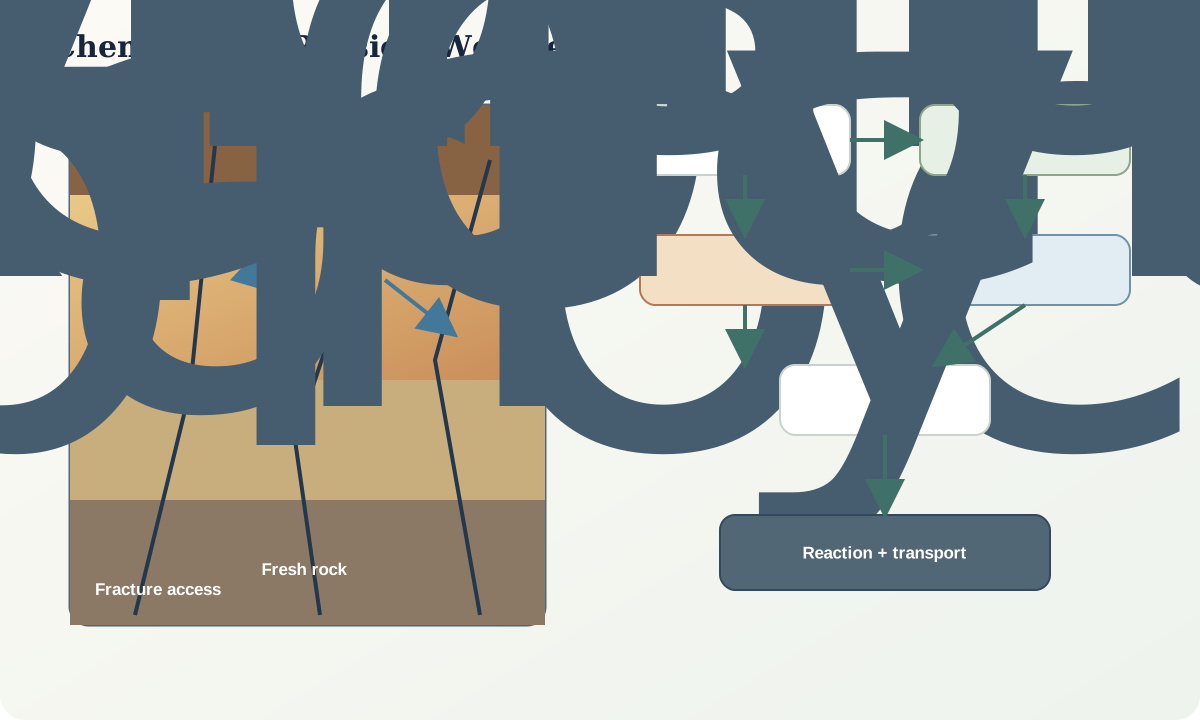
Learning objectives
After this lesson, you should be able to distinguish physical disintegration from chemical transformation; balance representative hydrolysis and oxidation reactions; explain controls on reaction rate and transport; calculate a component mass-transfer coefficient using an immobile reference; separate concentration change from mass change; and design observations that test whether a weathering front is reaction-limited or transport-limited.
Start with a field problem
A granitoid core becomes friable upward while preserving original texture. Feldspar is cloudy, biotite is altered and fractures carry iron coatings. Near the surface, quartz grains remain in a clay-rich matrix. Did the profile form mainly by physical grain separation, chemical removal, volume expansion, imported clay or several coupled stages?
Preserved texture identifies saprolitic inheritance but does not quantify mass transfer. Fractures can admit oxygenated water, reactions can enlarge porosity, and unloading or thermal cycling can create new fracture area. Conversely, secondary minerals can clog pores and slow flushing. Weathering is a coupled reactive-transport system rather than a single downward-moving colour boundary.
Core process model
Physical weathering increases surface area or separates material without necessarily changing mineral identity. Mechanisms include unloading, thermal stress, freeze–thaw, salt crystallisation, wetting and drying, root growth, abrasion and stress corrosion. Chemical weathering dissolves, hydrolyses, oxidises, reduces, hydrates, carbonates or precipitates phases. Biological activity changes acidity, redox state, ligands, moisture and physical access.
A simplified balanced hydrolysis of potassium feldspar to kaolinite is
2\,\mathrm{KAlSi_3O_8}+2\,\mathrm{H^+}+9\,\mathrm{H_2O}
\rightarrow
\mathrm{Al_2Si_2O_5(OH)_4}+4\,\mathrm{H_4SiO_4}+2\,\mathrm{K^+}.
The equation tracks atoms and charge but does not specify reaction rate, saturation state or whether kaolinite is the actual product. A simplified pyrite-oxidation pathway is
4\,\mathrm{FeS_2}+15\,\mathrm{O_2}+14\,\mathrm{H_2O}
\rightarrow
4\,\mathrm{Fe(OH)_3}+8\,\mathrm{SO_4^{2-}}+16\,\mathrm{H^+}.
Natural pathways include intermediate sulfur and iron species, microbes, buffering reactions and secondary sulfates. The generated acidity can accelerate dissolution until neutralised.
Reaction progress depends on mineral surface area, temperature, fluid composition, saturation, residence time and reactive surface condition. Supply-limited systems remove weathered material faster than fresh substrate can react; transport-limited systems retain products or solutes long enough for equilibrium or secondary precipitation to matter. Hydrology can switch the regime seasonally.
Using component i as a relatively immobile reference, mass transfer of component j can be estimated by
\tau_j=\frac{C_{j,w}C_{i,p}}{C_{j,p}C_{i,w}}-1,
where C is concentration and subscripts w and p denote weathered and parent material. The method requires plausible parent equivalence and immobility of i.
Evidence and measurement
Log weathering by material properties rather than colour grade alone: original fabric preservation, hardness, disaggregation, fracture density, porosity, mineral replacement, clay mineralogy, bulk density and chemistry. Sample fresh parent variation as carefully as the weathered profile. A single “fresh” specimen may not represent a heterogeneous intrusion or stratigraphic unit.
Mineralogy constrains reaction products; pore-water chemistry constrains active transport; solid chemistry integrates past gain and loss. Thin sections, diffraction, spectroscopy and microscopy require representative sampling and declared detection limits. Bulk density is essential for inventories. Measure water-table position and redox indicators repeatedly because one visit may capture a transient state.
Choose an immobile reference by testing several candidates, mineral hosts and profile trends. Titanium, zirconium or another refractory component may still move mechanically, reside in resistant grains or enter imported dust. Similar ratios do not prove identical parentage. Use multiple parent samples, textures and isotopic or mineralogical evidence where needed.
Worked example
In a synthetic instructional profile, parent material contains 2.0 wt% K and 0.50 wt% Ti. A weathered sample contains 0.60 wt% K and 0.50 wt% Ti. Treating Ti as immobile gives
\tau_K=\frac{0.60\times0.50}{2.0\times0.50}-1=-0.70.
The model indicates 70% K loss relative to Ti. If the weathered sample instead contains 0.75 wt% Ti because quartz and soluble components were removed, the result becomes \tau_K=-0.80. The interpretation is sensitive to the reference, parent equivalence and analytical uncertainty.
Suppose bulk density falls from 2.60 to 1.55 t/m³ while a nominally immobile element rises from 0.50 to 0.75 wt%. The higher concentration does not mean addition. For equal present volume, its inventory changes from 13.0 to 11.6 kg/m³, so even the “immobile” element appears to have lost mass or the equal-volume assumption is inappropriate. Strain and volume change must be considered.
Misinterpretations and uncertainty
Do not write an unbalanced reaction as if it proved a pathway. Do not infer current reaction rate from the total depth of a profile without age and denudation constraints. Deep saprolite may be old, polygenetic and partially stripped. A weathering front can be irregular along fractures and mineral domains; one vertical core may not define its geometry.
Chemical depletion indices can be dominated by parent composition, sorting, potassium addition or mixed material. Loss on ignition combines several volatile components and is not a direct clay or organic-carbon measurement. Oxidation colour does not prove an oxidising pore water at the time of sampling.
Practical investigation
Select a hypothetical rock containing feldspar, mica, quartz and sulfide. Draw a reaction network showing primary minerals, aqueous products and possible secondary phases under oxidising and reducing conditions. Balance at least one reaction and state which variables control rate and equilibrium.
For a supplied depth profile, calculate \tau for three mobile elements against two candidate immobile references. Plot the results with density, mineralogy and fabric preservation. Identify intervals where transported input or parent change is a better explanation than progressive in-place weathering.
Mastery check
- How can physical disintegration accelerate chemical weathering?
- What information is absent from a balanced reaction equation?
- Which assumptions are required for an immobile-reference calculation?
- Why must bulk density accompany concentration profiles?
- Which observations distinguish a reaction front from an imported material boundary?
Sources and further reading
- Approaches to modelling weathered regolith, Brantley and White, 2009.
- Chemical erosion and weathering across climatic gradients, Ferrier and co-authors, 2016.
- Origin of exceptionally deep weathering profiles, Hewawasam and co-authors, 2013.
- Regolith production and chemical weathering of granitic rocks, Vázquez and co-authors, 2016.