B4 · Publication Volume 9
Regolith Profiles
residual material, transported cover, saprolite and soil horizons
Learning objectives
After this lesson, you should be able to define regolith broadly; distinguish soil horizons, saprolite, saprock, residual lag and transported cover; log profile boundaries using material evidence; explain how weathering-front advance and surface erosion control profile thickness; calculate a simple profile inventory; and construct alternative residual-versus-transported interpretations for a drill or exposure log.
Start with a field problem
A shallow excavation exposes red sandy clay over mottled clay, then friable material preserving a granitoid texture, then fractured fresh rock. Quartz fragments occur throughout, and a stone line separates the red layer from the mottled clay. Is the upper layer a soil horizon developed in place, colluvium derived from the same granitoid upslope, aeolian sand mixed into an older soil, or reworked lateritic gravel?
Depth is not origin. Material directly above bedrock can occupy an incised channel, and material at the surface can retain residual fabric. Soil horizons may cross a lithological or depositional boundary because pedogenesis overprints more than one parent. The correct log separates what is seen from how it formed.
Core process model
Regolith includes weathered rock, soil, sediments, duricrust and organic surface material above relatively fresh substrate. Saprock is partly weathered rock whose coherent rock properties remain significant. Saprolite is deeply weathered material that preserves recognisable parent-rock fabric or volume relations despite major mineralogical change. Residual regolith remains close enough to its parent for a defensible parent relationship. Transported regolith has crossed a process boundary by gravity, water, wind, ice or human movement.
Soil horizons describe pedogenic organisation, not a universal geological sequence. An A horizon may be organic-enriched and eluviated, a B horizon may accumulate clay, iron, aluminium or salts, and a C horizon may be weakly altered parent material; actual systems require the classification and diagnostic criteria used. These symbols do not replace geological descriptions.
Let W be the downward advance rate of the weathering front relative to material and \varepsilon be the surface denudation rate. A schematic thickness balance is
\frac{\mathrm{d}D}{\mathrm{d}t}=W-\varepsilon,
where D is regolith thickness. If W=\varepsilon, thickness can be steady while material continuously enters and leaves the profile. If deposition adds cover, a separate burial term is required. Density and volumetric strain connect front motion to mass.
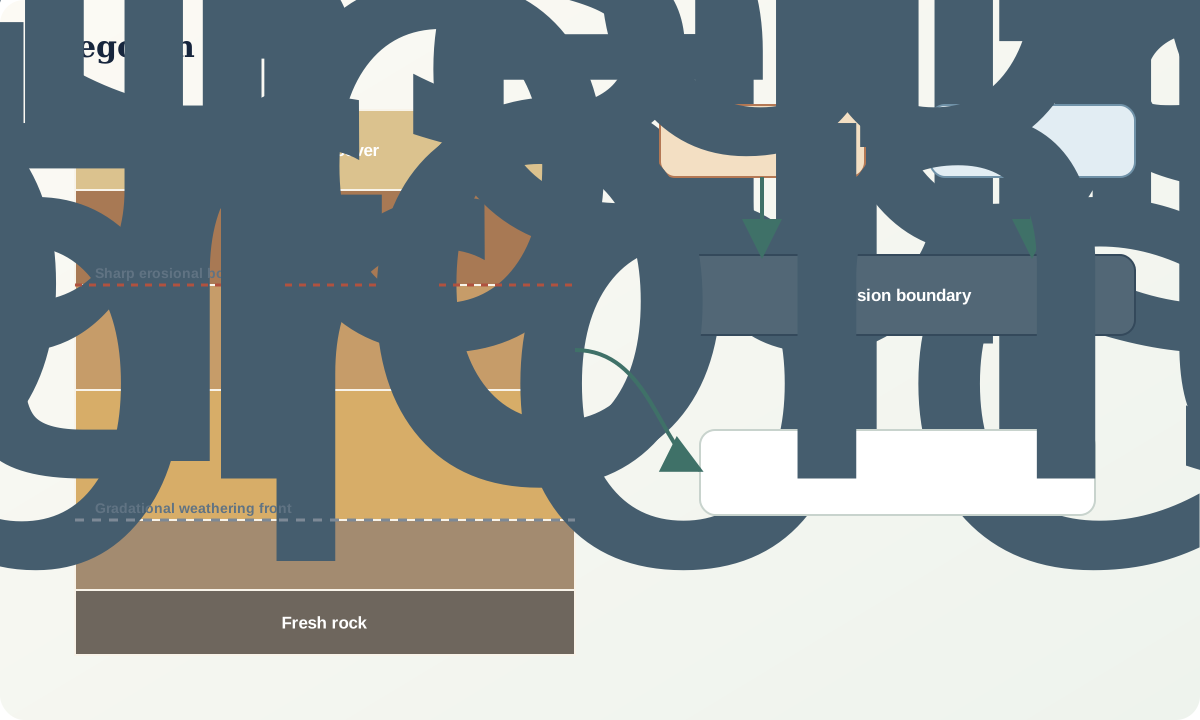
Profiles are architectures assembled through production, transformation, truncation, transport, burial and overprinting. Boundaries may be gradational reaction fronts, sharp erosional unconformities, depositional contacts, pedogenic transitions or sampling artefacts. A single profile can contain all of them.
Evidence and measurement
Log each interval for matrix and clasts, grain-size distribution, sorting, rounding, fabric, sedimentary structures, preserved rock texture, mineral pseudomorphs, hardness, plasticity, porosity, roots, mottles, nodules, coatings, cement and moisture. Describe boundaries by depth range, shape, sharpness, relief and evidence for truncation or mixing. Photograph with scale, orientation and colour control.
For drill cuttings, recovery and downhole mixing can destroy boundaries. Record method, sample interval, recovery, contamination risk and whether fragments are representative of matrix. Core or exposures preserve architecture better but remain spatially limited. Geophysics can extend boundaries only after petrophysical contrasts are measured and alternative causes tested.
Parentage is strongest when fabric, mineral sequence, resistant-grain assemblage and chemistry vary continuously into known substrate. A matching bulk composition alone is weak because transported material can share the same source. Conversely, a textural discontinuity, exotic clasts, basal lag or cross-bedding supports transport, but later weathering may blur these features.
Worked example
Consider a synthetic five-interval log:
| Depth | Main observation | Initial interpretation | |---|---|---| | 0–0.4 m | loose, well-sorted fine sand; frosted quartz | possible aeolian cover | | 0.4–1.2 m | matrix-rich gravel; rounded mixed clasts; sharp wavy base | transported lag or sheetwash | | 1.2–3.8 m | mottled clay; sparse quartz; no parent fabric | uncertain residual or transported material | | 3.8–9.0 m | friable material preserving feldspar and joint fabric | saprolite | | >9.0 m | coherent fractured granitoid | saprock to fresh rock |
The residual-versus-transported decision boundary is confidently below 3.8 m but uncertain between 1.2 and 3.8 m. Model A treats the mottled clay as upper saprolite whose fabric was destroyed. Model B treats it as transported clay deposited on truncated saprolite. Tests include resistant-mineral provenance, basal erosional geometry, immobile-element ratios, particle-size fabric and lateral continuity.
For the synthetic saprolite interval, thickness is 5.2 m, dry bulk density is 1.55 t/m³ and an element concentration is 300 mg/kg. Its areal inventory is
5.2\times1.55\times10^3\times300\times10^{-6}=2.42\ \text{kg/m}^2.
The value applies only to that interval and assumed representative density. It cannot be compared with a thin surface sample without normalising support and parent inventory.
Misinterpretations and uncertainty
Do not force every profile into a textbook horizon sequence. Do not use “laterite profile” as a substitute for interval descriptions. Core loss, sample mixing and moisture can shift apparent contacts. A gradational chemical front may appear sharp when sampled in broad intervals; a sharp depositional contact may appear smooth after bioturbation.
Preserved fabric supports in-place alteration but can occur in blocks moved without disaggregation. Destroyed fabric does not prove transport. Stone lines may form by deflation, faunal sorting, soil creep or depositional lag. Calcrete, silcrete and ferricrete can cross parent boundaries and cement both residual and transported material.
Practical investigation
Log a supplied profile twice. In the first pass, record observations only and ban origin terms. In the second, assign candidate processes and confidence. Draw at least two boundary models and mark the depth range over which each boundary could lie.
Calculate interval inventories for density and three components. Propagate uncertainty from boundary depth, density and concentration. Design one lateral transect and one mineralogical or geochemical test that would most reduce uncertainty in the transported/residual boundary.
Mastery check
- Why is a soil-horizon label not a geological origin?
- What evidence makes a saprolite interpretation defensible?
- How can regolith thickness remain steady while weathering continues?
- Why can a duricrust cross a parent-material boundary?
- Which observation best tests the ambiguous interval in the worked example?
Sources and further reading
- Approaches to modelling weathered regolith, Brantley and White, 2009.
- Origin of exceptionally deep weathering profiles, Hewawasam and co-authors, 2013.
- Regolith production and chemical weathering of granitic rocks, Vázquez and co-authors, 2016.
- Regolith geology of the Yilgarn Craton, Anand and Paine, 2002.