B4 · Publication Volume 9
Laterite, Ferricrete and Gossan
supergene minerals, iron caps, preservation and misidentification
Learning objectives
After this lesson, you should be able to distinguish lateritic weathering products, ferricrete and gossan by process and parent relation; explain residual, detrital and groundwater-driven iron accumulation; recognise evidence of sulfide oxidation; calculate concentration and inventory enrichment factors; and design tests that avoid treating every iron-rich surface material as a direct bedrock indicator.
Start with a field problem
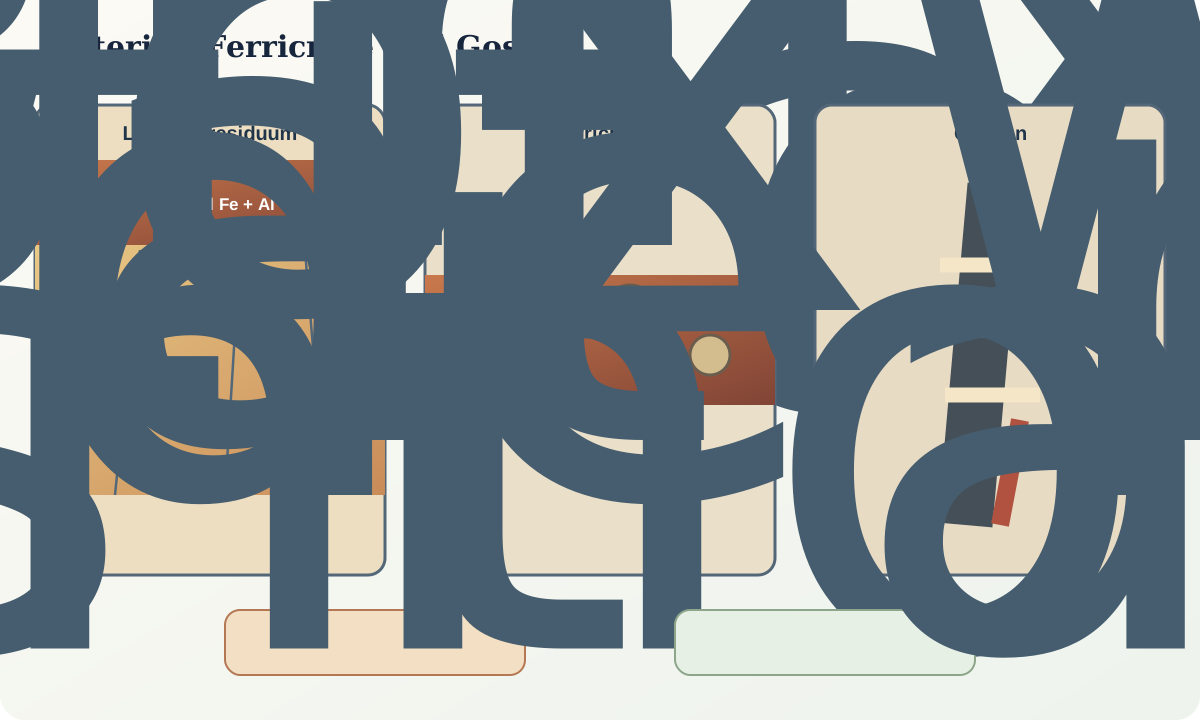
Three hard red-brown materials occur in one landscape. The first preserves the texture of mafic rock on a plateau. The second cements rounded quartz and mixed pebbles along a valley margin. The third contains boxwork cavities and secondary iron minerals above a sulfide-bearing structure. A colour-only map would combine them, but their source distances and exploration meaning differ fundamentally.
The plateau material may be residual lateritic regolith, the valley material ferricrete formed within transported sediment, and the boxwork material gossan formed by oxidation of sulfides. Yet each diagnosis remains a hypothesis. Ferruginous clasts can be reworked from a plateau, gossan can be displaced, and boxwork can be mimicked by dissolution of non-sulfide minerals.
Core process model
Lateritic weathering refers broadly to intense chemical weathering and residual or secondary concentration of relatively immobile aluminium and iron phases, commonly with strong loss of alkalis, alkaline earths and silica. “Laterite” has been used in several descriptive and genetic senses, so define the usage, material and profile position. A lateritic profile may include saprolite, mottled zones, ferruginous or bauxitic horizons and reworked products; it is not one mandatory vertical sequence.
Ferricrete is surficial or near-surface material cemented or strongly indurated by iron oxides or oxyhydroxides. Iron may be residual, transported in particles, moved in solution and precipitated at hydrologic or redox boundaries, or recycled through several generations. Ferricrete can form within alluvium, colluvium, aeolian sediment or residual regolith. Its cement age and clast age can differ.
Gossan is an iron-rich, oxidised product related to sulfide mineralisation or sulfide-bearing rock. Sulfide oxidation releases iron, sulfate, acidity and mobile metals; gangue reaction, groundwater flow and secondary precipitation redistribute them. Gossan interpretation uses relic sulfides or pseudomorphs, boxworks, mineral sequence, trace-element associations, structural continuity and depth relation to the primary sulfide source.
A concentration enrichment factor for component j is
EF_j=\frac{C_{j,s}}{C_{j,p}},
but an inventory factor should also include density and thickness. EF_j>1 does not prove external addition. Loss of other mass can raise concentration, and iron-rich scavenging phases can adsorb trace components unrelated to the immediate substrate.
Evidence and measurement
Describe clasts and cement separately. Record clast provenance, rounding, sorting, internal fabric, pisolith or nodule structure, voids, coatings, cement generations and cross-cutting veins. In suspected gossan, document boxwork geometry, pseudomorph shape, residual sulfides, sulfate minerals, jarosite or other secondary phases, pH and relation to structure. Use mineral identification rather than relying on colour or hardness.
Map geomorphic position and lateral continuity. A ferricrete sheet following a palaeovalley has different source implications from a cap conformable with underlying saprolite. Test the basal contact and material immediately above and below it. Petrography and microchemistry can distinguish detrital ferruginous grains from authigenic cement; geochronology of suitable authigenic phases may constrain one formation episode but not the entire profile.
Geochemical interpretation should compare mobile and immobile elements, expected host minerals, size fractions and leach selectivity. Strong iron content can dilute elements not hosted by iron phases or concentrate elements by adsorption. Include blanks, duplicates, reference materials and mineralogical controls.
Worked example
Three synthetic teaching samples are compared with a candidate parent:
| Sample | Fe | Ti | Cu | Key texture | |---|---:|---:|---:|---| | parent rock | 8 wt% | 0.8 wt% | 120 mg/kg | primary igneous fabric | | cap A | 40 wt% | 4.0 wt% | 300 mg/kg | parent fabric preserved | | cap B | 35 wt% | 1.0 wt% | 260 mg/kg | rounded mixed clasts in cement | | cap C | 45 wt% | 0.7 wt% | 1,800 mg/kg | boxwork over sulfide vein |
Cap A has fivefold Fe, fivefold Ti and 2.5-fold Cu concentration. Similar Fe/Ti to parent is compatible with residual mass loss, though it does not prove it. Cap B has a different Fe/Ti relation and transported fabric, so local bedrock cannot be assumed as its parent. Cap C has strong Cu and process-specific geometry that supports, but does not alone prove, a gossan interpretation.
If cap A is 2 m thick at 2.0 t/m³, its Cu inventory is 2\times2{,}000\times300\times10^{-6}=1.2 kg/m². A 10 m parent interval at 2.8 t/m³ and 120 mg/kg contains 3.36 kg/m². Despite concentration enrichment, the cap contains a smaller Cu inventory. Thickness and mass loss change the conclusion.
Misinterpretations and uncertainty
Do not infer ore directly beneath every gossan-like exposure. Sulfide-bearing barren rock can form gossan; transported gossan fragments can be displaced; metal mobility varies with pH, redox state, ligands and adsorption. Iron-rich material may inherit trace elements from groundwater rather than the vertical substrate.
Do not use a single laterite profile model across climates and landscape positions. Erosion can remove upper zones, sediment can bury remnants, and later ferruginisation can overprint both. Pisoliths are not automatically residual; they may be detrital or authigenic within transported cover.
Practical investigation
Prepare an observation matrix for three unknown iron-rich samples. Rows should include geomorphic position, basal contact, clast provenance, cement, internal fabric, mineralogy, mobile and immobile chemistry, structural relation and depth continuity. Score which observations favour residual laterite, ferricrete or gossan, while allowing mixed histories.
Build two source models for the most ambiguous sample. One must use local residual accumulation; the other must use transported sediment plus groundwater cement. Predict the petrographic, mineralogical and transect-scale result that would discriminate them.
Mastery check
- Why is “iron-rich” not a genetic classification?
- How can ferricrete form within transported sediment?
- Which evidence links a gossan to a sulfide source?
- Why can concentration enrichment coexist with inventory loss?
- How would you recognise reworked ferruginous clasts?
Sources and further reading
- Ferruginous regolith in the Yilgarn landscape, Anand, 2001.
- Gossan development and geochemical dispersion, Bowell, 1994.
- Gossan geochemistry and mineralisation indicators, Atapour and Aftabi, 2007.
- Regolith geology of the Yilgarn Craton, Anand and Paine, 2002.