E6 · Publication Volume 28
Failure Recovery and Operational Observability
corruption, partial jobs, rollback, metrics and alerts
*corruption, partial jobs, rollback, metrics and alerts*
Learning objectives
This lesson is general and institution-neutral. It uses no real company, individual, property, project or identifiable place. Generic roles describe responsibilities only, and SYN-ARCH identifiers denote explicitly synthetic teaching evidence.
- Frame the decision governed by corruption, partial jobs, rollback, metrics and alerts.
- Model the relevant boundaries, states and contracts before selecting an implementation.
- Define measurable invariants, failure evidence and a safe release consequence.
- Produce a tested recovery playbook and decision-centred observability specification from synthetic evidence and defend its trade-offs.
Decision boundary
Define failure in terms of the decision or evidence placed at risk. Component availability is useful but insufficient: a service can respond while returning stale, partial or corrupted evidence. For each failure class, define detection, containment, safe state, recovery source, recovery objective, verification and responsible role. Rollback restores a previously verified system or alias only when data and contract compatibility are preserved; otherwise use forward correction or isolated reconstruction. Observability supplies evidence for diagnosis and control, not a substitute for explicit integrity checks and recovery tests.
Core concepts
Logs describe discrete events, metrics summarize measured populations and traces connect work across boundaries. All three need stable resource, version and correlation context. Symptoms differ from causes; an alert should state the violated decision objective and lead to evidence, not claim an unverified diagnosis. Recovery point objective bounds acceptable retained-data loss, while recovery time objective bounds restoration delay for a declared service and condition. These are design inputs with consequences, not aspirational numbers. Backups, replicas, checkpoints and immutable source packages cover different failure modes and require restoration proof.
System model and contracts
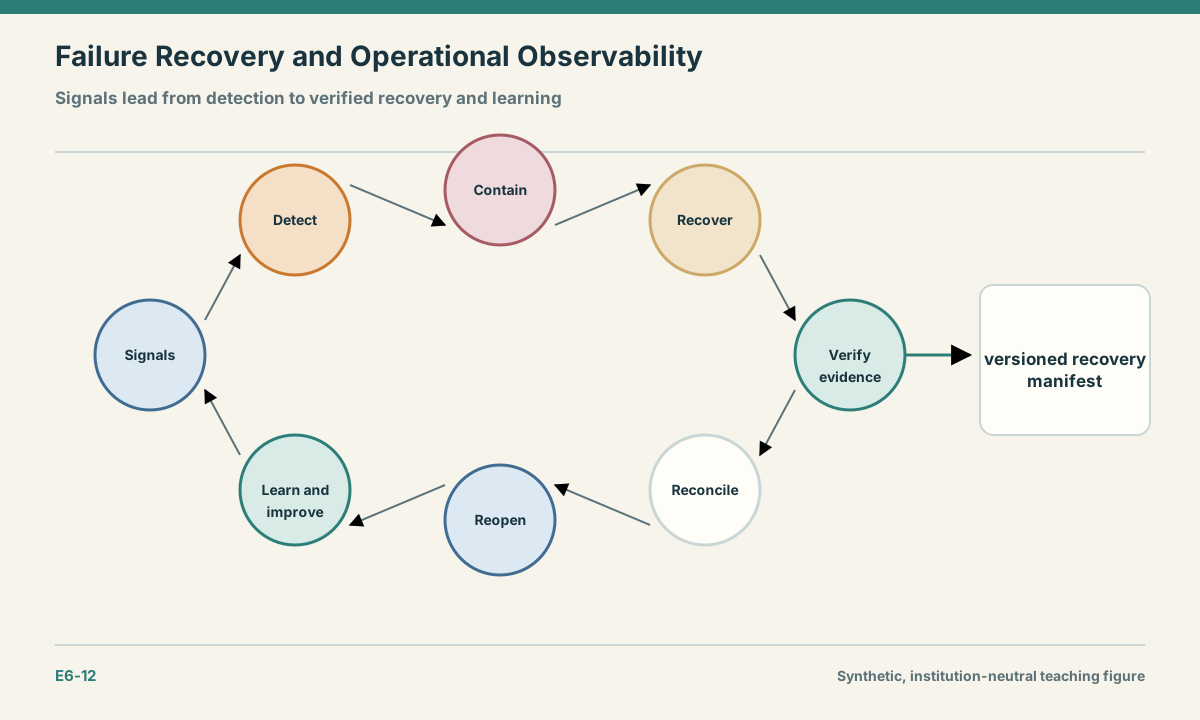
Create a failure catalogue covering unavailable dependency, delayed queue, duplicate event, partial write, missing object, digest mismatch, schema incompatibility, stale cache, corrupted checkpoint, incorrect policy and misleading output. Link each to detection signal, severity, affected decisions, containment, runbook, recovery source, verification test and escalation. Telemetry records service and operation identity, environment, version, request or run correlation, state, duration, result class and bounded attributes. A recovery manifest lists restored artefacts, source versions, procedure version, validation findings and alias movements.
Invariants and acceptance criteria
| Invariant | Test evidence | Release consequence | |---|---|---| | Health reflects correct decision-capable evidence, not process uptime alone. | contract test and recorded counterexample | block publication | | Every alert links a violated objective to bounded diagnostic evidence. | replay comparison and digest check | quarantine the artefact | | Recovery uses declared sources and verifies scientific as well as technical integrity. | role-based acceptance trace | return the decision unresolved | | Partial jobs and alias movements are reconciled before publication resumes. | failure injection and recovery record | retain the last verified version | | Incident hypotheses remain distinct from confirmed findings. | domain review against declared evidence | record an explicit review finding |
Quantitative engineering
Availability is defined over correct decision-capable responses, not process uptime alone. Report error and rejection rate by class, latency percentiles, queue age, stale-result count, digest failure, trace completeness, alert precision, detection delay, containment delay and verified recovery duration. Observed data-loss window is compared with the declared recovery point objective; recovery duration is compared with the declared recovery time objective. Use burn or trend measures only against a stated objective and window. One successful recovery does not establish a distribution, so retain repeated exercise evidence and conditions.
Data quality, evidence and uncertainty
Recovery evidence comes from controlled fault injection and isolated restoration, not from the existence of a backup label. Exercise missing and corrupted members, partial workflow output, incompatible schema, wrong alias, lost event, unavailable identity policy, stale cache and regional or node-level loss where applicable. Verify restored identity, digest, reference, units, version graph, approval state, permissions and decision outputs. Preserve timelines, commands or actions, manifests, telemetry and reviewer findings. Synthetic incidents teach process; they do not establish the probability of a real event.
Interoperability and versioning
Telemetry contracts define signal name, unit, population, dimensions, version, sampling, retention and privacy boundary. Trace context crosses client, service, job and storage work without carrying secrets. Alert contracts define objective, query, threshold or condition, evaluation window, severity, routing role, suppression, evidence link and resolution rule. Runbooks are versioned executable procedures where safe and reviewed instructions elsewhere. Recovery contracts declare source of truth, ordering, idempotency, compatibility checks, validation and rollback or forward-fix boundary.
Security and professional responsibility
Telemetry and recovery systems often aggregate sensitive identities, extents and failure details, so apply least privilege, minimization, integrity and retention controls. Correlation values are opaque and scoped. Logs reject secrets and sanitize untrusted text to prevent injection or misleading records. Backups and recovery artefacts inherit source classification and are tested under constrained identities. Incident access is temporary and audited. Recovery cannot bypass authorisation, approval history or evidence integrity merely because availability is urgent.
Operational workflow and observability
During an incident, preserve evidence while moving through detection, triage, containment, correction, recovery and validation. Record hypotheses separately from confirmed findings. Freeze or redirect publication when integrity is uncertain, while keeping a visible status for affected consumers. After recovery, reconcile every partial job and alias, replay missed events, verify caches and compare decision outputs. A review updates failure catalogue, tests, alerts, runbooks and architecture decisions. Close an incident only when the affected evidence is verified and unresolved consequences are explicitly assigned.
Integration checkpoint
Connect the failure recovery and operational observability artefact to the preceding volume architecture. Trace one synthetic object from source identity through the new boundary to a reviewed output, then trace one rejection or failure back to the earliest violated invariant. Update the architecture decision record with the chosen option, alternatives, assumptions, evidence, consequences, owner role, review state and triggers for reconsideration. A checkpoint passes only when another reviewer can reconstruct both the successful path and the blocked path without oral explanation.
Synthetic worked example
SYN-ARCH-12 reports healthy process metrics while one object upload is truncated and the manifest alias has already moved. A consumer receives a partial model. The revised publication path validates member length and digest before atomic alias movement. A trace connects upload, validation, manifest and request. Fault injection reproduces the partial write; the alert names published-package integrity rather than generic storage health. Recovery returns the alias to the last verified manifest, quarantines the candidate, replays the job and proves the restored model, permissions and version history before reopening publication.
Practice and assessment
- Which decision or evidence is unavailable, stale, partial or corrupted?
- What objective, signal and verification distinguish symptom from cause?
- Which recovery source and compatibility checks restore a safe state?
- What evidence must be reconciled before publication reopens?
Assessed artefact: a tested recovery playbook and decision-centred observability specification. Submit the artefact with its source manifest, acceptance evidence, unresolved risks and a short explanation of why one plausible alternative was not selected.
Common failure modes
- Equating process uptime with trustworthy scientific availability.
- Assuming a replica or backup is recoverable without restoration tests.
- Alerting on symptoms while claiming an unverified root cause.
- Rolling back code without checking data and contract compatibility.
- Closing an incident before affected evidence and aliases are reconciled.
Sources and further reading
- OpenTelemetry specification, defining interoperable traces, metrics, logs, resources and context propagation.
- W3C Trace Context, defining HTTP headers that propagate distributed request identity.
- NIST SP 800-61 Rev. 3 incident-response recommendations, integrating preparation, detection, response and recovery with risk management.
- NIST SP 800-53 Rev. 5 control catalogue, covering access control, audit, configuration, recovery and system integrity.
- RFC 9530 Digest Fields, defining content and representation digests for HTTP messages.