D2 · Publication Volume 18
Resource Estimation Workflow
data, domains, composites, variography, estimation and validation
Learning objectives
By the end of this lesson, the learner should be able to map an estimate from decision purpose to released evidence; identify the dependency between data, domains, support, continuity, estimation, validation and classification; define approval gates; and distinguish a numerical inventory from a reportable mineral resource.
The central discipline is sequence. Later calculations inherit earlier errors. A sophisticated estimator cannot repair biased drilling, an invalid density basis or domains that mix incompatible populations. Conversely, a modest estimator can be useful when its assumptions match the question and its limitations are visible.
Purpose, users and reference point
State who will use the model and which decisions it may support. Long-range planning, exploration targeting, environmental material accounting and short-term selectivity may require different domains, supports and resolutions. Name the reference point for quantity and quality: in situ material, excavated material, plant feed or another explicitly defined state. Do not combine quantities measured at different reference points without loss, dilution, moisture and recovery conventions.
Write exclusions beside the purpose. If the model does not include recoverability, geotechnical sterilisation or processing response, say so. A resource workflow may inform later studies but should not silently assume their conclusions.
Dependency graph and stage gates
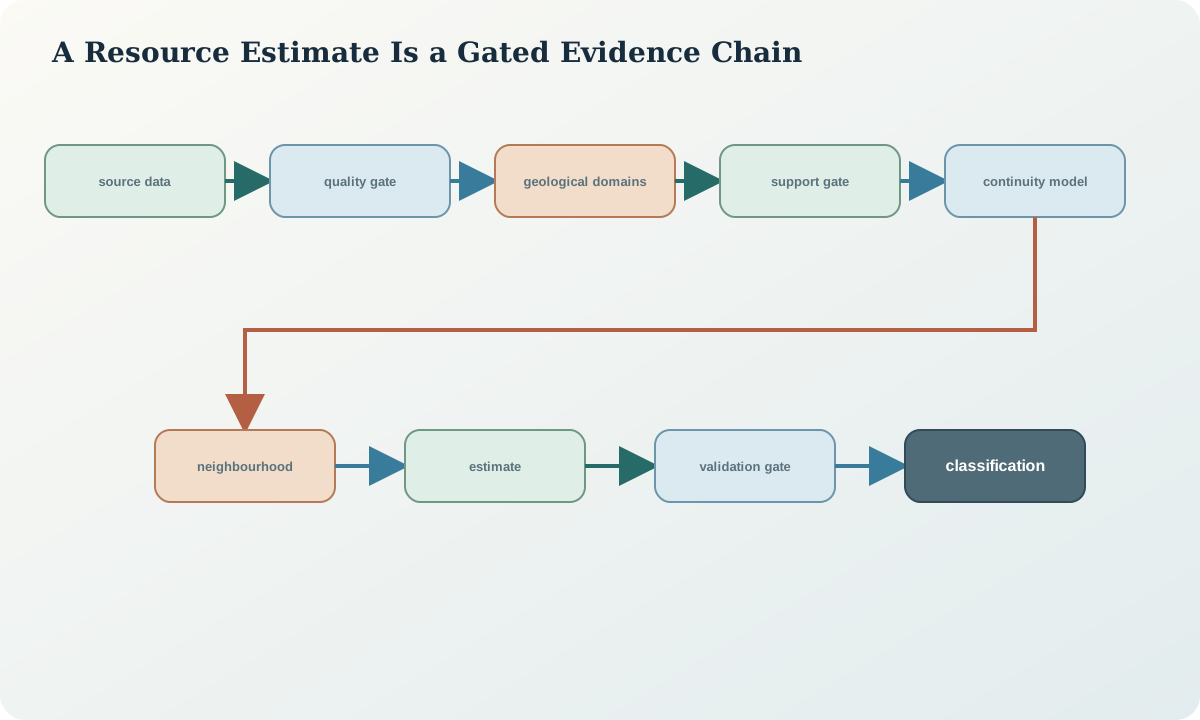
Represent the workflow as a directed graph. Raw observations feed validation; validated intervals feed domains and composites; domains and support choices feed statistics and variograms; those artefacts feed estimation; geometry and density feed tonnage; validation and reasonable-prospects evidence feed classification and reporting. A change upstream should identify every dependent artefact that becomes stale.
Use stage gates with explicit acceptance criteria. A data gate may require coordinate, interval, assay and density checks. A domain gate may require section review and contact analysis. An estimation gate may require approved variograms and neighbourhood tests. A release gate may require independent reproduction of totals, a complete limitation statement and resolution of material review comments.
Domain, support and population logic
The workflow must connect geological continuity with statistical population. A domain is not valid merely because values inside it have a similar histogram. It should have a geological membership rule, a boundary interpretation and a reason to expect usable continuity. At the same time, geological labels do not guarantee stationarity. Trends, mixtures and structural offsets may require subdomains, locally varying means or alternative scenarios.
Support is part of population definition. A one-metre composite, a five-metre composite and a twenty-metre block are different random variables even when they share a unit. Record support before comparing variance, high-grade frequency or cut-off response.
Reproducibility and separation of duties
Separate source data, derived tables, interpretations and released outputs. Source records should be immutable or versioned. Transformations should be scripted or specified sufficiently for independent repetition. Interpretive decisions need named criteria and review evidence, but the tutorial does not assign those decisions to any named person or institution.
Critical totals should be reproduced through an independent route. Examples include checking block tonnage from geometry and density outside the main model, rebuilding composite means from raw intervals, or comparing a released resource table with a query over the frozen block export. Independence refers to the calculation path, not merely a second click in the same workflow.
Inventory, estimate and classified resource
An inventory is a quantity produced by applying geometric and numerical rules. An estimate adds evidence-based assumptions about domains, support and spatial continuity. A classified resource additionally requires confidence categories and reasonable prospects under the applicable framework. These terms must not be used interchangeably.
The same block model may contain cells outside a reporting constraint, unclassified extrapolation or material with no demonstrated economic context. Preserve flags so summaries can separate those populations. Never make classification a colour ramp that automatically follows distance from data.
Synthetic worked example
For the synthetic lens, the purpose is to prepare an internal review estimate at a stated block support. The data gate rejects twelve intervals with unresolved overlaps and quarantines one duplicate mismatch. The domain gate approves two lenses and carries the fault-adjacent zone as two scenarios. The support gate adopts two-metre composites after residual and boundary tests. Estimation is run separately for each scenario.
The first release contains estimated blocks, density, unclassified and classified flags, and a scenario identifier. It does not claim mineability. A summary query shows that including unclassified extrapolation would add 18% to tonnage; that row is displayed as a diagnostic inventory, not combined with the resource summary.
Practice and review checklist
- Draw the dependency graph for a proposed estimate and identify every upstream artefact that can change tonnage or grade.
- Define one acceptance test for data, domains, support, variography, estimation, validation and release.
- Mark each output as observation, transformation, interpretation, estimate, sensitivity or reportable result.
- Reproduce one material total by an independent calculation route.
- Explain which missing evidence prevents an inventory from becoming a classified resource.
Decision record and integration
The workflow record should contain purpose, reference point, frozen input versions, approved domain version, support and block definitions, estimation scenarios, validation status, classification rules, reasonable-prospects assumptions and unresolved limitations. Link each item to its artefact rather than copying values into prose.
This record becomes the index for all following chapters. Any later change to composite length, capping, variogram range, search or density must update both the dependency graph and the release manifest.
Sources
- Mineral-resource and mineral-reserve estimation best-practice guidelines, describes the main estimation stages, review controls, validation and documentation expected in a professional workflow.
- International reporting template, 2024 edition, distinguishes exploration results, mineral resources and mineral reserves and frames reasonable prospects and confidence.
- Australasian reporting code, 2012 edition, provides a worked national expression of materiality, transparency, competence and resource definitions.
- Modernization of mining-property disclosures, provides a public-regulatory example of technical-report, qualified-person and resource-disclosure requirements.