D2 · Publication Volume 18
Compositing
composite length, residuals, domain boundaries and dilution
Learning objectives
By the end of this lesson, the learner should be able to explain why irregular intervals are regularised; calculate length- and mass-weighted composites; select and test composite length; handle domain boundaries, gaps and residuals; and preserve lineage from each composite to its source intervals.
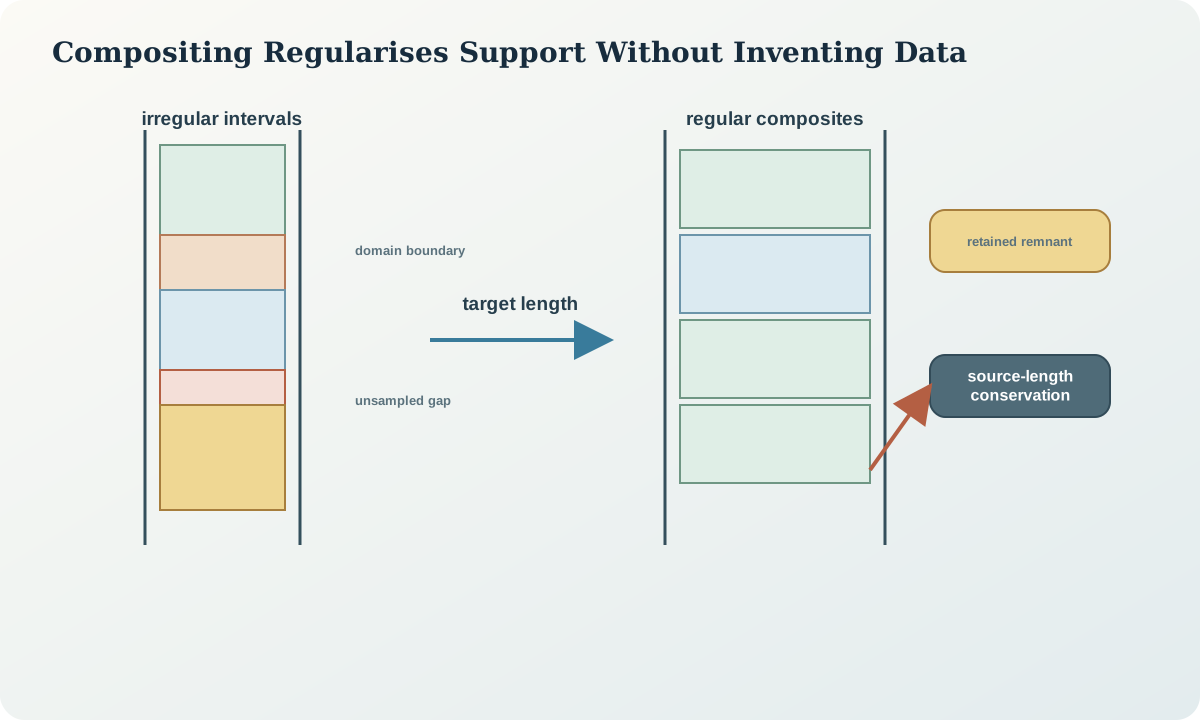
Compositing changes support. It can improve comparability, but it can also mix populations, hide extremes, create duplicated information or bias means when gaps and residuals are mishandled. The specification must be treated as an estimation parameter.
Composite objective and weighting
For compatible additive grades in intervals i intersecting a composite, use the contributing length l_i:
z_c=\frac{\sum_i l_i z_i}{\sum_i l_i}.
If density varies and the objective is a mass-weighted property, use a justified mass proxy m_i=V_i\rho_i and document how volume and density were derived. Do not mass-weight one variable while later treating the result as a simple length-support composite without recording the distinction.
The composite must store start, end, length, domain, contributing source keys, sampled length, unsampled length and any capped or transformed fields. This permits exact reconstruction.
Selecting composite length
Test candidate lengths relative to original sample lengths, geological thickness, expected continuity, data spacing, block dimensions and intended selectivity. A common sample length is a useful starting point, not a rule. Too short a composite can duplicate grades when long source intervals are split; too long a composite can blur boundaries and narrow features.
For each candidate, compare count, total sampled length, weighted mean, variance, quantiles, high-grade contribution and downhole variogram. Explain departures. The selected length should balance support consistency, population preservation and sufficient pairs for spatial analysis.
Domain boundaries and contacts
Composite within approved domains. Clip source intervals at boundaries using the adopted geometry and retain the clipped support. A composite that crosses a hard boundary combines populations the model later assumes are separate. For soft or uncertain boundaries, run alternative rules rather than conceal the uncertainty in one averaged interval.
Review composites on sections and along holes. Narrow domains may leave short intervals that fail the nominal length. Decide whether to retain, merge within-domain, weight, or exclude them using a stated residual policy.
Gaps, residuals and minimum coverage
Distinguish unsampled gaps from sampled zero-grade material and below-detection results. Set a minimum sampled proportion for a composite and report coverage explicitly. Do not fill an unsampled gap with zero unless the measurement meaning supports zero.
Residual strategies include retaining a short final composite, distributing residual length among neighbouring composites, merging it with the previous composite or excluding it. Each changes support. Compare the effect on totals and boundary representation, especially in short domains.
Validation and duplicate support
Reconcile total source length with composite length by hole and domain. Recalculate selected composites independently. Test that source metal accumulation \sum l_i z_i equals composite accumulation \sum l_c z_c within numerical tolerance for fully sampled intervals.
When one long assay is split into several short composites, the children share the same measurement information. They must not be interpreted as independent observations. Flag common source ancestry for variography and neighbourhood review.
Synthetic worked example
Candidate lengths of one, two and four metres are tested. One-metre composites triple several long assays and increase short-lag pairs without new information. Four-metre composites erase much of a narrow domain. Two metres preserves 99.6% of sampled length, changes the weighted mean by 0.2\% and retains enough within-domain pairs.
A rule requiring at least 80% sampled coverage removes 14 composites near gaps. Treating the same gaps as zero would lower the domain mean by 6.4%, so the zero-fill case is retained only as a diagnostic warning. Residuals longer than one metre are retained; shorter residuals are distributed within the final domain segment, with exact lineage.
Practice and review checklist
- Reconstruct five composites from their source intervals and confirm accumulation preservation.
- Compare at least three candidate lengths and explain changes in mean, variance and pair counts.
- Map every composite affected by a domain boundary or unsampled gap.
- Quantify the effect of each residual and minimum-coverage rule.
- Flag split children that share one original measurement.
Decision record and integration
The compositing specification should record target length, anchoring convention, weighting basis, boundary rule, gap treatment, minimum coverage, residual rule, numerical tolerances and validation totals. Store candidate-study results, not only the adopted output.
All subsequent statistics, variograms and estimates must reference the composite version. If domains change, composites must be rebuilt rather than merely recoded at their midpoints.
Sources
- Compositing and regularization of drillhole data for geostatistical resource estimation, compares compositing approaches and demonstrates effects on means, variance, gaps and variography.
- Mineral-resource and mineral-reserve estimation best-practice guidelines, places compositing inside the controlled resource-estimation workflow.
- Change of support and the volume–variance relation, explains why regularisation and block support alter variability and cut-off response.
- Choosing the discretization level for block property estimation, connects composite length, block dimensions, variogram continuity and numerical block support.