D2 · Publication Volume 18
Block Model Design
origin, rotation, parent and subcells, support and coding
Learning objectives
By the end of this lesson, the learner should be able to define a block model's origin, axes, rotation, dimensions and extent; distinguish parent cells, subcells and estimation support; code domains and proportions; manage density and units; and validate geometry and quantity independently.
A block model is a spatial data structure with numerical and geological semantics. Its cells are not observations, and smaller cells do not create resolution unsupported by data. Design must follow model purpose, geological geometry, intended selectivity and downstream interfaces.
Coordinate frame, origin and rotation
Declare the coordinate reference, vertical datum, units, local transform, axis order and rotation convention. Place the origin so block indices are stable and model extent covers the approved geological volume without excessive empty space. Record whether coordinates refer to centroids, corners or both.
Test the transform with known points and axis vectors. Round-trip local coordinates back to the source frame within tolerance. A sign or rotation-order error can shift every cell while leaving dimensions apparently correct.
Parent dimensions and intended support
Parent-cell dimensions should consider data spacing, variogram continuity, geological thickness, bench or mining geometry, intended selectivity, computational needs and reporting purpose. They should not be chosen only to follow the most detailed wireframe. The estimated support is the volume over which the property is intended to average.
Changing block size changes variance and grade–tonnage response. Compare plausible supports explicitly. A small parent block estimated with broad smoothing is not automatically a selective estimate.
Subcells, geometry and proportions
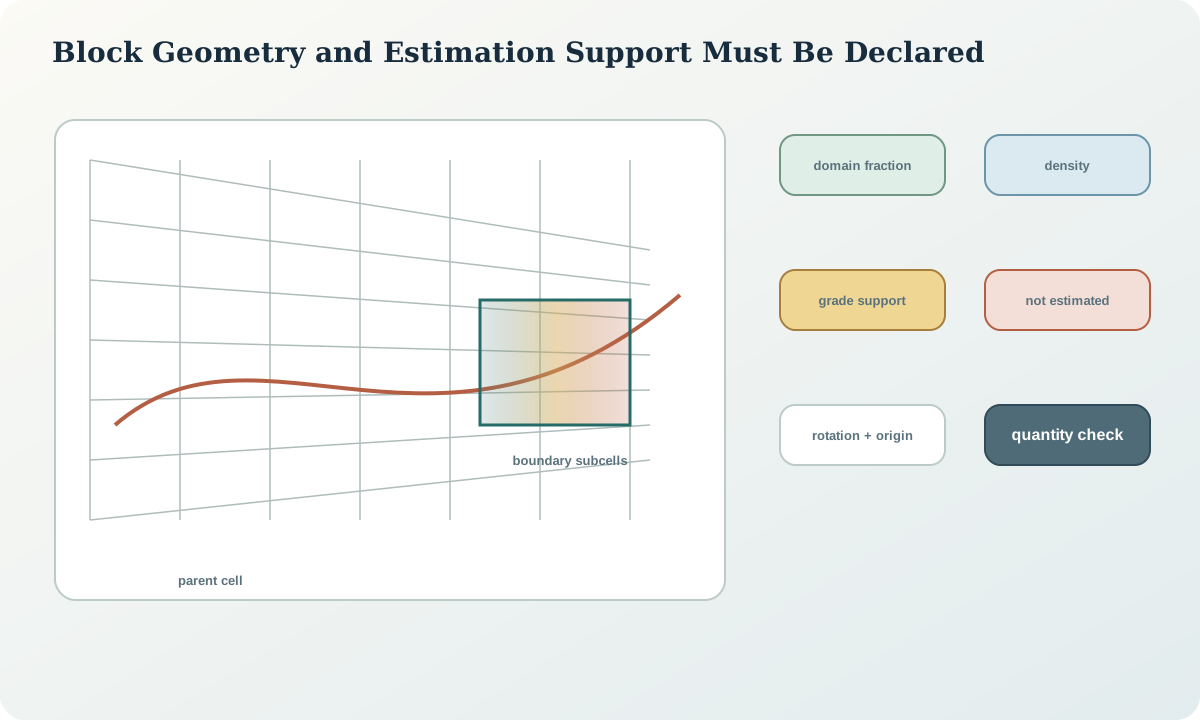
Subcells improve representation of boundaries and small geometric features. Decide whether properties are estimated at parent support, subcell support or a regular estimation grid. Copying a parent estimate into many subcells improves geometric volume but does not create finer grade information.
Store domain membership, proportion or dominant code with the rule used. Validate gaps, overlaps and cells that lie on boundaries. For proportion models, ensure proportions are in [0,1] and sum consistently for mutually exclusive materials.
Attributes, units and null states
Define a schema for geometry, domain, density, grade, estimation pass, sample counts, distances, method, classification, scenario, reporting constraint and validation flags. Use explicit null or not-estimated states. Do not use zero for an unestimated grade or default density unless zero has physical meaning.
Keep raw estimate, post-processed estimate and reporting fields separate. A rounding or classification process should not overwrite the underlying numerical result.
Tonnage and contained quantity
For a fully occupied block,
T_b=V_b\rho_b,
with moisture and material basis stated. For a partial domain fraction p_b, use T_b=p_bV_b\rho_b if the proportion and density definitions are compatible. Contained quantity for grade g_b is Q_b=T_bg_b after grade units are converted correctly.
Recalculate totals independently from block dimensions, proportions and density. Test conservation against domain solids and explain tolerance differences from subcelling or boundary approximation.
Synthetic worked example
The synthetic model uses 20\times20\times10\,\mathrm{m} parent cells aligned with the fold coordinate frame and subcells down to 5\times5\times2.5\,\mathrm{m} for boundaries. Grades are estimated at parent support; subcells inherit the parent grade and retain their own domain proportion and density. A separate 10\times10\times5\,\mathrm{m} support case is used only for sensitivity.
Independent volume queries differ from the closed-domain solids by 0.7\%, within the declared boundary tolerance. One density code is null in a weathered zone, preventing tonnage calculation rather than substituting the global mean. The omission is visible in the release summary and classification review.
Practice and review checklist
- Round-trip at least five points through the model rotation and origin transform.
- Compare parent dimensions with data spacing, continuity and intended selectivity.
- State whether every attribute is estimated at parent, subcell or another support.
- Reconcile block proportions and volumes with domain geometry.
- Independently reproduce tonnage and contained quantity with explicit units.
Decision record and integration
The block-model specification should contain coordinate frame, origin, rotation, extent, parent and subcell dimensions, support, discretisation, schema, null conventions, domain coding, density basis, quantity formulas and geometry tolerances.
Downstream summaries must reference the frozen block definition. A grid change is a new estimation scenario, not a display preference, because it affects support, quantities, validation and grade–tonnage response.
Sources
- Choosing the discretization level for block property estimation, relates block geometry and internal numerical support to variogram continuity and estimation error.
- Change of support and the volume–variance relation, explains how block volume changes variability and recoverable grade distributions.
- Mineral-resource and mineral-reserve estimation best-practice guidelines, describes block-model design, density, coding, validation and reporting documentation.
- Simple feature access, common architecture, provides general geometry and spatial-object principles relevant to valid boundaries and interoperable coordinates.