D2 · Publication Volume 18
Estimate Validation
global and local checks, swath plots, visual review and reconciliation readiness
Learning objectives
By the end of this lesson, the learner should be able to design a validation plan before seeing results; perform data-honouring, global, local, swath, boundary and visual checks; use alternative estimates and cross-validation appropriately; diagnose conditional bias and smoothing; and document unresolved failures.
Validation asks whether the implemented model behaves consistently with its purpose, data, geology and assumptions. It does not prove that the unknown ground is correct. Many checks share the same inputs, so apparent agreement is not automatically independent confirmation.
Validation plan and acceptance criteria
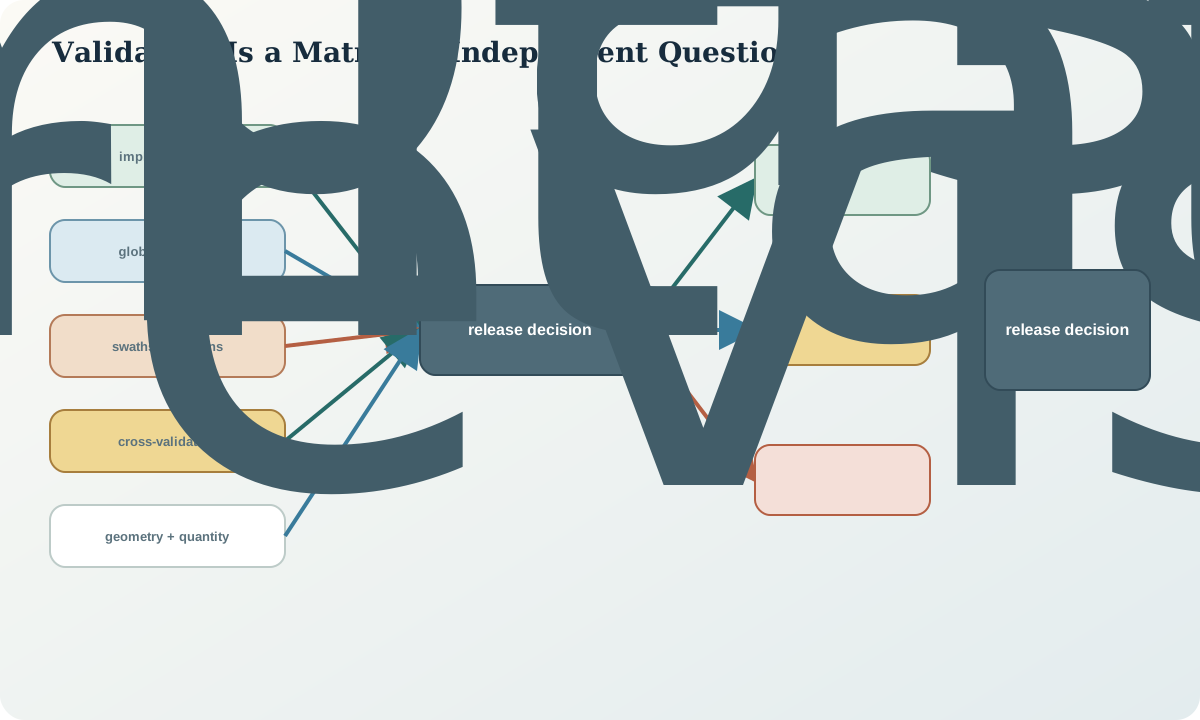
Define checks, populations, tolerances and decision owners before final estimation. Include implementation checks, geological checks, statistical checks, spatial checks, quantity checks and downstream fitness. Identify which failures are blocking and which require limitation or lower confidence.
Freeze the validation dataset and model version. Re-running until plots look acceptable without recording rejected settings is parameter tuning, not validation.
Data honouring and implementation checks
Compare estimates at sample locations or small supports, recognising that block estimates need not equal point data. Confirm domain eligibility, neighbourhood counts, pass flags, weights, discretisation and null states. Recalculate selected blocks independently from the exported inputs and parameters.
Check model extent, rotations, volumes, density, proportions, units and contained quantity. A grade model can look plausible while tonnage is wrong because of a geometry or density error.
Global statistics and distribution checks
Compare sample, composite, declustered target and block means by domain. Examine variance and quantiles at compatible support. Estimated block variance should generally reflect smoothing and change of support; matching raw sample variance may indicate overfitting or a support mismatch.
Compare grade–tonnage curves from the primary and alternative estimates. Explain differences rather than selecting the closest curve by preference.
Swaths, sections and local checks
Aggregate samples and blocks in moving or fixed windows along principal coordinates. A swath plot reveals trend reproduction, edge behaviour and local bias. Include counts, total support and uncertainty so sparse windows are not interpreted like dense ones.
Review plans, sections and three-dimensional slices with data, domains, estimates, pass, distance and differences between methods. Examine high-grade influence, hard-boundary transitions, isolated estimates and unestimated holes. Visual review needs a checklist and captured evidence, not a general statement that the model was inspected.
Cross-validation and alternative methods
Leave-one-out or leave-group-out checks test the combined domain, variogram and neighbourhood at sampled locations. Report mean error, mean absolute error, root-mean-square error, standardized diagnostics and plots by grade, domain and location. Removing whole holes can better test clustered drill data than removing one composite while leaving adjacent composites from the same hole.
Nearest-neighbour and inverse-distance models help reveal smoothing and weighting effects. They are not ground truth. Production reconciliation, when available at compatible support and reference point, is powerful but still includes sampling, movement and measurement errors.
Failure diagnosis and closure.
Trace a failed check upstream: data, support, domain, tail treatment, variogram, neighbourhood, block geometry, density or summary logic. Change one controlled assumption at a time and preserve the sensitivity. Do not correct a local problem by globally scaling the model without a causal basis.
Close each validation issue with evidence, accepted limitation, scenario or rejection. A material unresolved issue should block release or reduce the scope and confidence of the output.
Synthetic worked example
Global means agree within 1.2% after support and declustering considerations. An east–west swath shows the block model 9% high in a sparsely drilled western window. Section review finds that a long search crosses the uncertain fault scenario. Shortening the search reduces the local bias but leaves several blocks unestimated.
Both outcomes are retained. Scenario A uses the shorter search and lower coverage; scenario B keeps the longer search with a local uncertainty flag. Leave-one-hole-out validation shows lower error for A near the fault. The review does not average the scenarios; it records which geological assumption each represents.
Practice and review checklist
- Write acceptance criteria before reviewing the final model.
- Recalculate selected blocks, volumes and quantities independently.
- Compare statistics only at clearly stated supports and populations.
- Produce swaths in principal directions with support counts.
- Use leave-group-out tests and preserve every material failed check.
Decision record and integration
The validation package should contain a test matrix, input versions, scripts or queries, plots, tolerances, outcomes, issue owners, resolutions and limitations. Every plot needs domain, support, scenario and coordinate metadata.
Only validated configurations may feed grade–tonnage, reasonable-prospects and classification review. If a later parameter changes, rerun the affected validation suite rather than copying the previous approval.
Sources
- Checking continuous-variable realizations for mining, demonstrates data reproduction, cross-validation, swaths, trends and uncertainty checks.
- Mineral-resource and mineral-reserve estimation best-practice guidelines, specifies resource-block-model validation and documentation expectations.
- Process modelling, supplies a general official framework for model building, assumptions, residuals and validation.
- Impact of judgement in mineral-resource classification, provides comparative estimation, swath and classification examples and highlights practitioner sensitivity.