D2 · Publication Volume 18
Cut-Off, Grade–Tonnage and Reasonable Prospects
economic context, sensitivity and modifying factors
Learning objectives
By the end of this lesson, the learner should be able to calculate grade–tonnage curves; distinguish cut-off from reporting constraint; test economic and technical assumptions without conducting a definitive economic study; understand the effect of support and selectivity; and explain why unconstrained mineralised inventory is not automatically a mineral resource.
A cut-off is a decision threshold under stated assumptions, not a geological constant. Reasonable prospects require a defensible pathway by which some part of the material could eventually be extracted, processed and sold or used. The level of study varies with the reporting framework and context, but arbitrary inclusion is never sufficient.
Grade–tonnage calculation
For blocks satisfying a reporting constraint and cut-off c, calculate
T(c)=\sum_b T_bI(g_b\ge c), \qquad
\bar g(c)=\frac{\sum_bT_bg_bI(g_b\ge c)}{T(c)}.
Also report contained quantity Q(c)=T(c)\bar g(c) with compatible units. Curves should identify support, density basis, classification, scenario and reference point. Do not mix classified and unclassified material without separate lines.
Cut-off components and value basis
A simplified break-even relationship may include price, recovery, payability, selling cost, processing cost and incremental mining or handling cost. Multi-product material may require a value or equivalent-grade formulation, but correlations, recoveries, penalties and units must be explicit.
Inputs are uncertain and time-dependent. Use ranges and scenarios. The tutorial does not prescribe a commodity price, cost or fiscal regime; its synthetic numbers exist only to demonstrate calculation structure.
Reporting constraints and geometry
Reasonable-prospects assessment usually requires more than applying a grade threshold. Consider plausible extraction geometry, minimum width, depth, slope or underground shapes, access, recovery, dilution, processing route, infrastructure, legal, environmental and social constraints at an appropriate preliminary level.
The resource envelope should not be engineered to false precision, but it must exclude isolated or inaccessible blocks lacking a coherent pathway. Record the assumptions and the blocks excluded by each constraint.
Support, selectivity and information effect
Grade–tonnage response changes with block support and selective capability. Fine blocks may imply selection that future data and equipment cannot achieve. A smoothed estimate can understate high and low tails, while a point-support distribution can overstate recoverable selectivity.
Compare supports, change-of-support models or conditional realizations. Distinguish selective-unit grade known with current drilling from grade that could be known at mining time with denser control data.
Sensitivity, scenarios and communication
Create a sensitivity matrix for cut-off, price or value, recovery, density, support, domain and key geometry. Show tonnage, grade and quantity together. A result that appears stable globally may shift materially in one classification or spatial sector.
Avoid presenting a single cut-off as a forecast. State the base assumptions, plausible range, exclusions and non-modelled factors. An educational grade–tonnage table is not a valuation or investment recommendation.
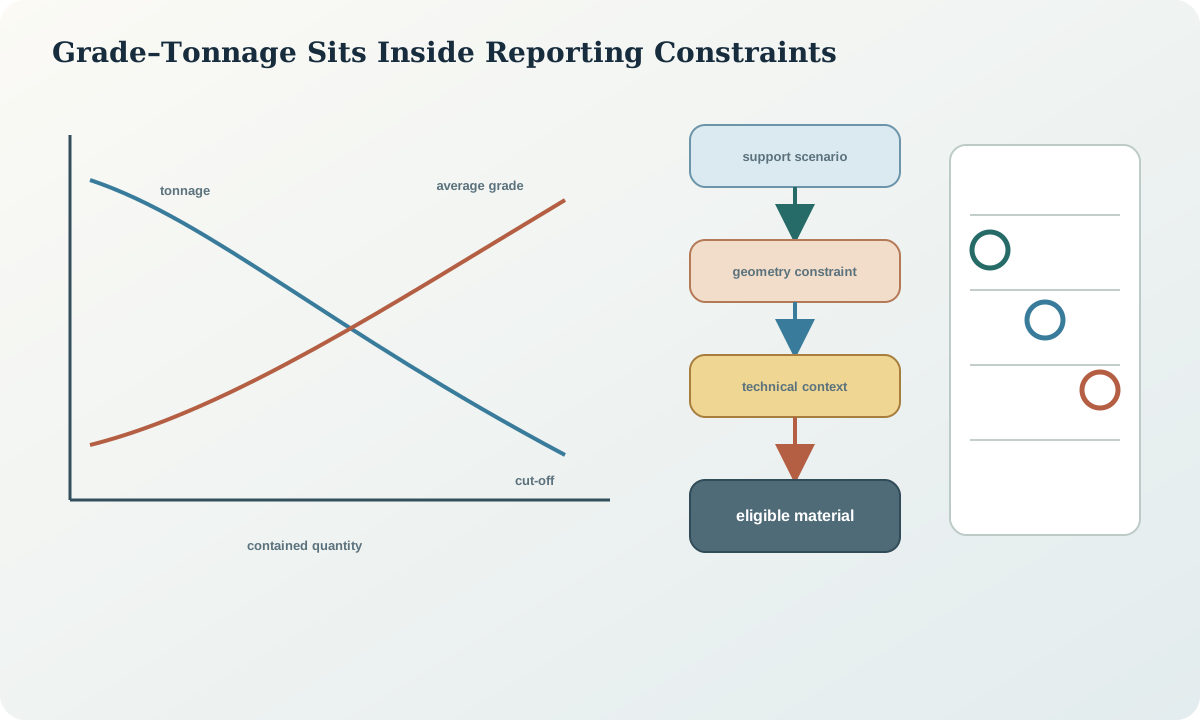
Synthetic worked example
The synthetic case uses a purely fictional value model. At cut-offs from 0.3 to 1.2 units, tonnage declines while average grade rises. Applying a coherent geometry constraint removes 7% of tonnes but only 3% of contained quantity. A smaller-support case shows more material above a high cut-off, demonstrating additional assumed selectivity.
Recovery sensitivities shift the illustrative break-even threshold enough to change the included western lens. Because that lens is also the least certain geological scenario, it is reported separately. No conclusion about economic viability is drawn.
Practice and review checklist
- Reproduce grade–tonnage and contained quantity from frozen block fields.
- Label support, density, scenario, classification and reference point on every curve.
- Separate grade threshold from geometric and other reporting constraints.
- Test at least five material assumptions across plausible ranges.
- State which technical, economic, legal, environmental and social factors remain outside the model.
Decision record and integration
The reasonable-prospects record should contain the applicable definition, assumed pathway, cut-off or value calculation, units, prices or ranges, costs, recoveries, geometry, selectivity, exclusions, sensitivities and responsible review boundaries. It should identify the frozen model and date of assumptions.
Classification and resource summaries must query only eligible blocks under the adopted constraint. Changes in economic or technical context require reassessment, not merely relabelling a previous table.
Sources
- International reporting template, 2024 edition, defines mineral resources and the requirement for reasonable prospects of eventual economic extraction.
- Australasian reporting code, 2012 edition, explains why a resource is not an inventory of all drilled mineralisation and links cut-off to realistic assumptions.
- Canadian mineral-resource and mineral-reserve definition standards, provides confidence categories, reasonable-prospects guidance and modifying-factor definitions.
- Modernization of mining-property disclosures, gives a public-regulatory example of resource, reserve and technical-report requirements.