D2 · Publication Volume 18
Resource Classification
geological confidence, data quality, continuity and criteria
Learning objectives
By the end of this lesson, the learner should be able to distinguish geological confidence from numerical precision; build a classification matrix from convergent evidence; evaluate data quality, continuity, estimation and reasonable-prospects criteria; avoid isolated or mechanically striped categories; and document professional judgement transparently.
Classification communicates confidence in quantity, grade or quality, geometry and continuity at a scale relevant to the intended use. It is not a reward for dense drilling, a direct conversion of kriging variance or a property that software discovers automatically.
Confidence dimensions
Assess at least geological interpretation, domain continuity, grade continuity, data quantity, data quality, support, density, estimation behaviour, validation, spatial sensitivity and reasonable-prospects context. A high score in one dimension cannot necessarily compensate for a material failure in another.
Define what each category is expected to support under the applicable framework. Confidence should be tied to decision scale: a volume may support broad planning but not detailed local scheduling.
Evidence matrix and criteria
Create a matrix with rows for criteria and columns for confidence categories. Use measurable indicators where useful: hole spacing, number of holes, estimation pass, distance, pair support, domain probability, validation error or scenario spread. Each indicator needs a geological rationale and threshold sensitivity.
Add qualitative evidence with structured questions and captured sections. For example: is the contact observed in multiple orientations; is the structural scenario stable; do density measurements represent the material; does a plausible alternative domain change quantity materially?
Spatial coherence and post-processing
Raw block criteria often produce speckled categories. Apply coherent-volume rules only after understanding why isolated blocks occur. Smoothing classification can improve communication but must not upgrade blocks that fail evidence criteria. Preserve raw and post-processed fields and quantify changes.
Review category boundaries on sections against drilling, domains and uncertainty. Avoid narrow stripes caused solely by search-pass radii. Boundaries should be explainable in terms of evidence and intended decision scale.
Numerical metrics and their limits
Data spacing, kriging variance, slope of regression and simulation spread describe parts of estimation confidence under adopted models. They do not include all data-quality, domain, tail, density or economic uncertainty. Thresholds calibrated in one domain may not transfer to another.
Use multiple indicators and validate them against withheld data, scenario behaviour or later observations where available. If indicators disagree materially, the lower-confidence interpretation or an explicit uncertainty zone is usually more defensible than an average score.
Governance and material change
Record who reviews each evidence domain in a real workflow, but the tutorial assigns no role to a named individual or institution. Separate preparation, technical review and approval where practical. Classification criteria should be approved before final category totals are known to reduce outcome-driven tuning.
New drilling, domain revision, density changes, economic context or validation failure can trigger reclassification. Maintain a block-level reason code and a version-to-version change table.
Synthetic worked example
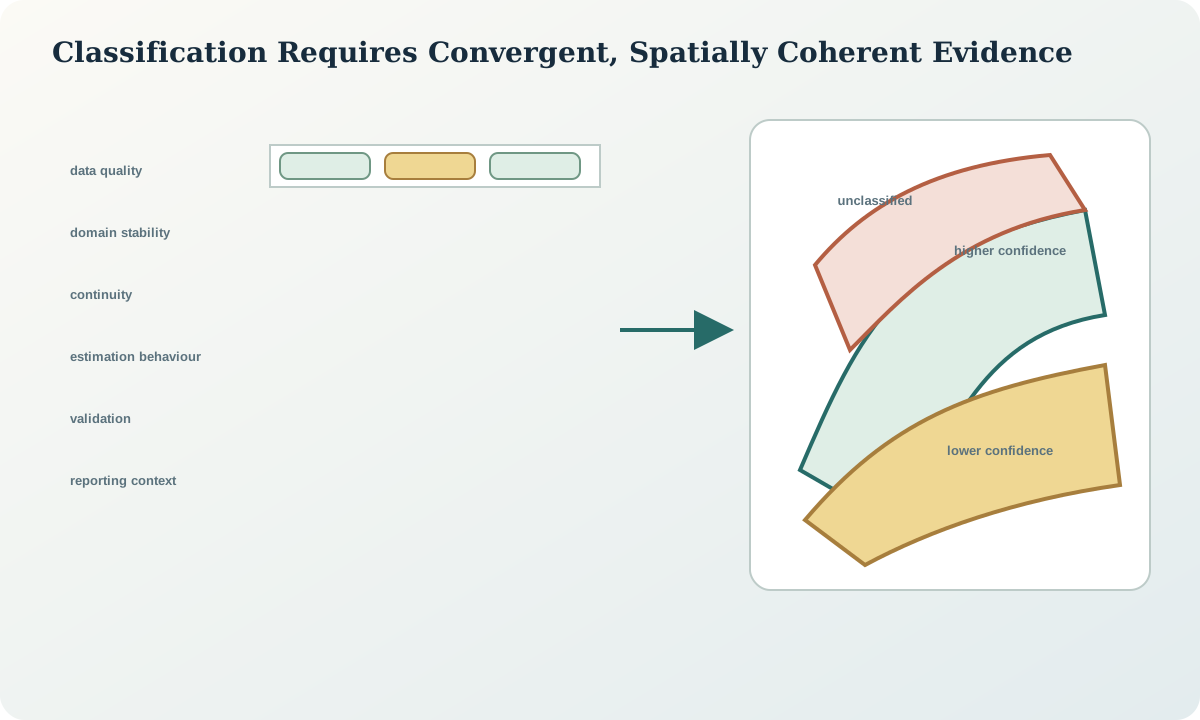
The synthetic matrix uses five gates: accepted data quality, stable domain scenario, minimum independent-hole support, acceptable validation behaviour and a coherent reasonable-prospects envelope. Data-spacing bands are supporting indicators, not sole criteria. The central lens satisfies the highest teaching confidence, the eastern lens satisfies the middle level and the fault-adjacent western lens remains lowest or unclassified by scenario.
Applying a minimum coherent-volume rule removes 46 isolated high-confidence blocks but upgrades none. A shorter variogram alternative reduces the middle-confidence volume by 12%. The released table reports both the adopted categories and this sensitivity.
Practice and review checklist
- Define category purpose before examining category tonnage.
- Build an evidence matrix with both quantitative and geological criteria.
- Map disagreement between data-spacing, estimation and scenario indicators.
- Compare raw and spatially post-processed categories and prohibit unsupported upgrades.
- Produce a versioned change table with block-level reason codes.
Decision record and integration
The classification record should contain the applicable definitions, decision scale, evidence matrix, thresholds, calibration, sections, sensitivities, post-processing, excluded volumes, review comments and final reason codes. State which uncertainties are not represented by the category.
Resource summaries must retain category, scenario and reporting-constraint fields. Never add unlike categories into a single number without displaying their composition and applicable disclosure rules.
Sources
- International reporting template, 2024 edition, provides harmonised confidence categories and principles of transparency, materiality and competence.
- Canadian mineral-resource and mineral-reserve definition standards, relates categories to nature, quality, quantity and distribution of data and confidence in continuity.
- Mineral-resource classification: comparison of techniques, compares geometric, variance, cross-validation and simulation-related classification approaches.
- Impact of judgement in mineral-resource classification, demonstrates the sensitivity of categories to criteria and practitioner decisions.