B2 · Publication Volume 7
Volcanism and Eruptive Products
lava, pyroclastic and volcaniclastic products and eruption style
Learning objectives
After this lesson, you should be able to distinguish magma from lava, classify pyroclast sizes, compare effusive and fragmenting paths, recognise fall, density-current and reworked deposits, and avoid inferring eruption style from one texture.
Start with a field problem
A volcanic succession contains massive coherent rock, breccia, a normally graded ash-rich bed, a poorly sorted matrix-supported unit and cross-bedded tuffaceous sediment. Which are lava, autobreccia, primary fall, pyroclastic density-current deposit, debris flow or later reworking?
All can occur close together, and alteration can obscure glass and juvenile clasts. A process interpretation must combine contacts, clast type, grain-size distribution, sorting, grading, fabric, welding, bedding, lateral change and stratigraphic context. “Volcanic” identifies a source family, not one transport mechanism.
Core process model
Magma is subsurface molten or partly molten material containing liquid, crystals and gas. Lava is magma erupted as a coherent liquid or crystal-bearing flow or dome. Pyroclasts are fragments generated by volcanic fragmentation. Volcaniclastic is broader and includes volcanic particles deposited or redeposited by volcanic and sedimentary processes.
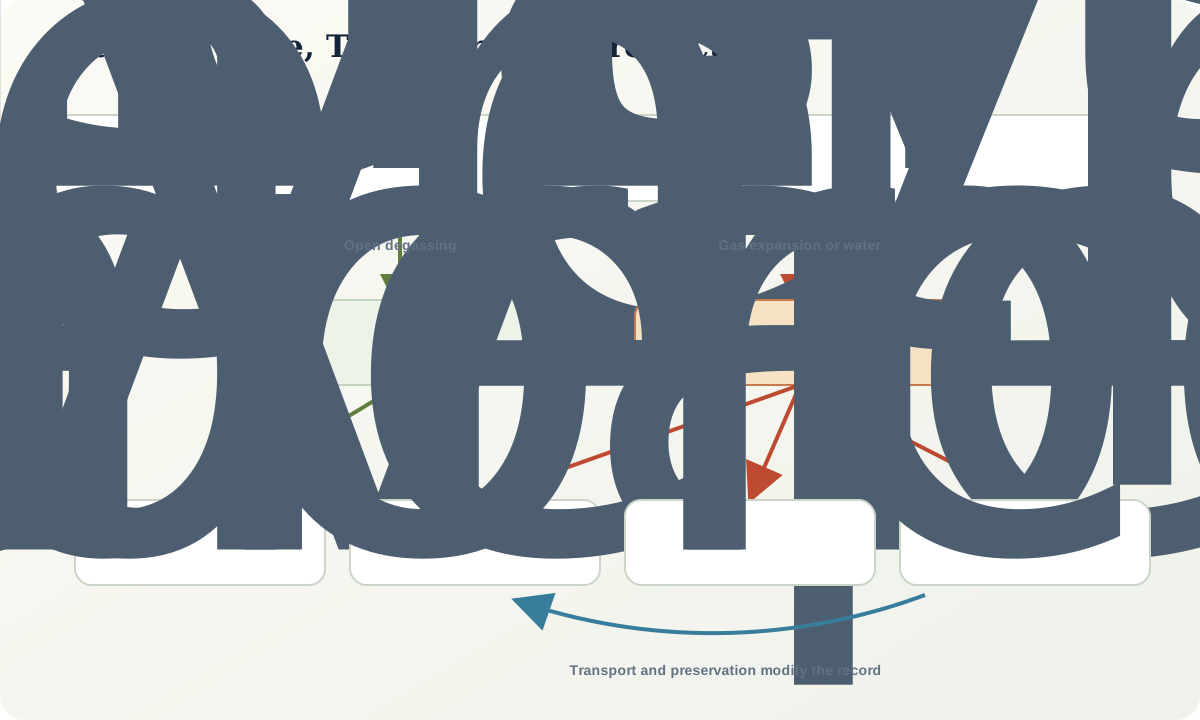
Viscosity reflects composition, temperature, crystal fraction, bubbles and shear conditions. Dissolved gas can exsolve as pressure falls. If bubbles grow and remain connected, gas may escape with limited fragmentation; if overpressure develops faster than relaxation, magma can fragment. External water can add another fragmentation mechanism. No single silica threshold determines eruption style.
Pyroclasts are commonly described by size: ash below 2 mm, lapilli from 2 to 64 mm, and blocks or bombs above 64 mm, with shape and state at ejection distinguishing some terms. A deposit also needs a transport description. Fall particles settle from the atmosphere; pyroclastic density currents move as particle–gas mixtures along the ground; ballistic clasts follow trajectories; lava moves coherently; lahars and ordinary sedimentary flows can remobilise loose volcanic material.
Welding, compaction, devitrification and alteration modify deposits after emplacement. A welded tuff may look like lava; an autobrecciated flow margin may look fragmental; a reworked ash bed may preserve ripple cross-lamination that did not form during eruption. Establish primary texture before assigning process.
Evidence and measurement
At each bed or flow, measure thickness, contact character, grain-size distribution, component proportions, sorting, grading, clast support, fabric and lateral continuity. Separate juvenile clasts, accidental lithics and crystals where possible. Record vesicle shape, pumice flattening, glass shards, welding and alteration under the microscope.
A grain-size sample must match the question. Fine ash is easily lost during collection, washing or sieving. Large blocks require area or volume counts rather than a small bag. Report the full method and censored fractions. Deposit density varies strongly with vesicularity, welding and porosity, so convert volume to mass only with measured or bounded density.
Eruption reconstruction combines stratigraphy with independent constraints: vent proximity, dispersal direction, isopachs, palaeowind, topography and chronological correlation. A preserved exposure samples the deposit, not the entire eruption. Erosion can remove thin distal beds and valley confinement can focus currents.
Worked example
Suppose an ash-fall unit is mapped over three area bands. The inner 20 km² averages 0.40 m thick, the next 80 km² averages 0.12 m and the outer 300 km² averages 0.025 m. A first-order bulk volume is
V=20(0.40)+80(0.12)+300(0.025)=25.1\ \mathrm{km^2\,m}.
Because 1\ \mathrm{km^2\,m}=10^{-3}\ \mathrm{km^3}, the mapped deposit volume is about 0.025\ \mathrm{km^3}. This is not automatically dense-rock equivalent or total erupted volume. Distal material outside the map, erosion, compaction and variable porosity matter.
If dry bulk density is 900\pm200\ \mathrm{kg\,m^{-3}}, mass is roughly 2.3\times10^{10} kg with substantial uncertainty. State how band-average thickness was calculated and test alternative extrapolations. Precision in the arithmetic cannot recover unmapped deposit.
Misinterpretations and uncertainty
Dark colour does not prove basalt; fine grain size does not prove ash; poor sorting does not uniquely identify a density current; and welding does not prove a single eruption. A massive unit may be lava, intrusive rock, densely welded ignimbrite or altered sediment. Vesicles can be flattened or mineral filled. Hydrothermal alteration can move alkalis and make a TAS classification misleading.
Hazard terms should not be transferred casually to ancient deposits. A geological interpretation of a density-current deposit does not by itself define present hazard probability, magnitude or runout. Current hazard assessment requires active-system monitoring, topography, recurrence and specialist review.
Practical investigation
Describe a synthetic 30 m volcanic section without genetic names. Use grain-size classes, component types, support, grading, structures, contacts and alteration. Then assign at least two process interpretations to each unit and state the discriminating observation. Create a correlation panel that distinguishes certain, probable and possible ties.
For one ash bed, estimate deposit volume with two different outer-boundary assumptions. Report why the range is more defensible than a single value.
Mastery check
- How do pyroclastic and volcaniclastic differ?
- Which variables control magma viscosity and fragmentation?
- Why can welded tuff be mistaken for lava?
- What does an ash-size boundary describe, and what does it not describe?
- Which missing observations dominate uncertainty in a deposit-volume estimate?
Sources and further reading
- Eruption styles, U.S. Geological Survey Volcano Hazards Program.
- Ash Fall—A Hard Rain of Abrasive Particles, U.S. Geological Survey.
- Ash-flow tuffs: origin, relations and identification, Ross and Smith, 1961.