B2 · Publication Volume 7
Metamorphic Facies, Index Minerals and Reactions
facies, isograds, mineral reactions and pressure–temperature paths
Learning objectives
After this lesson, you should be able to explain metamorphic facies and isograds, distinguish index minerals from universal grade markers, read reaction textures, construct a qualified pressure–temperature path and assess the assumptions of thermobarometry and pseudosection modelling.
Start with a field problem
Across a mapped belt, chlorite-bearing pelites give way to biotite-, garnet-, staurolite- and sillimanite-bearing rocks. In one sample, garnet cores contain chlorite and quartz inclusions, rims touch biotite, and late chlorite replaces cracks. Does the map show a simple increase in grade, a folded set of isograds, different bulk compositions, multiple metamorphic events or retrogression?
The sequence is useful but not self-interpreting. Index-mineral appearance depends on effective bulk composition, pressure, fluid and reaction progress. Isograds are mapped surfaces marking a mineral or reaction criterion; they are not necessarily synchronous time lines. Textures are needed to connect the map pattern to a P–T–deformation history.
Core process model
A metamorphic facies groups mineral assemblages that develop under a broadly similar range of conditions in stated compositions. Facies such as greenschist, amphibolite, granulite, blueschist and eclogite are not rock names that can be assigned from colour. Their diagnostic assemblages depend strongly on protolith, especially the traditional mafic reference composition.
An index mineral is useful when its first or characteristic occurrence tracks a reaction or grade change within a mapped compositional domain. An isograd marks that occurrence or reaction boundary. If bulk composition changes across the map, the same mineral boundary may not have the same significance. Structural repetition or truncation can also distort the pattern.
Mineral reactions may be discontinuous, continuous or kinetically incomplete. A simplified dehydration reaction can be written
\text{hydrous reactants}=\text{less hydrous products}+\mathrm{H_2O}.
The actual reaction must balance components and use the appropriate solution compositions. Reaction products may occur as rims, coronas, symplectites or new grains along foliation. Preservation depends on nucleation, diffusion, fluid escape and later deformation.
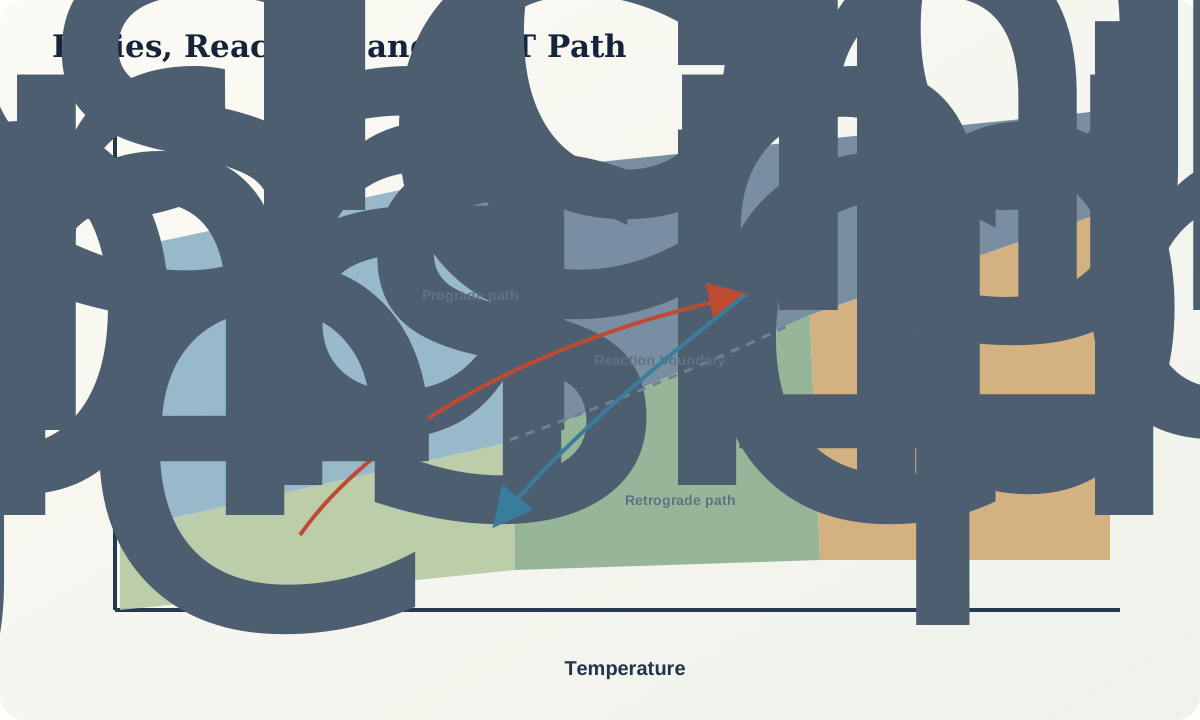
A P–T path represents conditions experienced by a material domain through time. Prograde evolution generally accompanies increasing metamorphic temperature, while retrograde evolution follows decreasing temperature after a peak, but pressure can rise or fall independently. A clockwise or counter-clockwise loop is an interpretation requiring timing and texture, not a tectonic label read from one assemblage.
Evidence and measurement
Construct an assemblage table by textural domain. Distinguish minerals that demonstrably coexist and touch from inclusions, relics and fracture products. Record mineral compositions and zoning. If a reaction boundary is inferred, show reactants, products and where they occur relative to deformation.
Conventional thermobarometry combines calibrated equilibria that respond differently to pressure and temperature. Pseudosections calculate stable assemblages for a specified bulk composition over a P–T grid. Mineral-composition isopleths and modes may further constrain a field. Every result depends on thermodynamic data, activity–composition models, oxidation state, fluid assumptions and effective bulk composition.
Uncertainty is not just the width of a calculated contour. It includes whether equilibrium was achieved, whether the analysed composition was later modified and whether the modelled chemical system represents the domain. Report alternative domains and model choices.
Worked example
Suppose a pelitic sample contains garnet cores with abundant chlorite inclusions, garnet rims adjacent to biotite and staurolite, and sillimanite in a later foliation. Late chlorite fills fractures. A defensible relative path is:
- chlorite-bearing assemblage before or during early garnet growth;
- garnet-rim + biotite + staurolite equilibrium at higher temperature;
- sillimanite growth during a later high-temperature fabric;
- fracture-controlled chlorite during cooling and fluid ingress.
This sequence does not provide numerical P and T by itself. Build a pseudosection using a representative effective composition, then compare predicted assemblages, garnet modes and core–rim compositions with observations. If the model matches the rim but not the core, treat the core as an earlier fractionated domain rather than forcing one equilibrium calculation through both.
If conventional estimates give 650\pm50\ ^\circ\mathrm{C} and 0.7\pm0.15\ \mathrm{GPa}, plot the uncertainty region, not only its centre. A model field overlapping that region is supporting evidence, not independent confirmation if both methods share the same thermodynamic calibration.
Misinterpretations and uncertainty
Facies diagrams are schematic and composition dependent. A rock can retain an assemblage from an earlier facies while partly re-equilibrating in another. “Granulite” can be used as a facies term or, in some schemes, a rock name with specific criteria; state which usage applies. Blueschist colour is not diagnostic, and eclogite requires an appropriate assemblage rather than merely red and green minerals.
Index-mineral zones can be offset by faults, folded, repeated or controlled by bulk composition. Mineral isopleths may intersect because analyses average zones or because the model is incomplete. Small numerical uncertainty from a solver does not include uncertainty in geological domain selection.
Practical investigation
Create a P–T grid with seven schematic facies fields and plot two possible paths through the same peak field: one with early high pressure and one with late heating at lower pressure. For each path, predict three textural or chronological observations that would discriminate it.
Map five index-mineral occurrences across a synthetic fold. Draw at least two plausible isograd configurations and identify the structural measurements needed to choose between them.
Mastery check
- Why is a metamorphic facies not a universal rock name?
- What does an isograd map, and why may it not be isochronous?
- Which textures support a mineral reaction relation?
- What is the effective bulk composition in a pseudosection?
- Why do a P–T point and a P–T path require different evidence?
Sources and further reading
- IUGS metamorphic nomenclature and facies summary, Subcommission on the Systematics of Metamorphic Rocks.
- On thermobarometry, Powell and Holland, 2008.
- Applying phase-equilibria modelling to metamorphic processes, review of assumptions and applications.