B2 · Publication Volume 7
Metasomatism and Fluid–Rock Reaction
metasomatism, alteration fronts and mass transfer
Learning objectives
After this lesson, you should be able to distinguish metasomatism from approximately isochemical metamorphism, map reaction fronts, select a plausible precursor, test immobile-element assumptions and quantify first-order gains and losses with mass change included.
Start with a field problem
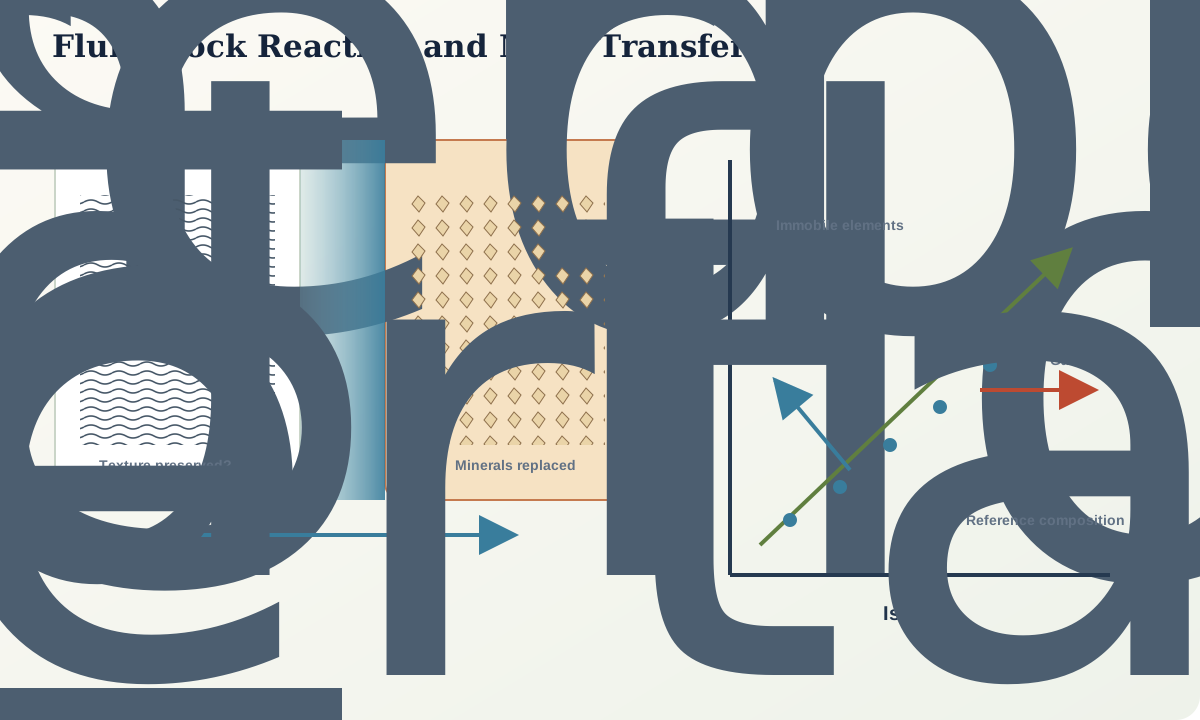
Across a sharp front, a dark mafic rock becomes pale and quartz rich. Original pillows or bedding remain visible, but amphibole is replaced by mica and carbonate, and sodium is lower in altered samples. Did fluid add silica, remove iron and sodium, change volume, or simply dilute elements by adding another component?
Concentration change is not the same as mass transfer. If silica is added, the concentration of an immobile element can fall even when none was removed. If volume collapses, several concentrations can rise without external addition. A metasomatic interpretation therefore requires a precursor relation and a mass- or volume-balance framework.
Core process model
Metasomatism is metamorphic or hydrothermal change involving significant change in bulk chemical composition through interaction with fluid or melt. Mineral replacement can preserve shape while changing composition. An alteration front marks a gradient in reaction progress, permeability, fluid composition, temperature or integrated fluid flux.
Fluid moves along connected fractures, grain boundaries, pores and reaction-generated pathways. Reaction can increase permeability by dissolution or decrease it by precipitation and sealing. Deformation may repeatedly reopen paths. The observed alteration halo is the combined result of transport, reaction kinetics, buffering and later overprint.
Choose a precursor using field continuity, relic textures, immobile-element patterns, isotopes and spatial relations. “Least altered” is not automatically original; it may represent a different flow, sediment layer or intrusion pulse. Sample pairs should match protolith and structural position as closely as possible.
General mass-conservation relations and the isocon method compare altered and reference compositions while allowing mass or volume change. Elements assumed immobile define a scaling relation. That assumption is geological: it must be tested with several elements, petrography and process knowledge.
Evidence and measurement
Map front geometry at multiple scales. Record lithological controls, veins, fractures, breccias, mineral zones, density, porosity and volume markers. Sample across rather than only within the most altered zone. Preserve raw concentrations and analytical uncertainty.
On an isocon-style plot, reference concentrations occupy one axis and altered concentrations the other. Elements that behaved immobily should lie on a line through the origin after appropriate scaling. The slope constrains relative mass or volume change under the selected convention; elements above or below the line indicate possible gains or losses.
No statistical fit can prove immobility. Zirconium, titanium or aluminium may be relatively immobile in some systems and mobile in others. Outliers can reflect accessory-mineral nugget effects, analytical limits or protolith heterogeneity. Test alternative immobile sets and show how conclusions change.
Worked example
A fresh reference contains 1.0 weight percent TiO₂ and an altered sample contains 0.8 percent. If titanium was conserved, the altered mass corresponding to one unit of original mass is
M_A=\frac{1.0}{0.8}M_0=1.25M_0.
The rock gained 25 percent mass under that assumption. Now consider Na₂O: the fresh rock has 3.0 percent and the altered rock 1.0 percent. The final sodium mass on the original-mass basis is
1.25(0.010)=0.0125,
compared with 0.030 initially. The loss is 0.0175, or about 58 percent of initial sodium.
For SiO₂, fresh and altered concentrations are 50 and 45 percent:
1.25(0.45)-0.50=0.0625.
Silica increased by 6.25 percentage points of original mass, equivalent to 12.5 percent of the initial silica mass. The lower altered concentration did not mean silica loss; mass addition diluted it.
Repeat the calculation assuming titanium experienced 10 percent loss. The inferred total mass factor and every element gain change. Report this sensitivity and seek additional immobile elements before claiming exact transfer.
Misinterpretations and uncertainty
Alteration mineral abundance does not directly equal element gain. Carbonate can form by redistributing calcium already present; quartz veins can add silica locally while adjacent wall rock loses it. A visually sharp front may be a protolith contact. Density and volume changes can invalidate simple concentration differences.
Vein orientation does not uniquely identify fluid source or flow direction. Stable isotopes can be modified by exchange and mixing. Fluid inclusions sample particular trapping events and may re-equilibrate. A mineralised zone is not proof that all alteration was synchronous with metal deposition.
Practical investigation
Create a seven-sample traverse from fresh to intensely altered rock. Plot mineral modes, density and ten major or trace elements against distance. Test three immobile-element sets and calculate mass change and gains or losses for each. Highlight conclusions that remain stable across all choices.
Draw a reaction–transport diagram showing source, pathway, front, products and sinks. Mark which arrows are observed, inferred or unconstrained. Add one sampling location that would most effectively test whether the front follows permeability or protolith.
Mastery check
- Why can an element concentration decrease even when the element was added?
- What evidence supports correlation of altered rock with a precursor?
- How does an isocon account for mass or volume change?
- Why is immobile-element selection a geological rather than purely statistical decision?
- Which observations distinguish a reaction front from an original lithological contact?
Sources and further reading
- The isocon diagram: a simple solution to Gresens' equation, Grant, 1986.
- Isocon analysis: review and applications, Grant, 2005.
- BGS Rock Classification Scheme, metasomatic and hydrothermal rock terminology.