B2 · Publication Volume 7
Rock Evolution and Mineralisation
magmatic–hydrothermal systems and metamorphic fluids
Learning objectives
After this lesson, you should be able to integrate relative age, petrography, geochemistry, pressure–temperature evidence and geochronology; distinguish magmatic and metamorphic fluid hypotheses; evaluate links to mineralisation; and publish an auditable event sequence with alternatives.
Start with a field problem
A deformed volcanic succession is intruded by porphyritic stocks. Garnet-bearing schist surrounds some intrusions, quartz–sulfide veins cut both intrusion and foliation, and late carbonate fractures cut the veins. Zircon, mica and carbonate analyses yield different age groups. Which dates crystallisation, metamorphism, cooling, veining or later resetting? Are the metals magmatic, metamorphic, remobilised or derived from several reservoirs?
Spatial association is not enough. A mineral system requires sources, transport pathways, physical and chemical traps, timing and preservation. The rocks may record several fluid events, only one of which deposited economically interesting minerals. The reconstruction must begin with cross-cutting and textural relations before ages are assigned to labels.
Core process model
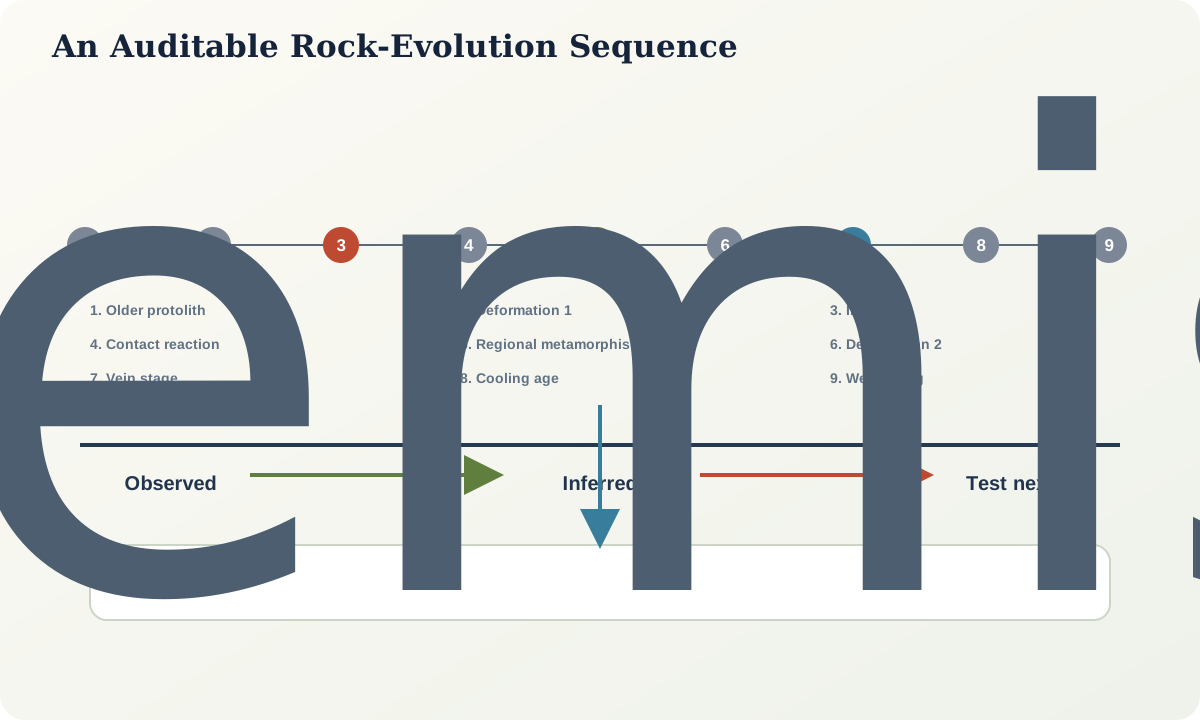
Build the history as events and transitions. A protolith forms, is buried or deformed, receives intrusions, reacts and recrystallises, transmits fluids, cools, fractures and weathers. Each event can modify evidence from earlier events. The final sample is an archive with selective preservation, not a complete film.
Magmatic–hydrothermal fluids can exsolve from crystallising magma and transport heat, volatiles, salts and metals. Metamorphic fluids can be produced or consumed by reactions, introduced from another domain or focused by deformation. Meteoric, basinal or seawater-derived fluids can also enter. Fluid origin is tested with mineral chemistry, inclusions, isotopes, mass balance, timing and regional context; no single vein texture uniquely assigns it.
Mineral deposition requires a change in solubility or transport capacity through cooling, pressure change, boiling or immiscibility, mixing, wall-rock reaction, redox change, pH change or ligand loss. Different minerals in one vein can record stages. Later deformation or metamorphism can remobilise and concentrate earlier material.
Numerical ages date specific isotopic systems and domains. Zircon crystallisation, monazite reaction, mica cooling and vein-mineral growth have different meanings. Closure is not a fixed universal temperature; grain size, cooling rate, diffusion, fluid and recrystallisation matter. Integrate dates with textures and field sequence.
Evidence and measurement
Create an event matrix. Rows are observations: contact A cuts fabric S1, mineral M overgrows S1, vein V1 is folded by S2, mineral Z seals a V1 fracture, and age population G comes from a mapped textural domain. Columns are candidate events. Record whether each observation supports, contradicts or is neutral to an event order.
Petrochronology links age with mineral composition and texture. Image grains before analysis, target domains and report discordance, common components, standards and uncertainty. A precise weighted mean from mixed domains is less useful than a wider but geologically coherent age.
For mineralisation, separate evidence for metal source, ligand or fluid source, pathway, trap and timing. Report grade or abundance only with sampling support and analytical quality. A teaching reconstruction must not be presented as a resource estimate or operational decision.
Worked example
Consider the following observations:
- regional foliation S1 bends around garnet and is cut by an unfoliated dyke;
- the dyke has a narrow contact-reaction rim that overgrows S1;
- a later crenulation S2 deforms S1 and the dyke margin;
- quartz–sulfide vein V1 cuts S2 and contains wall-rock fragments;
- carbonate vein V2 cuts V1 and is undeformed;
- zircon cores are inherited, zircon rims overlap the dyke contact relation, mica ages are younger, and carbonate dates overlap V2 within uncertainty.
The minimum sequence is protolith, S1 and garnet growth, dyke intrusion and contact reaction, S2 deformation, V1, then V2. Zircon rims may date intrusion if their texture and chemistry support magmatic growth. Mica ages may record cooling after S2 or later resetting; carbonate can date V2 only if the analysed domain is demonstrably vein growth.
Two mineralisation hypotheses remain. In model A, V1 fluid exsolved from the dyke or a related concealed intrusion. In model B, regional metamorphic fluid moved along S2 structures after the dyke crystallised. Test A with temporal overlap, fluid and melt inclusions, isotopes and spatial zoning. Test B with reaction-devolatilisation evidence, regional structural continuity and isotopic reservoirs. A mixed model should be considered if neither end member closes mass and isotope balance.
Misinterpretations and uncertainty
“Magmatic-looking” vein geometry is not a source measurement. Age overlap does not prove causation when uncertainties and event durations are large. A cooling age cannot automatically date deformation. Inherited crystals can make an intrusion appear older; fluid alteration can reset domains and make it appear younger.
Mineral association is not economic significance. Sampling bias, weathering enrichment, nugget effects and selective exposure can exaggerate apparent grade. Tectonic stories can become circular when a rock is assigned to a setting by geochemistry and the same setting is then used to explain the geochemistry.
Practical investigation
Construct two complete histories for the synthetic dataset in the start problem. Draw a directed graph in which nodes are events and edges are observed ordering constraints. Add numerical ages as probability intervals attached to mineral domains, not as exact event labels. Identify any cycles or contradictions.
Build a mineral-system evidence table with source, transport, pathway, trap, timing and preservation. Give every cell an evidence identifier and confidence. Select one new field observation, one mineral analysis and one age analysis that would best distinguish magmatic from metamorphic fluid models.
Mastery check
- Why must a numerical age be linked to a mineral domain and geological process?
- Which evidence distinguishes magmatic–hydrothermal from metamorphic fluid models?
- How can later deformation remobilise an earlier mineral assemblage?
- Why does spatial association between an intrusion and veins not prove causation?
- What makes an event sequence auditable and revisable?
Sources and further reading
- Porphyry copper systems, Sillitoe, 2010, as a process synthesis rather than a universal template.
- The isocon diagram, Grant, 1986, for quantified wall-rock change.
- On thermobarometry, Powell and Holland, 2008, for equilibrium and uncertainty discipline.
- IUGS Task Group on Igneous Rocks, terminology and international systematics context.