D3 · Publication Volume 19
Mine Geology Roles and Timescales
long-term, short-term and daily control and feedback
Learning objectives
By the end of this lesson, the learner should be able to separate long-term, tactical, short-term and daily geological questions; identify which model version supports each decision; design a feedback route between horizons; distinguish prediction error from a change in information; and build a time-aware evidence register.
Mine geology is a translation function between geological evidence and material decisions. The same lens may be represented as a broad domain in a long-term resource model, a detailed contact in a short-term model, a marked boundary at a face and a set of movement events after extraction. These representations have different supports and purposes. Treating one as a more colourful copy of another hides the reason each exists.
Decision horizons and their questions
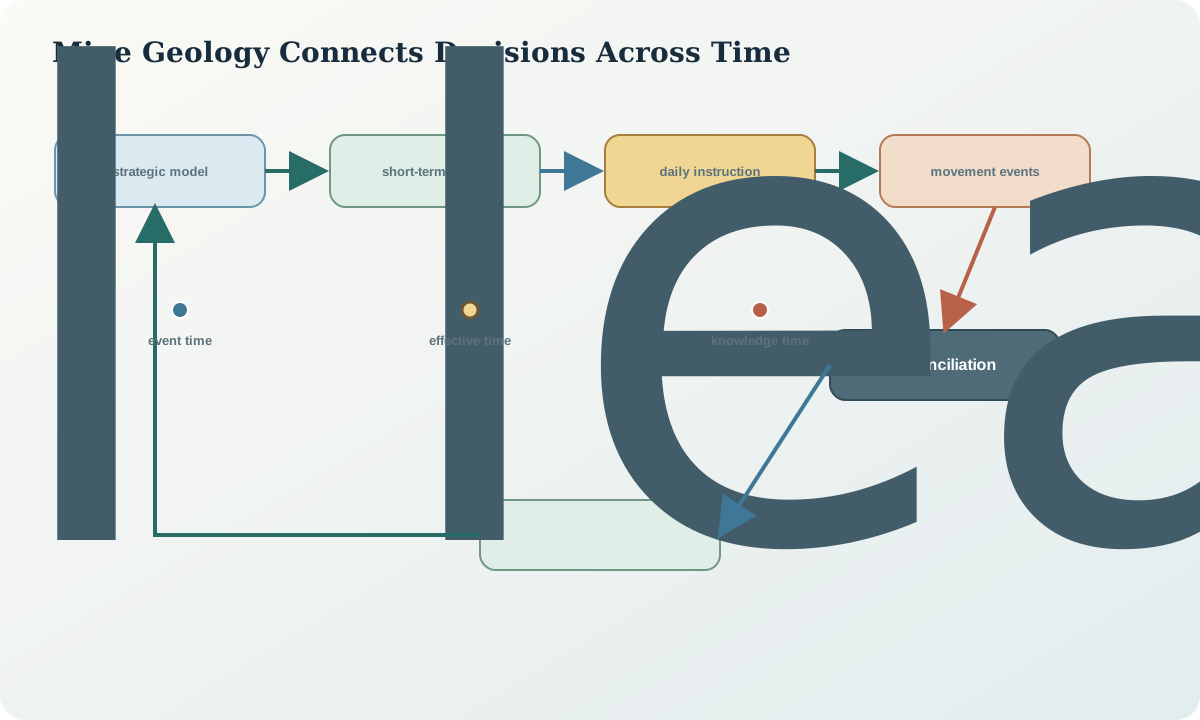
A strategic horizon asks about global continuity, inventory and broad extraction options. A tactical horizon resolves sectors, levels, benches or production blocks. A short-term horizon sequences specific parcels and integrates dense recent evidence. A shift-scale horizon decides where to mark, dig, load, direct, sample or pause. The horizon is defined by decision latency and consequence, not by a universal number of days.
Each horizon should have a declared target support and update trigger. A long-term model may remain stable until material new drilling or interpretation becomes available. A short-term model may update when a face exposes a contact, control assays pass validation or a survey changes accessible geometry. An operational instruction may require immediate reissue when its coordinates, destination rule or safety boundary changes.
One reality, several valid representations
Representations should be nested without being forced to coincide. The long-term model predicts before close-spaced control evidence exists. The short-term model conditions on later evidence. The mined shape records what was removed, while movement records state where broken material was directed. Differences therefore combine forecast error, support change, new information and execution effects.
Use a comparison table with rows for model version, effective time, included observations, domain rules, block or parcel support, density basis, classification rule and spatial extent. A later representation is not automatically the truth; it is usually a better-informed estimate for a different purpose. Surveyed excavation may define geometry well while still relying on estimated density and grade.
Effective time, event time and knowledge time
Three clocks matter. Event time is when an observation or movement occurred. Effective time is when a model or instruction became valid for use. Knowledge time is when a record entered the controlled system. Late assays and corrected surveys make these clocks diverge.
Keep all three when possible. If a contact was observed before loading but entered after loading, a retrospective model can learn from it, but the instruction used by the loader did not contain it. Evaluating execution against the retrospective boundary would confuse an information delay with non-compliance. Bitemporal records allow the historical decision and current best interpretation to coexist.
Roles as controls, not named people
Define functions rather than tying the workflow to job titles or individuals. Required functions include observing geology, validating analytical data, maintaining spatial control, updating interpretations, authorising operational releases, recording movement, measuring inventory, calculating balances and independently reviewing material variances. One setting may separate these functions among several roles; another may combine them with compensating review.
For every critical transition, specify who may propose, check, release, consume and supersede an artefact, but keep the textbook role-neutral. The essential control is that an observation cannot silently become an instruction and that a person or automated process cannot approve its own unresolved exception without an auditable rule.
Handoffs and acceptance criteria
A handoff is complete only when the receiving decision has enough context to use the artefact safely. A short-term model release should include extent, coordinate reference, effective time, input cut-off, domain and classification versions, unresolved zones and a checksum or stable identifier. A dig-line release should state the model release from which it was derived. A movement event should retain the instruction version active at loading.
Acceptance criteria should be testable. Examples are: every new control sample has a valid position and status; every revised surface closes within the release extent; every operational polygon carries an effective timestamp; and every reported parcel can be connected to a source model and destination event. “Reviewed” without criteria is not evidence.
Feedback loops and update thresholds
Feedback occurs at different speeds. A daily loop may correct a contact or destination. A campaign loop may revise a local domain trend or density relationship. A periodic model review may reconsider continuity, estimation parameters or classification. The observation must be routed to the horizon capable of acting on it.
Define update thresholds before seeing a favourable or unfavourable result. Triggers may be geometric, statistical or causal: repeated contact offsets in one direction, a persistent conditional grade bias, a domain-specific dilution pattern, or an unexplained residual beyond its uncertainty envelope. One anomaly normally opens an investigation; a repeated coherent pattern may justify a model change.
Version graph and supersession
Use an immutable version graph. Each release identifies its parents, new inputs, changed rules, outputs and reason. A correction fixes an implementation or data defect; a revision incorporates new evidence or interpretation; a scenario represents a defensible alternative. These labels prevent users from assuming every change means the former geology was wrong.
Never overwrite an operationally used model or instruction. Mark it superseded and preserve its valid interval. If a release must be withdrawn, record which downstream parcels, polygons and reports consumed it. This dependency graph determines which comparisons require recalculation.
Synthetic worked example
The synthetic lens has long-term release LT-07, short-term release ST-19 and dig-line release DL-44. A face contact observed at event time 08:10 is entered at knowledge time 11:35 after a delayed coordinate check. ST-20 becomes effective at 12:10 and shifts the ore boundary four metres east. Two loads moved at 10:40 and 11:05 under DL-44; later loads use DL-45.
The morning loads are assessed against DL-44 for instruction compliance and against ST-20 only for retrospective geological learning. The review records an information-latency issue but does not label the loader's actions incorrect. The four-metre shift opens a campaign-level test: whether earlier contacts in the same domain show a coherent directional offset.
Practice and decision record
Construct a four-horizon table for a synthetic extraction area. For each horizon, state the decision, target support, update trigger, maximum acceptable information age and output artefact. Then create a version graph for one late assay and one corrected survey. Explain which historical outputs remain valid, which require recalculation, and which should only receive a limitation note.
The decision record should contain event, effective and knowledge times; input and output identifiers; comparison purpose; affected downstream artefacts; and the reason a change is classified as correction, revision or scenario. Conclude with one feedback trigger that is sensitive enough to learn but resistant to isolated noise.
Sources
- Mineral-resource and mineral-reserve estimation best-practice guidelines, distinguishes long-term and short-term model comparisons and the evidence each can test.
- Reconciliation along the mining value chain, frames reconciliation as comparisons among measures and estimates at different points and times.
- Provenance data model, supports explicit entities, activities, derivations, invalidations and alternate versions.
- International reporting template, 2024 edition, provides general principles for transparent, material and evidence-bounded technical reporting.